.png)


The zendesk vs intercom knowledge base debate is one of the more lopsided comparisons in customer support tooling, because neither product was actually built as a knowledge base first. Zendesk Guide is the help center bolted on the side of a ticketing platform. Intercom Articles is the help center bolted on the side of a Messenger and AI agent platform. Both work. Both have real customers. And both share the same architectural blind spot that no pricing page on either site will mention: neither tool knows when the articles it publishes have gone stale.
This article compares both help centers across structure, editor, AI features (Zendesk Answer Bot and Zendesk AI Agent vs Intercom Fin), pricing (per-agent vs per-resolution), and the failure modes they share. It closes with a decision framework based on your stack and team size, and where a self-updating help center fits in a market that still sells static documentation by the seat.

What is Zendesk Guide?
Zendesk Guide is the knowledge base and help center module inside the Zendesk Suite, a ticketing-first customer service platform. Guide is sold as part of every Suite plan rather than as a standalone product, which means you cannot buy the Zendesk knowledge base without also buying the ticketing system. Its primary use case is ticket deflection: customers search the help center, find the answer, and never file the ticket in the first place.
The output is a public or private help center site with hierarchical categories, sections, and articles, plus optional community forums and a customer portal. The editor is a WYSIWYG with attachments, links, and basic Markdown. Multi-brand customers can run separate help centers per brand from one account, which is why Zendesk Guide is still the default at companies running two or more product lines under one support org. The product has been on the market since 2014 and is mature on the publishing side: themes, multilingual content, SEO controls, custom domains, and a Help Center API are all in the box.
What is Intercom Articles?
Intercom Articles is the knowledge base built into Intercom, a Messenger-first customer engagement platform. Articles sits next to the Messenger widget, the Inbox, and Fin AI Agent in the same product. You cannot buy Articles separately. Its primary use case is inline help: customers see snippets surface inside the Messenger while typing, and Fin AI quotes articles when answering questions without escalation.
The output of Intercom Articles is a help center site plus the same articles indexed by Fin AI and the Messenger search. The editor is a clean block-based interface, simpler than Zendesk Guide, and built for fast publishing rather than complex taxonomy. Article collections (Intercom's equivalent to categories) are flat, and Intercom does not have native multi-brand support: one workspace, one help center. The trade-off is integration depth. Articles are not a separate destination in Intercom. They are content that the Messenger and Fin consume in conversation.
Quick verdict on the zendesk vs intercom knowledge base question
If you already own a ticketing-first support stack and need a customer-facing help center with multi-brand support, multilingual content, community forums, and deep theming, Zendesk Guide wins on publishing depth. If you already own a Messenger-first stack and want Fin AI to do most of the deflection in the chat widget while a smaller help center supports the conversation, Intercom Articles wins on integration depth. Neither wins on freshness, which is the dimension that actually moves ticket volume after month six.
How to create knowledge base articles with each tool
The day-one experience inside the zendesk vs intercom knowledge base comparison is closer than the marketing pages suggest. Both require a paid seat, both publish through a web editor, and both expect you to organize content by hand.
Publishing in Zendesk Guide
In Zendesk Guide, you open Guide admin, pick a category and a section, click New article, write in the WYSIWYG, attach images, add internal links to other articles, set visibility (public, signed-in users, internal agents only), pick a label set, and publish. Articles are versioned, and Zendesk tracks publish history per author. Multi-brand customers pick the brand from a dropdown at the top of the editor.
Publishing in Intercom Articles
In Intercom Articles, you open Articles in the side nav, pick or create a collection, click New article, write in the block editor, embed images and videos, add links, set visibility (public, logged-in users), tag for Fin AI training, and publish. Intercom auto-translates articles to other languages on higher tiers and pushes the new article to the Messenger and Fin within minutes. The editor surface area is smaller. The publish step is faster.
The end product looks similar on the customer side: a hosted help center on a vendor or custom domain, with categories, search, and article pages. The difference is what happens after publish. Zendesk pushes traffic to the help center as a destination. Intercom pushes content into the conversation. Different bets on where customers look for answers.
Feature breakdown of Zendesk Guide and Intercom Articles
Six dimensions decide most zendesk vs intercom knowledge base evaluations once the marketing pages are out of the way: editor depth, AI deflection, workflows, enterprise readiness, analytics, and integrations. Each one breaks differently between the two products, and stack fit usually decides the final choice.
Editor and authoring
Zendesk Guide ships a classic WYSIWYG editor with HTML access, file attachments, and tight integration with Zendesk's content blocks for reusing snippets across articles. The editor is functional rather than delightful. Power users tend to switch to the HTML view for layout control. Intercom Articles uses a block editor closer in spirit to Notion: each paragraph, image, or callout is a discrete block, drag and drop reorders them, and the interface stays out of the way. For teams who publish a lot of short, current articles, Intercom feels faster. For teams who publish long structured documentation with shared content blocks across many articles, Zendesk wins.
AI features: Answer Bot and Zendesk AI Agent vs Fin AI
Zendesk markets two AI surfaces on top of the knowledge base. Answer Bot is the legacy article-suggestion engine that surfaces help center articles in tickets and chat. The newer Zendesk AI Agent is the autonomous resolution layer, sold under the Advanced AI add-on at $50 per agent per month on top of the Suite license. A 2025 Forrester benchmark put Zendesk AI Agent at roughly 38 percent deflection under standard configurations. Intercom Fin is the equivalent autonomous agent, priced at $0.99 per resolution with a 50-resolution monthly minimum on all Intercom plans. Fin reports a 67 percent resolution rate across its install base over the last 30 days (Fin AI public stats, late 2025), with the same Forrester benchmark putting Fin at roughly 50 percent resolution under standard setups. Both numbers are conditional on knowledge-base quality. An AI agent reading from a stale article will confidently quote stale information.
Team collaboration and workflows
Zendesk Guide on Growth and above includes article workflows: draft, review, publish, scheduled publishing, content cues that flag articles based on staleness or low ratings, and team permissions per category. Intercom Articles has lighter primitives: a draft state, a manual outdated-article flag, and review reminders, but no formal multi-stage approval. For teams over ten people working on documentation, Zendesk's workflow depth shows. For teams of one to three, Intercom's lighter touch is faster.
Enterprise readiness and security
Zendesk Suite Enterprise unlocks SAML SSO, advanced sandbox, custom roles, and compliance certifications (HIPAA on Professional and above, SOC 2 Type II, GDPR). Intercom matches on SOC 2, GDPR, and SSO at the Expert tier, but lacks HIPAA without a custom enterprise contract. For regulated buyers (healthcare, fintech, public sector), Zendesk has a longer track record on procurement. For B2B SaaS buyers without specific compliance requirements, the difference disappears.
Analytics and search insights
Zendesk Guide tracks article views, search queries, no-result searches, ratings, and ticket-deflection metrics, and Suite Professional and above add Explore (Zendesk's BI tool) for cross-channel analytics. Intercom Articles tracks views, reactions, Fin AI source citations, and conversation deflection, with the analytics tightly fused to the Messenger funnel. Intercom is stronger on the conversation side. Zendesk is stronger on the standalone help center side.
Integrations and stack fit
Zendesk has the larger marketplace (over 1,500 listed integrations) and deeper native ties to Salesforce, Jira, Slack, and most CRM and product analytics tools. Intercom's marketplace is smaller but tighter, with stronger native depth on HubSpot, Stripe, Mixpanel, and product-led growth tools. Stack-fit usually decides this dimension before features do. If your CRM is Salesforce, Zendesk is the lower-friction choice. If your stack is HubSpot or product-led, Intercom slots in cleanly.
Pricing comparison: per-agent vs per-resolution
The zendesk vs intercom knowledge base economics diverge sharply at the pricing model layer. Zendesk charges per agent per month. Intercom charges per seat per month plus per resolution for Fin AI. The two models behave very differently as your support team and ticket volume grow.
Zendesk Suite list pricing (billed annually) is Team $55, Growth $89, Professional $115, Enterprise $169 per agent per month, with monthly billing about 20 percent higher (Zendesk pricing page). The Advanced AI add-on, which unlocks Zendesk AI Agent in any serious deflection setup, is $50 per agent per month on top of the Suite license. A 10-agent team on Suite Growth with Advanced AI runs $1,390 per month before other add-ons.
Intercom seat list pricing is Essential at $29 per seat per month, Advanced at $85, and Expert at $132, per the current Intercom pricing page. Fin AI is billed at $0.99 per resolution with a 50-resolution monthly minimum, charged once per conversation regardless of how many questions are answered, per the Fin AI pricing page. A 10-seat team on Advanced with 1,500 Fin resolutions runs $850 in seats plus $1,485 in Fin, for $2,335 per month.
The pattern is clear. Zendesk's per-agent model scales linearly with headcount and is largely insensitive to deflection volume. Intercom's per-resolution model scales with the actual work the AI does, which means a high-traffic B2C product can run a much bigger Fin bill than a B2B equivalent. Intercom Articles pricing only makes sense in the context of total Fin spend, and Zendesk Guide pricing only makes sense in the context of the Suite plan that wraps it.
The shared limitation neither tool will mention on the pricing page
Both Zendesk Guide and Intercom Articles are built to publish content. Neither is built to know when that content stops being correct. This is the single biggest blind spot in the entire zendesk vs intercom knowledge base discussion, and every other comparison article skips past it because the marketing pages skip past it.
The mechanic is the same in both products. A writer publishes an article about feature X. Engineering ships a UI change on Tuesday that moves the button, renames the field, or restructures the flow. The article is now wrong. Nobody on the support side knows until a customer files the ticket the help center should have deflected. The help center does not read the product. The product does not write to the help center. The two systems drift apart at the speed of engineering. Documentation decay is the hidden cost of every help center, and it shows up as a slow erosion of self-service deflection, not a single visible failure.
This is why Fin AI's 67 percent resolution rate and Zendesk AI Agent's 38 percent deflection are conditional numbers, not promises. When the underlying article is stale, the AI quotes the stale version with full confidence. Intercom Fin's accuracy is a documentation problem, not a model problem, and the same is true for any AI agent reading from a static knowledge base. The Consortium for Service Innovation, the standards body behind Knowledge-Centered Service (KCS), sets a benchmark that 90 percent of organizational knowledge should be available at or before the time of case closure. Hitting that bar requires content that updates as the product updates. Neither Zendesk nor Intercom solves the update side of the equation.
Which failure mode is more disruptive
The two products fail in different ways when the knowledge base falls behind the product.
Zendesk's failure mode is the dead destination. A customer lands on a help center article, follows the steps, the steps no longer match the UI, the customer files a ticket, the agent confirms the article is wrong, and the article sits in the queue for a writer to fix. The help center loses authority slowly. Search-engine traffic to outdated articles continues to bring new customers into the same dead end. The ticket-deflection rate trends down over months without anyone flagging it.
Intercom's failure mode is the confident wrong answer. Fin AI reads the stale article, summarizes it inside the Messenger, and the customer trusts the answer because it arrived in conversation rather than via a static page. The error compounds faster because Fin is paid per resolution and incentivized to resolve, which means stale answers get marked resolved at the same rate as correct ones. By the time enough customers escalate to a human, the AI confidence score has already trained against the wrong content. AI chatbots give wrong answers when the knowledge base is wrong, and Fin is no exception.
Which is more disruptive depends on stack. A B2B team with a small customer base feels Zendesk's dead-destination failure as a slow leak. A B2C team running Fin AI on 50,000 conversations a month feels Intercom's confident-wrong-answer failure as an immediate spike in escalations and refund requests.
Who Zendesk Guide and Intercom Articles are actually best for
Use Zendesk Guide if you already run Zendesk Suite, your support team is larger than 15 people, you publish in three or more languages, you need multi-brand or community forums, your CRM is Salesforce, and your compliance profile requires HIPAA or a long procurement track record. The honest comparison between HappySupport and Zendesk covers when this fit breaks down.
Use Intercom Articles if you already run Intercom Messenger, your support motion is conversation-first, your product is B2B SaaS with a Messenger-installed customer base, you want Fin AI to do most of the deflection inside the chat widget, your CRM is HubSpot or your stack is product-led, and your team is under 15 people. The HappySupport vs Intercom comparison goes deeper on the architectural differences.
The honest read on the zendesk vs intercom knowledge base question is that the decision rarely turns on the help center itself. It turns on the platform around it. Pick the surface that matches the rest of your support stack, and accept that the editor and AI deflection inside either tool will be good enough for the first eighteen months. The maintenance line below the surface is what actually shifts the math at year two.
Do not use either as a standalone knowledge base. Both are designed to live inside their parent platform. If you want the knowledge base layer without the rest, you are paying for software you will not use. In that case, look at the alternatives below.
Alternatives to Zendesk Guide and Intercom Articles
If the zendesk vs intercom knowledge base comparison surfaces a misfit on either side, there are four alternatives worth a serious look depending on team profile.
- Help Scout Docs. Bundled with Help Scout's helpdesk, cheaper than both Zendesk and Intercom for small to mid-market teams. Strong editor, limits at multi-brand and multilingual.
- Document360. Standalone help center, per-project pricing, strong block editor, best fit when documentation is a daily tool for a dedicated writing team and the helpdesk lives elsewhere.
- GitBook or Notion. Internal-docs tools that some B2B SaaS teams stretch into customer-facing help centers. Cheaper, weaker on customer-facing polish, no native ticket deflection.
- HappySupport. Built for product-led B2B SaaS shipping weekly, where the maintenance problem dominates the editor problem. Covered in detail below.
For a broader view, the best help center software comparison by team profile covers the full landscape across editors, AI deflection, and maintenance.
HappySupport in the zendesk vs intercom knowledge base debate
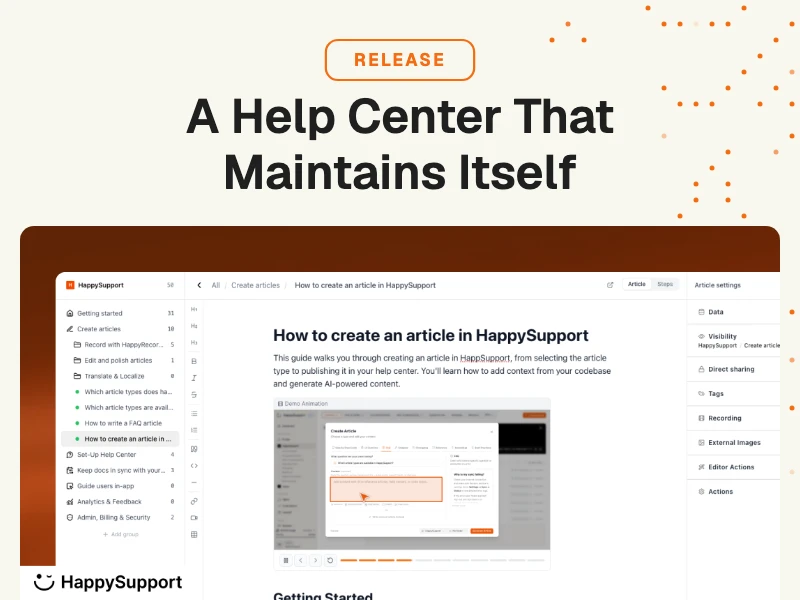
HappySupport is a different category of help center than either Zendesk Guide or Intercom Articles. The two incumbents publish content; HappySupport keeps it correct. The architecture is built around two pieces: HappyRecorder, a Chrome extension that captures UI flows as DOM and CSS selectors rather than pixel screenshots, and HappyAgent, a GitHub Sync layer that watches the product repository for changes that affect documented flows and flags the affected articles for update. When engineering renames a field or restructures a screen, the affected articles surface automatically with a list of exact changes to apply, instead of waiting for a customer to file the ticket that reveals the drift. This compresses the maintenance labor line that dominates the 3-year total cost of every Zendesk or Intercom deployment, and it removes the structural condition that makes AI agents quote stale information with confidence. For teams whose release cadence is faster than their content-review cadence, HappySupport closes the maintenance gap that neither Zendesk Guide nor Intercom Articles addresses. Read more on what a self-updating help center actually means in practice, and on why the zendesk vs intercom knowledge base choice misses the layer that matters most.