.png)

Helpjuice pricing is one of the cleaner pricing pages in the help-center category in 2026. Three tiers, three flat monthly numbers, no per-user math, no quote-only games. The current Helpjuice pricing is $249 per month for Knowledge Base, $449 for AI-Knowledge Base, and $799 for Unlimited AI-Knowledge Base. Every plan includes unlimited articles, unlimited readers, and the custom design Helpjuice is known for. Two things this clean page does not show you. First, the AI Suite (Swifty AI chatbot, AI Search, AI Writer, Chrome extension, tutorial builder) only turns on starting at the $449 tier, so most teams who want any AI feature pay 80 percent more than the headline number from day one. Second, the flat monthly bill has zero maintenance hours inside it. Helpjuice gives you the editor and the publishing surface. Every article still gets written, updated, re-screenshotted, and audited by a human on your team, every week the product ships.
This article walks through every Helpjuice pricing tier as it stands in 2026, what each plan includes, how flat-monthly billing compares to per-seat alternatives like Zendesk Guide, what the AI Suite actually unlocks, the user-cap traps that quietly force tier jumps, the true total cost of ownership at three realistic team sizes, and what to verify before signing. Then a short alternatives section for teams who realize at the end that the maintenance line is the line that hurts.

What is Helpjuice?
Helpjuice is a standalone knowledge base and help center platform, founded in 2011 and used by more than 10,000 teams according to its marketing site. The product covers article authoring, search, version history, multilingual content, AI-powered search and writing, an embeddable chatbot called Swifty AI, and a published reader portal. Its long-standing differentiator is custom design: every paying customer gets a hand-designed knowledge base theme as part of the subscription, not a template they configure themselves.
Helpjuice is not a helpdesk, a ticketing system, or a digital adoption platform. It is sold as the knowledge surface for support teams, internal documentation teams, and product organizations that want a dedicated knowledge base separate from Zendesk, Intercom, or Help Scout. The pricing reflects that: flat monthly per knowledge base, regardless of how many readers see it. What the pricing model is silent on, the same gap every help-center tool has, is what happens to articles three weeks after the product ships a UI change.
Helpjuice pricing plans and what each tier includes
Helpjuice publishes three plans on its official pricing page. All three are flat monthly numbers, billed monthly with no annual discount listed publicly. The current Helpjuice pricing structure replaces the older four-tier model (Starter, Run-Up, Premium Limited, Premium Unlimited) that older review sites still reference; the active 2026 lineup is the three plans below. Every plan includes unlimited articles, unlimited end-user readers, version history, analytics, custom branding, and the integrations library (Slack, Zendesk, Salesforce, Intercom, Google Analytics, plus API access).
What the Knowledge Base plan ($249) actually gives you
This is the entry tier and it deliberately does not include AI. You get a fully custom-designed knowledge base, real-time collaboration on articles, AI article translation into 40 plus languages (translation only, not authoring), live edit, advanced search, and analytics on what readers search for. Up to 30 internal users can author and edit. No SSO, no Swifty chatbot, no AI Writer. For a 5-person support team running a public knowledge base, this tier covers the basics.
What the AI-Knowledge Base plan ($449) adds
This is the tier most growing teams land on. The user cap moves to 100, storage doubles to 24GB, SSO turns on, and the full AI Suite activates. That includes Swifty AI (the embeddable chatbot trained on your knowledge base), AI Search (semantic search across articles), AI Writer (article drafting and rewriting), the auto-updating Chrome extension, and the tutorial builder for step-by-step guides. The price jump from $249 to $449 is 80 percent, $2,400 per year extra, and the entire $200-per-month delta is what Helpjuice charges for AI.
What the Unlimited AI-Knowledge Base plan ($799) unlocks
This is the enterprise tier for teams that want to invite internal stakeholders without watching the user counter. The user cap goes to unlimited, storage hits 38GB, and Helpjuice throws in unlimited customization credits (their internal currency for design changes, marketed as "$1,000,000 in value"). Functionally, the AI Suite is identical to the $449 plan. You are paying $350 per month extra for unlimited authoring seats. For a 150-person company where everyone in product, engineering, and customer success contributes to docs, that math works. For a 12-person support team, it does not.
The flat-monthly Helpjuice pricing model and how it compares to per-seat
Helpjuice pricing is structurally different from the help-center module sold inside helpdesks. Zendesk Guide pricing follows Zendesk's per-agent model: Suite Team starts at $55 per agent per month, Suite Professional at $115 per agent per month, where the knowledge base is bundled in. Intercom's Articles product sits inside its per-seat plans the same way. Document360, the closest direct competitor, prices per project per month and quote-only since late 2024.
Where flat-monthly wins
If your team is small but your knowledge base needs are wide, flat monthly is friendly. A 25-person support team using Zendesk Suite Professional pays $115 times 25, which is $2,875 per month just for the helpdesk seats, and Guide is bundled. If they instead run a Helpjuice Knowledge Base separately on a smaller Zendesk tier, the math can flip in their favor. Knowledge-led organizations with low headcount and high readership benefit most from flat-monthly: you are not punished for letting more people contribute.
Where flat-monthly hurts
The trap is the user cap. Helpjuice's $249 tier stops at 30 users. The $449 tier stops at 100. If you are at 28 users on the cheaper plan and the support team hires three people, you do not pay $20 per extra seat the way per-seat tools work. You jump the entire tier, $200 per month more, $2,400 per year more, for two extra seats. The per-seat tools are smoother at the margin. Helpjuice is binary. Most teams hit this trap once and either rush to the next tier or play games with shared logins, which breaks audit trails.
Helpjuice AI features and what the AI Suite costs on top of base pricing
The Helpjuice AI Suite is sold as included with the $449 plan, but it is genuinely the marketing reason to skip the entry tier. Five components live under the AI Suite banner: Swifty AI chatbot, AI Search, AI Writer, Chrome extension, and tutorial builder. None of them are sold a la carte. None of them are bundled into the $249 base tier. There is no per-conversation overage on Swifty AI based on the publicly listed pricing.
Swifty AI: the conversational chatbot
Swifty AI is Helpjuice's answer to Intercom Fin and Zendesk AI Agent. It reads your knowledge base, answers customer questions in chat, and tracks resolution rates and unanswered queries. Coverage and accuracy are constrained by what is in your articles. If a recently shipped feature is undocumented or the article is six weeks behind the product, Swifty will either decline to answer or confidently quote stale information.
AI Search and AI Writer
AI Search is semantic search, layering intent matching on top of keyword matching. AI Writer drafts and rewrites articles inside the editor. Both are useful, both depend entirely on the input quality. A well-maintained knowledge base on AI Search is fast and intuitive. A neglected knowledge base on AI Search still surfaces dead articles, just faster.
The Chrome extension and tutorial builder
The Chrome extension lets agents pull article snippets while working in other tools (Gmail, Zendesk, Salesforce). The tutorial builder generates step-by-step guides from sequential actions. Both are quality-of-life upgrades for the authoring side, not customer-facing AI features.
The AI feature problem the pricing page does not mention
Every Helpjuice AI feature reads from your articles. Swifty AI quotes them. AI Search surfaces them. AI Writer rewrites them. When an article describes a UI element that no longer exists in your product, the AI Suite cheerfully propagates the stale information to every customer who asks. This is structural to every AI-on-top-of-static-docs architecture. AI chatbots are only as accurate as the docs underneath them, and the AI Suite price is paying for the chatbot, not for keeping the docs current.
Helpjuice pricing total cost at realistic team sizes
License cost is the visible line in any Helpjuice pricing calculation. Maintenance labor is the invisible line that dwarfs it. Every Helpjuice deployment that survives past month six requires somebody to update articles when the product ships, audit dead content quarterly, fix screenshots after UI changes, and keep multilingual versions aligned. For B2B SaaS teams shipping weekly, that work runs 8 to 12 hours per month for a focused knowledge base, more for multi-product or multilingual teams. At a fully-loaded support and docs labor rate of $75 per hour in the US (or 65 to 70 euros per hour in DACH), the math gets honest fast.
Small team, Knowledge Base plan, three years
Knowledge Base license at $249 per month over 36 months: $8,964. Maintenance labor at 8 hours per month at $75 per hour over 36 months: $21,600. Total: $30,564. License is 29 percent of the three-year cost. Maintenance is 71 percent. The AI Suite is unavailable on this tier, so any AI requirement forces a jump and pushes maintenance hours up further (AI surfaces fail loudly when content is stale, and the team ends up auditing more, not less).
Growing team, AI-Knowledge Base plan, three years
AI-Knowledge Base license at $449 per month over 36 months: $16,164. Maintenance labor at 10 hours per month at $75 per hour over 36 months: $27,000. Total: $43,164. License is 37 percent of the three-year cost. Maintenance is 63 percent. AI is included so there is no add-on line, but the maintenance pressure is higher because Swifty AI surfaces every stale answer to every customer who chats in.
Enterprise team, Unlimited plan, three years
Unlimited AI-Knowledge Base license at $799 per month over 36 months: $28,764. Maintenance labor at 20 hours per month at $75 per hour over 36 months: $54,000. Total: $82,764. License is 35 percent of the three-year cost. Maintenance is 65 percent. The unlimited user count means more contributors, more articles, more drift, and more audit hours. The license stops growing. The labor does not.
The breakdown matters because it changes how you should think about the price. You are not buying a knowledge base. You are buying a knowledge base plus a recurring labor commitment that scales with how often the product changes. If the product ships weekly, the maintenance line grows. Documentation decay is the hidden cost of every help center, and Helpjuice has the same structural blind spot as Document360, Zendesk Guide, and every other tool in the category despite a clean pricing page.
Helpjuice pricing hidden costs and what to verify before signing
The published monthly Helpjuice pricing number is the floor. Six categories of cost stack on top before your effective spend reaches reality. Verify each one in writing before you sign a multi-year contract.
- Tier jumps from user caps. Going from 30 to 31 users means jumping from $249 to $449, not paying $20 more. Going from 100 to 101 users means jumping to $799. Map your headcount trajectory honestly before picking a tier.
- AI lock at the $449 tier. If anyone on the team wants Swifty AI, AI Search, or AI Writer, the $249 plan is off the table. The realistic entry tier is $449 for almost every modern team.
- Customization beyond included credits. Custom design is in the base price, but ongoing tweaks ferndesk reports cost roughly $20 for minor edits and $175 for comprehensive redesigns. The Unlimited plan includes more credits, the cheaper plans burn them faster.
- Storage overages. 12GB at the entry tier is fine for text and small images. Embedded video, screenshots at high resolution, and downloadable PDFs eat storage quickly. Verify overage pricing in writing.
- Annual vs monthly billing. Helpjuice's public pricing page lists monthly prices only and does not publicly publish an annual discount. Negotiate one explicitly on a multi-year deal; 10 to 15 percent is the typical industry range.
- Renewal pressure. Helpjuice does not publish renewal-cap policy. Inflation-linked renewals of 5 to 10 percent year over year are standard in the help-center category. Negotiate a cap before signing.
The 14-day free trial requires no credit card, and Helpjuice publishes a 30-day money-back guarantee on its pricing page. Use both. Build your real knowledge base inside the trial, not a sandbox version.
When Helpjuice pricing makes sense and when it does not
Before recommending a tier, it helps to be honest about who Helpjuice pricing is built for and who ends up paying more than they should.
Helpjuice is the right choice for knowledge-led B2B companies with low to medium headcount: teams where the knowledge base is the primary self-service surface, headcount is under 100, customization and brand consistency matter more than helpdesk integration, and the support stack already includes a separate ticketing tool. The custom-design pitch is real and Helpjuice's search is genuinely strong, which has been its long-standing user reputation.
It is the wrong choice for teams over 100 users that do not need unlimited (the $799 jump is steep), for organizations that need helpdesk-knowledge-base bundling (Zendesk Guide or Intercom Articles fit better), and for fast-shipping product teams where maintenance labor dominates the TCO. The Helpjuice editor is fine but not the differentiator. The Swifty AI chatbot is competitive but bound to the freshness of your content. For an honest comparison across the category, our breakdown of the best help center software for SaaS teams shows where Helpjuice fits and where it does not.
An open-access resource on the maintenance side of knowledge management is the KCS library at the Service Innovation Consortium. KCS (Knowledge-Centered Service) is the methodology most mature support orgs use to keep articles current as the product evolves. It is platform-agnostic and applies whether you run Helpjuice, Document360, Zendesk Guide, or anything else.
Helpjuice pricing alternatives by team profile
Three honest alternatives to consider, depending on where you sit:
- Document360. Direct competitor with a stronger pure-editor and a per-project pricing model. Better fit for content-led single-product SaaS. See our Document360 pricing breakdown for the comparable math.
- Zendesk Guide. Knowledge base bundled inside Zendesk's helpdesk. Better fit if you already pay for Zendesk seats. See our Zendesk Guide pricing breakdown.
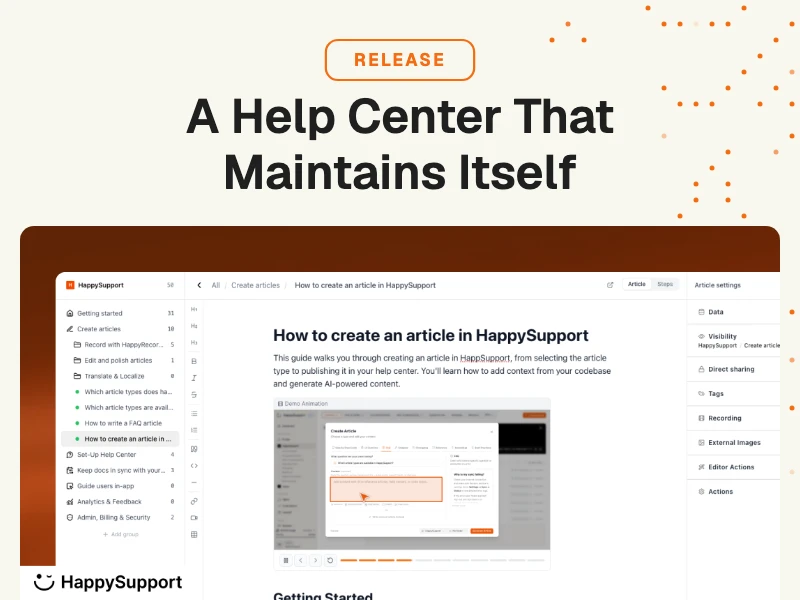
- HappySupport. Built for product-led SaaS teams shipping weekly. Different category from Helpjuice: the focus is on keeping the help center current automatically as the product changes, not on the cleanest editor or the prettiest custom design.
HappySupport in this context
HappySupport is a different category of tool than Helpjuice. Helpjuice solves the publishing problem: how do you let teams write articles, how do you make them searchable, how do you make them look custom-designed. HappySupport solves the freshness problem: how do you keep those articles accurate when the product ships every week. The architecture is DOM/CSS recording in a Chrome extension (HappyRecorder), which captures UI flows as code-selectors instead of pixels, paired with HappyAgent GitHub Sync, which watches the product repository for changes that affect documented flows and flags the affected articles for update. The maintenance labor line in the 3-year TCO model above is the line HappySupport is built to compress. For teams whose release cadence is faster than their content-review cadence, the math shifts: instead of license plus growing maintenance debt, you get license plus capped maintenance time. Read more on what a self-updating help center actually means.