The redocly vs mintlify decision is one of the cleaner forks inside the API documentation market. Redocly is the commercial platform built on top of Redoc, the open-source OpenAPI renderer with 25,000+ GitHub stars, sold per seat with deep OpenAPI handling at its core. Mintlify is the markdown-first hosted SaaS with a polished editor, AI Assistant and Writing Agent, and a customer list (Anthropic, Cursor, Perplexity, Coinbase) that reads like a who's who of AI developer products. Both ship beautiful API documentation. Both let teams scale a developer portal to thousands of pages. And both share a structural blind spot the marketing pages skip past: each ships beautiful static docs, neither knows when the underlying API or the product around it actually changed.
This article compares Redocly and Mintlify across OpenAPI rendering, editor and content authoring, AI features (Mintlify Writing and Assistant agents vs Redocly AI search and MCP servers), customization, hosting and deploy, enterprise readiness, pricing (per-seat starting at $10 on Redocly vs $250-per-month Pro on Mintlify with seat add-ons), and the dimension neither vendor markets. It closes with a decision framework based on team profile and where a self-updating help center fits inside the gap both leave open.
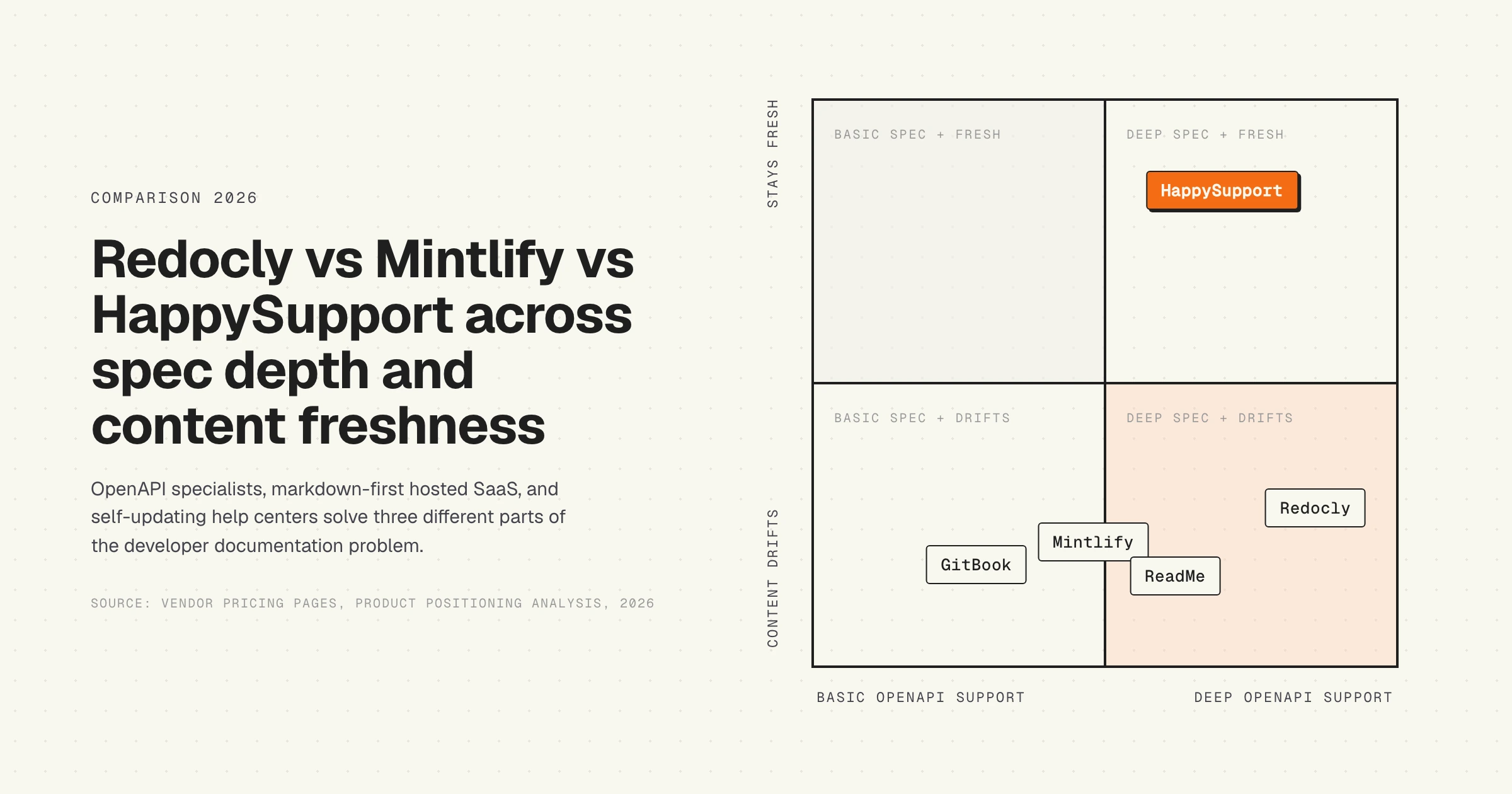
What is the difference between Mintlify and Redocly?
In one line: Redocly treats the OpenAPI specification as the product and gives you tooling to govern it, while Mintlify treats the documentation site as the product and gives you tooling to write it faster.
Everything else follows from that difference:
- What each is built around. Redocly is built on Redoc, an OpenAPI renderer, and grew outward into linting, an API registry, mock servers and a catalogue. Mintlify was built as a docs site generator and grew inward toward the API reference.
- Where the work happens. Redocly's centre of gravity is the CLI and CI: you lint the spec, bundle it, and fail the build when it breaks your rules. Mintlify's is the repository and the editor: MDX files, two-way Git sync, and pull-request review, with an AI Writing Agent drafting changes.
- Who the tool assumes you are. Redocly assumes an API platform team that owns a specification many people contribute to. Mintlify assumes a team writing guides and concepts around an API, some of whom are not engineers.
- How AI shows up. Mintlify's AI writes and answers: the Writing Agent drafts content, the Assistant answers questions in the docs. Redocly's AI is about being read: AI search, Typesense, and MCP servers so external agents can consume your docs as a knowledge source.
- How you pay. Redocly is per seat and starts at $10 per seat per month. Mintlify has a genuine free tier and then a $250 per month Pro plan that bundles 5 seats and 5,000 AI credits.
The practical read: if you can describe your documentation problem as "our spec is inconsistent and drifts," that is Redocly. If you can describe it as "we do not publish fast enough and the site looks dated," that is Mintlify.
Linting, versioning and developer experience: which is stronger?
The three requirements that come up together most often, taken one at a time.
Linting: Redocly, clearly, and it is the single biggest gap between them. Redocly CLI lints, bundles, splits and decorates OpenAPI, AsyncAPI and Arazzo definitions, with rulesets you extend and then fine-tune rule by rule for your own API. You run it in CI, so a pull request that violates your style guide fails before review. Enterprise adds governance on top. Mintlify's checks are lighter and oriented around whether the docs build and the spec parses, rather than around enforcing a house style across a large surface. If "linting" in your requirement means "we want our API design rules enforced automatically," that is a Redocly feature and not really a Mintlify one.
Versioning: Redocly, by a smaller margin. Redocly's API registry handles multiple API versions as a first-class concept, with branches per version and the mock server enabled per version. Mintlify does versioned documentation and, because content is MDX in Git, you have the repository's branching available to you. The difference is what is versioned: Mintlify versions the docs, Redocly versions the specification and derives the docs from it. For a public API with v1 and v2 live simultaneously and different consumers on each, Redocly's model maps onto the problem more directly.
Polished developer experience: this splits, so be precise about whose experience. For the reader of your documentation, Mintlify is the stronger default. The component library is opinionated, the result looks current without design work, and that is why AI companies with developer audiences keep choosing it. For the contributor, Redocly is stronger if the contributors are engineers, because the whole flow is docs-as-code with linting in CI and the mock server available to test against; and weaker if they are not, because everything goes through Git.
So on the composite question: Redocly is stronger if linting and versioning are genuine requirements rather than nice-to-haves, because they are core to the product rather than adjacent to it, and you are accepting a less polished out-of-the-box reader experience in exchange. Choose Mintlify if the polished reader experience is the requirement and your spec is small enough that inconsistency is not yet your problem.
One Redocly capability worth naming because it rarely appears in comparisons: the mock server. Enabled per API version from the registry, it lets consumers send real calls to your operations and get sample responses with no backend running. For a team publishing an API before it ships, or wanting integrators to build against v2 during a beta, that is a concrete capability with no Mintlify equivalent.
What is Redocly?
Redocly is the commercial OpenAPI documentation platform built on top of Redoc, the open-source three-panel API reference renderer that ships natively inside FastAPI, Django, and ASP.NET Core. The product launched as the open-source Redoc project, then layered a commercial platform on top covering authoring, hosting, AI search, and developer-portal features. The primary surface is a hosted documentation site that renders an OpenAPI specification into a three-panel layout (navigation, content, request and response examples), plus authoring tools to add guides and concepts around the API reference.
The output of Redocly is a developer portal with deep OpenAPI handling: support for OpenAPI 3.2, 3.1, 3.0, Swagger 2.0, AsyncAPI, and Arazzo, automatic spec rendering and validation, schema-driven code samples, and multi-version documentation. Add-on products extend the platform: Revel for guides, Reef for the developer portal shell, and the Realm bundle that combines all three at a single per-seat add-on. Enterprise customers get AI search, Typesense search, MCP servers, SSO, RBAC, and analytics. Redoc itself stays open source under MIT.
What is Mintlify?
Mintlify is the markdown-first hosted SaaS documentation platform that built its reputation on a polished editor, an opinionated default design, and an aggressive AI footprint across authoring and search. Customers include Anthropic, Cursor, Perplexity, and Coinbase, which is a meaningful signal for any team picking a developer documentation tool: companies whose audiences are the most discerning in the industry picked Mintlify. The primary surface is a hosted documentation site authored in MDX (Markdown plus JSX), with components for cards, tabs, accordions, syntax-highlighted code blocks, Mermaid diagrams, callouts, and an interactive API playground driven by an OpenAPI specification.
The output of Mintlify is a developer portal that combines guides, concepts, tutorials, and API reference under a single design system. Content lives in MDX files in a connected GitHub repository, with two-way sync and pull-request-based review. The Mintlify Writing Agent drafts and edits content from prompts, the Assistant agent answers developer questions inside the docs as conversational search, and the Enterprise tier adds self-updating workflows that watch the connected repository for changes and propose doc updates. The editorial bet is that an opinionated component library plus deep AI authoring is worth more than maximum customization.
Quick verdict on the redocly vs mintlify question
If your team is an API-first organization with a serious OpenAPI specification, you want best-in-class spec rendering, multi-version support, deep linting and CI integration, and per-seat pricing that scales linearly with team size, Redocly wins on OpenAPI depth and on enterprise governance. If your team writes a lot of prose guides and concepts around the API reference, wants an opinionated component library out of the box, values AI-assisted authoring and conversational search, and can absorb the $250-per-month Pro floor for 5 seats, Mintlify wins on time-to-publish and on editor polish. Neither tool was built to reconcile docs against the running product, which is the dimension most evaluations skip until production drift starts breaking customer flows.
| Dimension | Redocly | Mintlify |
|---|---|---|
| Origin | Open-source Redoc renderer (25k+ stars) | Hosted SaaS, AI-first |
| Authoring | OpenAPI spec plus Markdown | MDX with rich components |
| OpenAPI rendering | Three-panel, deep spec coverage | Single-page playground, less robust validation |
| AI features | AI search, MCP servers (Enterprise) | Writing Agent, Assistant, conversational search (Pro) |
| Entry price | $10 per seat per month (Pro) | $0 Hobby, $250 per month Pro (5 seats) |
| Customer examples | Enterprise API teams, complex specs | Anthropic, Cursor, Perplexity, Coinbase |
| Drift signal from product | None native | None native |
How to publish API docs with each tool
The day-one experience inside the redocly vs mintlify pairing tells you most of what you need to know about who each tool is for. Redocly expects an OpenAPI specification at the center of the workflow. Mintlify expects a writer with prose plus an OpenAPI specification at the side.
Publishing in Redocly
In Redocly, you point the project at an OpenAPI file (committed in your repo or hosted at a URL), configure navigation and theming in a YAML config, write any guide content as Markdown next to the spec, run a local preview through the Redocly CLI, and deploy via the Reunite platform with a custom domain. The OpenAPI rendering is the centerpiece: every endpoint, parameter, and response schema becomes a navigable, code-sample-rich page automatically. When the spec changes in a pull request, the docs preview updates with the diff. Spec linting through Redocly's CLI catches breaking changes and style violations in CI.
Publishing in Mintlify
In Mintlify, you connect a GitHub repository, write content as MDX files (Markdown plus JSX), drop in MDX components (Cards, Tabs, AccordionGroup, CodeGroup, Frame), reference an OpenAPI specification to auto-generate an interactive API playground, preview live in the web editor or via the Mintlify CLI, and deploy on every push to main. The opinionated default design ships out of the box. The Writing Agent can draft new pages or rewrite existing ones from prompts. The Assistant agent surfaces inside the published docs as conversational search.
The end product looks different on the developer side. Redocly's three-panel layout is the OpenAPI native experience that developers already know from any FastAPI app. Mintlify's single-column documentation with embedded playground feels more like reading a Notion-style guide with API examples woven in. Different bets on what a developer expects when they land on docs.
Feature breakdown of Redocly and Mintlify
Six dimensions decide most redocly vs mintlify evaluations once the marketing pages are out of the way: OpenAPI rendering, editor and authoring, AI features, customization, hosting and deploy, and enterprise readiness.
OpenAPI rendering and spec handling
Redocly is the OpenAPI specialist. The Redoc renderer underneath supports OpenAPI 3.2, 3.1, 3.0, Swagger 2.0, AsyncAPI, and Arazzo, with the deepest schema handling in the market: nested oneOf and anyOf compositions, polymorphism via discriminators, server variables, security schemes, and webhooks all render cleanly without manual intervention. Redocly's CLI lints the spec against custom rulesets and catches breaking changes in CI. Mintlify supports OpenAPI 3.0 and 3.1 with an interactive playground, but the integration is reported as less robust on edge cases: opaque error messages and incorrect validation failures on complex schemas. For teams whose OpenAPI specification is the source of truth, Redocly wins. For teams whose API is a smaller part of a larger documentation project, Mintlify's coverage is enough.
Editor and content authoring
Mintlify ships the polished MDX-based editor with a component library that handles Cards, Tabs, AccordionGroup, CodeGroup, Frame, Steps, Note, Warning, and Mermaid diagrams. Writers and developers share the same editing surface, which keeps the contribution barrier low. Redocly authoring happens in Markdown plus YAML configuration files, edited in whatever IDE the team uses. The component story is thinner: Redocly leans on its strong defaults and lets engineers extend through theming rather than through inline MDX. For teams with non-engineer writers, Mintlify is materially friendlier. For teams where every contributor is an engineer comfortable with Markdown and Git, Redocly's surface is enough.
AI features: Mintlify Assistant and Writing Agent vs Redocly AI search
Mintlify ships the broader AI footprint. The Pro plan includes 5,000 AI credits per month for the Writing Agent (content drafting and editing) and Assistant (in-docs conversational search), with $0.01 per credit overage. The Enterprise tier adds self-updating workflows that watch a connected repo and propose doc updates from code changes. Mintlify also pioneered the `/llms.txt` standard for making documentation accessible to AI assistants like Claude and ChatGPT, per the current Mintlify pricing page.
Redocly's AI is narrower and gated to Enterprise: AI search across the documentation, Typesense search for high-performance retrieval, and MCP servers for connecting external AI agents to the documentation as a knowledge source. The AI footprint is smaller in scope but tighter in execution: search and retrieval that AI agents consume rather than authoring assistance for human writers. For teams whose primary AI need is content creation, Mintlify wins. For teams whose primary AI need is making published docs consumable by AI agents, Redocly's MCP server hook is the cleaner fit.
Customization and design control
Mintlify wins on out-of-the-box design and loses on customization ceiling. The opinionated default design ships polished, the component library covers most needs, but layout customization stops at the templated layer. Redocly is the inverse: the default three-panel layout feels utilitarian compared to modern alternatives, but you can customize typography, spacing, layout, color schemes, and code blocks individually through theming. For teams that want their docs site to look like an extension of the product without engineering investment, Mintlify wins. For teams that need a docs site to match a complex brand system, Redocly's deeper customization wins.
Hosting, build, and deploy
Both products host on vendor infrastructure with custom domains on paid tiers. Mintlify deploys on every push to a connected GitHub or GitLab repo, with no build configuration to manage. Redocly's Reunite platform hosts the Redocly-built site with custom-domain support; the underlying Redoc renderer stays available as open source for teams that want to self-host. For teams that want zero infrastructure overhead, Mintlify wins. For teams that need an open-source escape hatch or want to host inside their own cloud account, Redocly's Redoc open-source path is the difference.
Enterprise readiness and security
Redocly Enterprise ships SSO, Guest SSO, RBAC, remote content syncing, AI search, Typesense search, MCP servers, analytics, and a 500-page limit. Enterprise+ adds data residency, single-tenant hosting, premium support, security questionnaires, and procurement assistance. Mintlify's Enterprise tier ships SSO, SOC 2 compliance, self-updating workflows, enterprise security and legal compliance, migration services, 24/7 incident monitoring, and custom SLAs. Both clear the enterprise bar; the difference is the surrounding ecosystem. Redocly's enterprise customers tend to be regulated industries with complex OpenAPI portfolios. Mintlify's enterprise customers tend to be modern AI companies with developer audiences who already know the Mintlify aesthetic.
Pricing comparison: per-seat vs Pro plus seat add-ons
The redocly vs mintlify economics diverge sharply because the two products charge for entirely different shapes. Redocly bills per seat with transparent monthly pricing. Mintlify bills per plan with seat inclusions and metered AI credits, plus per-seat overage costs.
Redocly base pricing (billed monthly) is Pro at $10 per seat per month (1 project, 100 pages, custom domain), Enterprise at $24 per seat per month (500 pages, SSO, RBAC, AI search, Typesense, MCP servers), and Enterprise+ at custom yearly pricing for single-tenant hosting and premium support, per the current Redocly pricing page. The Realm bundle (Redoc + Revel + Reef) adds $18 per seat per month on Pro or $42 per seat per month on Enterprise. A 3-person team on Pro with Realm runs $84 per month. A 3-person team on Enterprise with Realm runs $198 per month.
Mintlify pricing is Hobby at $0 for individuals (custom domain, web editor, MCP server, custom components), Pro at $250 per month including 5 seats and 5,000 AI credits ($0.01 per credit overage), and Enterprise at custom pricing for SOC 2, SSO, self-updating workflows, and 24/7 support. Annual billing knocks 15 percent off. Additional seats on Pro are not publicly priced (contact sales), and active teams typically land in the $400 to $600 monthly range once AI overages and extra seats are accounted for.
| Scenario | Redocly | Mintlify |
|---|---|---|
| 1 author, basic API docs | $10 per month (Pro base) or Redoc self-host free | $0 (Hobby) |
| 3 authors, Pro features, custom domain | $30 to $84 per month (with Realm) | $250 per month (Pro, 5 seats) |
| 10 authors, AI search, SSO | $240 to $660 per month (Enterprise with Realm) | $250 + 5 extra seats at $20 each = ~$350 per month plus AI overages |
| 25 authors, full enterprise | $1,650+ per month (Enterprise+ custom) | Enterprise custom (~$600+ per month) |
The pattern is clear. Redocly is cheaper for small API-first teams with simple needs (a Pro seat is $10 per month) and more expensive at scale once you add Realm and Enterprise features. Mintlify has a real free tier and a single Pro plan that covers 5 seats, which makes it cheaper for small teams that want AI authoring included; it becomes more expensive once seat overages and AI credit usage pile up. The wider Mintlify alternatives comparison covers where each lands in the broader developer-docs market.
How Mintlify pricing compares to ReadMe, GitBook and Redocly
The four names that get shortlisted together price on four different units, which is why comparing their headline numbers is misleading. Checked against each vendor's public pricing page in August 2026.
| Entry | Mid tier | Top tier | Billing unit | |
|---|---|---|---|---|
| Redocly | Pro, $10/seat/month | Enterprise, $24/seat/month | Enterprise+, custom yearly | Per seat, plus $18 or $42/seat for the Realm bundle |
| Mintlify | Hobby, $0 | Pro, $250/month for 5 seats | Enterprise, custom | Per plan, with AI credits metered at $0.01 |
| ReadMe | Starter, $0, 1 project | Pro, $250/month billed annually, 1 project | Enterprise, from $3,000/month | Per project, with add-ons |
| GitBook | Free, $0, 1 user | Premium, $65/site/month + $12/user | Ultimate, $249/site/month + $12/user | Per site and per user |
Read it by unit rather than by number, because the unit is what determines your bill in year two:
- Redocly bills per seat, so cost is a function of how many people write documentation. Ten authors on Enterprise with Realm is a real number you can calculate in advance. Add readers freely.
- Mintlify bills per plan plus AI usage. The $250 Pro plan is the same price for a team of two or five, which is why small teams like it. The variable is AI credits: 5,000 are included and overage runs $0.01 each, so heavy Writing Agent use is the line that moves.
- ReadMe bills per project, which is the sharpest edge in this table. Both Starter and Pro include one project, so a second API or a second brand is not a seat upgrade, it is an Enterprise conversation starting at $3,000 a month. Ask AI is also a $150 per month add-on across all plans rather than being included.
- GitBook bills twice, per site and per user. One site with ten users on Ultimate is $249 + $120 = $369 a month; a second site adds $249 flat. Multi-property teams pay the most here.
Cheapest by scenario, at published prices:
- A solo developer or an open-source project. Mintlify Hobby or ReadMe Starter, both $0, or GitBook Free if one user is genuinely enough. Redocly Pro at $10 is the cheapest paid option.
- Three authors, one API. Redocly, comfortably. Three Pro seats with Realm is $84 a month, against $250 on either Mintlify Pro or ReadMe Pro.
- Five authors who want AI authoring included. Mintlify Pro at $250 for 5 seats and 5,000 credits, since the same team on Redocly needs Enterprise for AI search and on ReadMe needs the $150 Ask AI add-on.
- Two or more separate documentation properties. Redocly or Mintlify. This is where ReadMe's per-project model and GitBook's per-site model both punish you.
- Enterprise governance, SSO and RBAC. Redocly Enterprise at $24 per seat is dramatically cheaper than ReadMe Enterprise at $3,000-plus per month, and it is the tier where Redocly's lint governance lives.
The honest summary: Redocly is the cheapest of the four at almost every size if you only need documentation, and it stops being cheapest when you add the Realm bundle at scale. Mintlify is the best value if AI authoring is load-bearing. ReadMe is the most expensive to grow into, because the jump from Pro to Enterprise is a factor of twelve with no middle tier. GitBook is the outlier and priced for a different job: it is a general documentation tool that also does API reference, so if the API is the point, the other three fit better. GitBook pricing and GitBook vs ReadMe go deeper on those two.
Mintlify vs Redocly for enterprise API documentation
At enterprise scale the comparison changes shape, because the things that decide a small-team choice, editor polish and time to first publish, stop being the deciding factors. Four things take over.
Governance over a specification many people touch. This is Redocly's strongest argument and the reason regulated buyers land there. Global lint rules enforced in CI mean an API design standard is a build failure rather than a review comment, which is the only mechanism that holds when dozens of contributors ship to one spec. Redocly also brings the surrounding lifecycle pieces: an API registry with versions and branches, Reef as an internal catalogue and scorecard, and API Scout for finding hidden or duplicate APIs across the organisation. That last set is an API governance product, not a documentation feature, and Mintlify does not compete for it.
Multi-version and multi-audience publishing. Enterprises usually run more than one live API version and more than one audience, with public docs, partner docs and internal docs on different access rules. Redocly Enterprise handles this through the registry plus RBAC and Guest SSO. Mintlify Enterprise covers SSO and access control but the model is less oriented around many concurrent specification versions.
Procurement and compliance. Both clear the bar and the details differ. Redocly Enterprise ships SSO, Guest SSO, RBAC, remote content syncing, AI and Typesense search, MCP servers and analytics, with a 500-page limit; Enterprise+ adds data residency, single-tenant hosting, premium support, security questionnaires and procurement assistance. Mintlify Enterprise ships SSO, SOC 2, self-updating workflows, migration services, 24/7 incident monitoring and custom SLAs. If data residency or single-tenant hosting is a hard requirement, that is a Redocly Enterprise+ conversation. Note the 500-page limit on Redocly Enterprise, which is a real constraint for a large portal and worth confirming against your page count before you sign.
Cost at enterprise headcount. Redocly Enterprise at $24 per seat per month stays predictable and calculable. Mintlify Enterprise is quote-based. For twenty-five authors, Redocly is a number you can put in a budget today; Mintlify is a negotiation.
Where Mintlify wins at enterprise anyway, and it is not a small thing: the self-updating workflows on its Enterprise tier watch the connected repository and propose documentation updates from code changes. That is the closest either vendor comes to addressing the drift problem this article ends on, and if your enterprise pain is that a large docs surface silently falls behind a fast-moving codebase, it is the more relevant capability. Redocly's answer to drift is to catch spec violations in CI, which is upstream and narrower: it validates that your spec is internally consistent, not that it matches what the service actually does.
The verdict for enterprise API documentation: Redocly for API governance at scale, multiple live versions, regulated procurement and predictable per-seat cost. Mintlify for a large prose-heavy developer portal where authoring throughput and keeping pace with the codebase matter more than enforcing a specification standard. If you are a platform team publishing a specification, Redocly. If you are a documentation team publishing a product, Mintlify.
Where both tools quietly fail
Both Redocly and Mintlify are built to publish content from a specification. Neither is built to know when that specification stops matching the running product. This is the single biggest blind spot in the entire redocly vs mintlify comparison, and every other article skips past it because both vendors' marketing skips past it.
The mechanic is similar in both products. A team commits an OpenAPI specification to a repo, points either tool at it, ships the developer portal, and walks away. Engineering changes the actual API behavior on Tuesday: a query parameter renames, a response field gains a new type, a deprecated endpoint quietly returns a different status code. The specification gets updated in a pull request a week later, or not at all. The published docs continue to show whatever the last committed spec said, with full AI confidence on both platforms. The OpenAPI Initiative best-practices guide emphasizes that "OpenAPI Descriptions are first-class source files" that should participate in CI to catch deviations between implementation and spec, which is exactly the gap most teams fail to close.
The same drift problem applies harder to the prose around the API reference. A guide that walks a developer through the in-product setup screens, an integration tutorial with screenshots, an onboarding flow that references UI elements: all of these go stale the moment the product UI moves. Documentation decay is the hidden cost of every help center, and developer docs are not exempt. The Mintlify Assistant and the Redocly AI search both quote the stale content with full confidence, because neither tool reads the running product to verify.
Which failure mode is more disruptive
The two tools fail in slightly different ways when the docs fall behind the product.
Redocly's failure mode is the perfectly rendered stale spec. The three-panel layout shows the API reference exactly as the last committed OpenAPI file describes it. The developer reads the canonical schema, writes integration code against it, ships, and the integration breaks in production because the real API behaves differently. The CI lint catches some breaking changes but not all: a status code change inside an existing endpoint can pass linting and still break consumers. The polish of the rendering masks the drift.
Mintlify's failure mode is the confidently rewritten stale guide. The Writing Agent generates new guides from a connected repository, but reads code and Markdown rather than running product. The Assistant answers developer questions in conversational search using the published content, which may be weeks behind the running product. When AI confidence sits on top of stale source material, developers trust the wrong answer faster than they would have trusted a stale static page. Screenshot documentation breaks every release, and the AI confidence layer amplifies the failure beyond what a static screenshot would.
Which is more disruptive depends on the surface. An OpenAPI-first developer portal feels Redocly's failure as integration bugs reported in customer support tickets. A prose-heavy developer portal with AI Assistant feels Mintlify's failure as developer trust eroding inside the docs themselves. Both are symptoms of the same root cause: the tool does not read the running product.
When Redocly is the right answer
- Your team is engineering-led and the OpenAPI specification is the source of truth for everything you ship.
- You need multi-version documentation for SDK or API versions, with each release carrying its own snapshot.
- You want CI-integrated linting through the Redocly CLI and breaking-change detection on every pull request.
- You can absorb per-seat pricing that scales linearly with team size, and the Pro tier at $10 per seat per month fits your usage.
- You prioritize OpenAPI depth (3.2, 3.1, 3.0, Swagger 2.0, AsyncAPI, Arazzo) over editor polish or AI authoring assistance.
When Mintlify is the right answer
- Your team includes non-engineer writers (PMs, technical writers, support engineers) who need a friendly MDX editor with a strong component library.
- You publish a lot of prose guides and concepts around the API reference, not just an OpenAPI dump.
- You want AI authoring out of the box: the Writing Agent for content drafting and the Assistant for in-docs conversational search.
- You value an opinionated default design and time-to-publish over deep customization control.
- Your audience expects the polished modern aesthetic that Anthropic, Cursor, Perplexity, and Coinbase ship, and you can absorb the $250 per month Pro floor for 5 seats. The wider best AI documentation tools comparison covers where Mintlify lands in the AI-first segment.
Do not use either as a customer-facing how-to help center for a product that ships weekly. Both tools were built for developer documentation, where the cadence is release-driven (a new API version every few weeks or months), not deploy-driven (a UI change every few days). The drift dynamics break either tool when stretched into help-center duty for non-developer audiences.
HappySupport is a different buy from Redocly or Mintlify, not a replacement for either. The developer portal (API reference, SDK guides, integration tutorials for engineers) belongs in Redocly or Mintlify. The customer-facing help center (in-product walkthroughs, UI-anchored how-tos, troubleshooting flows) belongs in a tool that reads the running product, and HappySupport covers that help center together with AI answers, a ticket inbox and an in-app widget from one content source. Whichever you pick for the developer portal, use HappySupport for the customer-facing articles that stop drifting between releases.
Alternatives to Redocly and Mintlify
If the redocly vs mintlify evaluation surfaces a misfit on either side, there are four alternatives worth a serious look depending on use case.
- ReadMe. OpenAPI-native hosted SaaS focused on developer portals with API key management, interactive API explorer, per-endpoint analytics, and a stronger developer-dashboard story than either Redocly or Mintlify.
- GitBook. Hosted SaaS with a polished block editor and AI authoring, broader than Mintlify on general documentation, lighter on OpenAPI rendering. GitBook vs ReadMe covers the adjacent comparison.
- Docusaurus. Open-source React-based static site generator from Meta, free under MIT, with versioning out of the box. Docusaurus vs GitBook walks through the open-source vs hosted-SaaS trade-off.
- HappySupport. Built for product-led B2B SaaS shipping weekly, where the maintenance problem on customer-facing how-to content dominates the editor problem on developer docs. Covered in detail below.
For a broader view, the best AI documentation tools comparison covers the full landscape across editors, AI features, and OpenAPI handling.
HappySupport in the redocly vs mintlify debate
HappySupport is a different category of help center than either Redocly or Mintlify. The two developer-docs incumbents publish content from a specification; HappySupport reconciles customer-facing content to the running product. The architecture rests on two pieces: HappyRecorder, a Chrome extension that captures UI flows as DOM and CSS selectors instead of pixel screenshots, and HappyAgent, the GitHub Sync component that watches the product repository for changes that affect documented flows and turns them into update proposals for the affected articles. When engineering renames a field, restructures a screen, or moves a button, the affected customer-facing articles surface automatically with a list of exact changes to apply, instead of waiting for the next sprint to catch the drift or for the AI Assistant to confidently rewrite a stale page from a stale source. For teams whose developer portal lives in Redocly or Mintlify but whose customer-facing how-to docs need a different freshness model, HappySupport closes the gap that the redocly vs mintlify decision still leaves open. Read more on what a self-updating help center actually means in practice, and on why customer-facing help content needs a different tool than the API reference.