

Alternatives to Mintlify are a popular search for two different reasons, and most articles confuse them. Some technical teams want a different docs-as-code stack because Mintlify's pricing or workflow does not fit. Other teams want something Mintlify does not actually solve at all: product documentation that has to keep pace with a weekly-shipping product. Those are not the same problem, and the right alternative to Mintlify depends on which one you have.
This comparison covers the serious Mintlify alternatives that come up in real evaluations, with the pricing verified against vendor pages in May 2026. It is honest about where Mintlify is still the right answer for creating developer documentation, and it ends with the maintenance problem that none of these tools, including Mintlify itself, address for product documentation.
What is Mintlify and what does it actually do well
Mintlify is a developer-focused docs platform built around docs-as-code workflows. Documentation lives in a git repo as Markdown files or MDX source files, and Mintlify renders it as a fast, search-friendly documentation page with API reference, code playgrounds, and an embedded AI assistant. Mintlify's Pro plan runs $250 per month per project with 5,000 included AI credits and $0.01 per credit overage, based on Mintlify's current pricing page. There is also a free hobby plan for individual developers and very small projects, useful for evaluating the platform before committing to paid pricing.
Where Mintlify is genuinely best in class: API documentation that changes via pull request, developer-facing docs maintained by engineers, and OpenAPI-driven reference pages. The editing model assumes a developer in the loop. The integrated ecosystem (docs, search, model context protocol server, an API playground for endpoint testing, and AI-powered assistant) means you do not have to assemble Algolia plus a chatbot plus a custom MCP server plus a playground plugin, then maintain every seam. Pages load quickly, the developer documentation rendering is solid, and the git integration is tight.
Where teams hit the wall: pricing that scales fast when you add team members, an editing experience that is hostile to non-technical contributors, and zero answer to the question every product team eventually asks. What updates the documentation when the product ships a UI change?
Why teams look for Mintlify alternatives in 2026
Three patterns show up consistently when teams Mintlify compare against other platforms. The first is pricing. Mintlify's Pro plan at $250 per month for a single project plus AI credit overages adds up quickly when a team has multiple docs sites or hits the credit ceiling on Assistant usage. Teams looking at $250 per month for one docs site often find a free Docusaurus deployment or a Document360 plan more honest about total cost. Custom pricing is available for enterprise features, but most growing teams want predictable pricing rather than a sales conversation.
The second pattern is contributor accessibility. Mintlify's editing model is Markdown in a git repo. That is a feature for engineers and a barrier for support teams, product managers, and other non-developers who are not comfortable in version control. Teams with non-technical team members look for tools with a real visual editor and optional Git sync rather than required.
The third pattern is the documentation type. Mintlify is built for static API and developer documentation. Product documentation is a different problem. Product docs cover help articles, customer support flows, screenshots of UI that change every release, and video tutorials. The team writing them is rarely the engineering team. The maintenance burden is constant. Mintlify does not solve this, and neither do most of its alternatives.
Visual editor versus raw code: the contributor choice
The choice of documentation tools depends on a team's preference for raw code integration versus user-friendly content editing. A good user experience in documentation platforms is characterized by ease of use, allowing both technical and non-technical users to contribute effectively without needing extensive training.
Documentation tools that feature a visual editor allow non-developers, such as product managers and marketers, to contribute documentation without needing to learn complex coding or Markdown skills. A web editor with a WYSIWYG surface means a product manager can fix a typo, add a screenshot, or suggest documentation improvements in the same workflow that engineers use to ship code. Platforms that support collaborative editing often include features like inline commenting and suggestion workflows, which facilitate feedback and revisions from various team members.
A hybrid approach to documentation, where both technical and non-technical contributors can work together, enhances collaboration across different team roles and improves the overall quality of documentation. Non-technical teams gain a real seat at the documentation process when the editor does not require Git knowledge as a precondition. The onboarding process of a documentation platform can greatly affect user experience; platforms that allow for flexible setup paths, such as a visual editor for non-technical users alongside a Markdown workflow for engineers, tend to provide a smoother experience. Documentation platforms that offer a visual editor can significantly enhance accessibility for non-technical contributors, enabling them to create and maintain documentation without needing to learn complex coding or Markdown syntax.
Quick verdict and comparison
The short version, ordered by how often each comes up as a real Mintlify alternative in 2026:
One pattern is missing from this table on purpose. None of these tools, including Mintlify itself, address documentation that has to stay in sync with a product UI shipping every week. That problem belongs in a different category, and the closing section covers it.
Rank the alternatives on what matters to your team
The ranker below scores every tool in this comparison on editor accessibility, AI features, content maintenance, and pricing. Sort by any column or filter by what your team cares about. The default sort is the composite score.
GitBook
GitBook is the most direct Mintlify alternative for teams that want a block-based visual editor without forcing contributors into a git repo workflow. The editing surface is a Notion-style block editor with custom components for callouts, tables, and embeds. Documentation can sync bidirectionally with a GitHub or GitLab repository, which means engineers can still edit Markdown files in their IDE and content editors can use the web editor in the browser. The platform includes an AI assistant for writing suggestions and continuous AI translations.
GitBook strengths
The visual editor is the strongest part of GitBook. It is genuinely easier to use for non-technical contributors than Markdown in a repo. Bidirectional git integration means you do not have to commit to docs-as-code as a religion. AI translation handles multiple languages with less manual effort than Mintlify's approach. Inline comments and suggested-edit workflows make it easy to suggest documentation improvements without losing the existing tools your team already uses.
GitBook weaknesses
Per-user pricing at scale becomes the issue. GitBook follows a tiered pricing model where costs increase as additional features or users are added, so a team of 20 contributors on the Premium plan adds up quickly. The customization options are narrower than Mintlify's MDX custom components, which matters more for branded developer hubs than for help articles. Search functionality is solid but not exceptional, and AI tools lag Mintlify Assistant in terms of accuracy on technical content.
ReadMe
ReadMe is the closest direct competitor to Mintlify if your documentation is an API developer hub first and everything else second. It combines API reference, broader product documentation, changelogs, and developer analytics in a single portal. Personalized interactive API docs let logged-in developers see their own API keys, test endpoints with their real credentials, and watch their requests and usage history in the documentation page itself.
ReadMe strengths
ReadMe is built for personalized developer hubs. The platform tracks which API calls each developer makes, surfaces relevant pages with code samples, and gives the documentation team usage analytics that Mintlify does not offer in the same depth. Onboarding flows for API consumers are stronger than what most generic documentation tools provide. The API playground supports request signing and authenticated calls, so technical teams can test endpoints in the same workflow they use to read the docs.
ReadMe weaknesses
ReadMe overlaps heavily with what Mintlify already does. Pricing starts around $99-150 per month for Core but climbs fast for additional projects or enterprise features. For teams that have both API docs and product documentation, ReadMe handles the API side well and the product documentation side less well. Recent technical writers have noted that the editing experience feels less polished than Mintlify's.
Docusaurus
Docusaurus is what you build when you want Mintlify's docs-as-code philosophy without the price tag or vendor dependence. Docusaurus is an open-source static-site generator built on React, using Markdown and MDX for documentation layout and design. Docusaurus is built by Meta, uses Git and MDX, and allows for absolute layout control with full self-hosting capabilities. You host it yourself, you customize the theme with custom CSS and custom scripts, and you own the entire stack.
Docusaurus strengths
The cost is the most honest part of Docusaurus. There is no vendor pricing, no per-user fee, no AI credit ceiling, no surprise on the invoice. The platform is widely adopted, the plugin ecosystem is large, and the documentation about Docusaurus is extensive. For an engineering team that wants full control and a preferred workflow that lives entirely in the git repo, this is the right answer.
Docusaurus weaknesses
Everything that Mintlify includes as a service is now your engineering team's responsibility. Search requires Algolia or another integration. AI features require building or wiring in a third-party. Authentication and access control require custom work. Preview deployments need to be configured through Netlify, Vercel, or your own CI pipeline. The total cost is rarely zero, it is just shifted from a vendor invoice to engineering time. Per the Stack Overflow Developer Survey, poor documentation remains a top developer frustration year over year, and a Docusaurus deployment that nobody maintains hits this problem fast.
Document360
Document360 is a comprehensive, enterprise-level standalone knowledge base featuring analytics and localization options, designed for creating extensive internal wikis or external self-service help centers rather than developer-first API docs. It includes approval workflows, role-based access, version control, and a category-based information architecture that fits help center use cases better than Mintlify's repo-as-docs model. Pricing starts around $199-249 per month for the Standard plan and moves into custom pricing for enterprise tiers.
Document360 strengths
Document360 handles knowledge base articles and customer support documentation more cleanly than Mintlify does. The visual editor is built for non-technical authors. Approval workflows, content review cycles, and audit logs make it a real fit for enterprise teams that have compliance requirements. Multilingual support is built in with localization workflows that scale across many languages. Analytics dashboards show which docs page and which relevant pages are read most, which articles never resolve a search, and where customers drop off.
Document360 weaknesses
Document360 is not a developer documentation tool. API reference rendering is weaker than Mintlify or ReadMe. Like GitBook, Document360 uses tiered pricing structures that increase costs as additional features or users are added, and sales-led pricing on the higher tiers means a fast-moving SaaS team that wants to evaluate the tool quickly hits friction. Many teams find Document360 too heavy for a startup or seed-stage SaaS that needs a help center launched this quarter.
Archbee
Archbee positions itself as a unified workspace for technical and product documentation. It blends developer-focused features (deep code blocks, Swagger and OpenAPI integration, custom components) with knowledge base features (article hierarchy, search, branded portals with a custom domain). Archbee supports deep code blocks, Swagger and OpenAPI integration, and connects easily with GitHub and GitLab for seamless syncing of source files into published documentation. Pricing starts around $60 per month for team plans.
Archbee strengths
Archbee handles mixed documentation use cases better than tools focused on one or the other. Teams with both internal engineering documentation and external customer-facing help articles can put both in one platform without the workflow split that comes from running Mintlify plus Document360. The same workflow covers internal wikis and customer-facing docs, which removes a real coordination tax.
Archbee weaknesses
The Archbee ecosystem is smaller than Mintlify's or Document360's. Integrations are narrower, the user community is smaller, and the platform's maturity on advanced features lags the leaders. For teams that need a single-purpose best-in-class tool, Archbee is rarely the top choice on either axis.
Stoplight
Stoplight is an API-first tool that overlaps with the developer documentation half of Mintlify's positioning. The platform is built around OpenAPI design, API mocking, and reference documentation. Annual pricing starts around $44 per month for the Starter tier.
Stoplight strengths
For teams that design APIs first and document them later, Stoplight is a real contender. The OpenAPI editor and design tools are deeper than Mintlify's. API mocking and validation features support a design-first workflow that pure documentation tools do not.
Stoplight weaknesses
Stoplight is narrow to API documentation. If your documentation needs are broader than API reference, Stoplight is not the answer. Most teams that pick Stoplight pair it with another tool for everything that is not API docs.
Other platforms worth knowing: Scalar and Redocly
Two more tools come up in real evaluations as adjacent options for API-focused teams. They do not replace a full docs platform, but they slot in cleanly when interactive API docs or OpenAPI tooling is the specific gap.
Scalar generates interactive API references and offers a full-featured, Postman-style API client in the browser. Teams that want a clean interactive API docs surface without paying for ReadMe's broader feature set often pair Scalar with an existing docs platform. The API playground inside Scalar lets developers test endpoints, manage API keys, and try requests in the same view as the reference itself.
Redocly specializes in linting, validating, and formatting large OpenAPI specifications for clean developer portals. For teams maintaining complex API surface area where spec quality is the real problem, Redocly handles the validation pipeline that other docs platforms leave to engineering. It plays well alongside Docusaurus, Mintlify, or a custom static-site setup.
Pricing comparison
Verified directly from vendor pricing pages in May 2026, with the actual cost of running each tool at a small SaaS team scale (roughly 10 contributors, one documentation site):
Pricing for documentation tools can vary significantly, with some platforms starting at low monthly fees while others can exceed $300 per month for comprehensive features. The pricing range looks wide but the comparison is misleading. A free Docusaurus deployment that costs an engineer half a day per month to maintain costs more than $250 of Mintlify in real terms. A $199 Document360 plan that takes two months of sales calls to start costs more than a $250 Mintlify trial that launches the same day. Real cost includes time to launch and time to maintain, not just the invoice.
AI features across these platforms
Most of these platforms now ship some form of AI assistant for content creation or search. The depth differs sharply, and the gap that matters most is not what they generate, but how they keep generated content honest over time.
“AI systems inherit the quality of the organization behind them. Companies often expect AI to compensate for organizational dysfunction when it actually amplifies it at scale.”
Annette Franz, Founder CEO of CX Journey Inc.
Proactive AI features can analyze customer interactions and support tickets to identify gaps in documentation and suggest improvements, which is more useful than another in-editor writing helper. AI-driven content audits can help maintain documentation accuracy by regularly reviewing existing articles against current product states and flagging outdated information. The platforms above all offer AI tools for the documentation creation step. None of them run continuous audits against the actual product state your customers see today.
The shared limitation none of these alternatives solve
Every tool in this comparison, including Mintlify itself, treats documentation as content. You write it, you publish it, you update it manually when something changes. The visual editor is different. The hosting is different. The pricing model is different. The fundamental assumption is the same.
For developer documentation that changes via pull request, that assumption works. An engineer touches the API, the engineer updates the docs in the same PR, the documentation stays in sync because the same person owns both. This is the case where Mintlify is genuinely best in class.
For product documentation, the assumption breaks. The product team ships a UI change on Tuesday. The support team finds out from a customer ticket on Friday. The screenshots in the help article are now wrong. The step-by-step instructions reference a button that has been renamed. According to the GitLab DevSecOps Survey, 65% of teams ship weekly or more frequently, but documentation updates run on quarterly review cadences if they run at all. The Consortium for Service Innovation's KCS methodology puts knowledge article useful life at roughly six months under normal conditions. For weekly shippers, useful life compresses to closer to three months. None of the tools in this comparison detect when an article goes stale. The detection is done by a customer, by reading a wrong instruction, and submitting a ticket.
The cost of this is concrete. SuperOffice's customer service benchmark research puts self-service deflection at roughly $0.10 per query versus $8-13 for live support. Every stale article that fails to deflect a ticket flips a $0.10 interaction into a $10 one. A help center with 60-day-old docs at a weekly-shipping SaaS is not deflecting tickets, it is generating them.
For more on why documentation decay happens systematically rather than as a content quality problem, see the documentation decay article and why your help center is always wrong by next sprint.
When Mintlify is still the right answer
Mintlify is the right tool if all three of these apply:
- Documentation type: API reference, developer guides, technical documentation maintained alongside code
- Contributor profile: engineers who already work in Markdown files and version control
- Update cadence: changes ship via pull request and the docs ship in the same PR as the preferred workflow
If those three line up, the Mintlify ecosystem of docs, search, model context protocol server, API playground, and AI assistant is genuinely well integrated. Switching to another tool in this comparison is usually a lateral move, not an upgrade, and existing workflows transfer cleanly.
If one of the three does not apply, the choice shifts. Mixed contributors with non-developers in the loop means GitBook becomes more attractive. Enterprise features and governance means Document360. Pure API design first means Stoplight. Full control with zero cost on the invoice means Docusaurus.
When the real answer is none of these tools
If you are searching for alternatives to Mintlify because your product documentation keeps going stale, the problem is not the tool. The problem is the category. Mintlify and every alternative in this comparison are documentation editors. They give you a place to write and publish. They do not give you a way to know when what you published no longer matches the product, and they do not automatically generate updates when the underlying product changes.
Product documentation that has to keep pace with a weekly-shipping product needs a different architecture. The system needs to know what the product looks like today, what the documentation describes, and where the two have diverged. That cannot be solved by a better visual editor or a better search. It is solved by tying the documentation directly to the product source code and the rendered user interface.
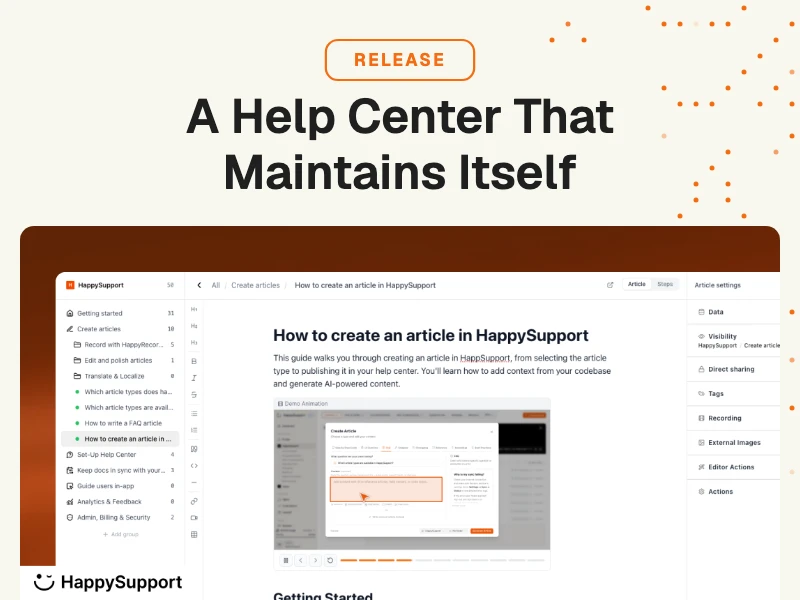
HappySupport is the self-updating Help Center platform built on this premise. The HappyRecorder Chrome extension records help articles as DOM and CSS selectors instead of screenshots, which means the system knows when a button moves, a label changes, or a flow rearranges. The HappyAgent GitHub Sync engine watches the product git repo and flags relevant pages when the underlying code changes touch the elements the article references. The result is a help center where the question is no longer "is this article still accurate" but "which articles need a 30-second review after this release." For product documentation in a fast-shipping SaaS, this is a different category from Mintlify and its alternatives, and it answers a question they do not. More on how this works in the self-updating help center deep dive and the GitHub sync documentation overview.
HappySupport sits beside your ticketing system, not in place of it. Most product teams pair a ticketing system (Intercom, Zendesk, Help Scout, Freshdesk, HubSpot Service Hub, Front, or Jira Service Management) for inbox, agent workflow, and SLAs, then add a help center layer that the ticketing tool reads from. HappySupport plugs into all of them as the always-current knowledge layer: keep your ticketing system, swap in HappySupport for the article surface that stops drifting between releases.