.png)

"Software for technical documentation" covers an unusually broad surface. API references, developer onboarding portals, runbooks, RFCs, end-user technical guides, internal engineering wikis. Each surface has different requirements, different audiences, and different failure modes. The right tool for one surface is the wrong tool for another, which is why generic "best technical documentation tool" listicles tend to be useless when an actual buying decision is in front of a team.
This article splits the technical documentation field by use case, recommends the tools that win for each use case, and is honest about the maintenance problem that hits every category equally: technical docs go stale faster than the code they document ships. We rank 12 tools across 6 use cases.
The 6 use cases that matter
- API reference documentation. Developer-facing endpoint documentation, request and response schemas, "try it" playgrounds. OpenAPI is usually the source of truth.
- Developer portal and SDK guides. Conceptual prose around the API reference, integration tutorials, authentication walkthroughs.
- Runbooks and incident response. On-call documentation, postmortems, troubleshooting guides for engineers.
- RFCs and design docs. Long-form architecture documents, ADRs, internal decision records.
- End-user technical guides. Documentation for power users, system integrators, IT admins.
- Internal engineering wiki. The catch-all for everything that does not fit the above categories: onboarding, conventions, tooling.
1. HappySupport: the customer-facing help center layer
HappySupport is the customer-facing help center for B2B SaaS, built around the one problem the rest of this list does not solve: keeping documentation aligned with the running product as the product changes. Where the developer-portal tools (Mintlify, GitBook, Redocly) handle API reference and the internal-wiki tools (Notion, Confluence) handle runbooks, HappySupport handles the UI walkthrough, troubleshooting, and onboarding surface that customers consume directly.
Where HappySupport wins
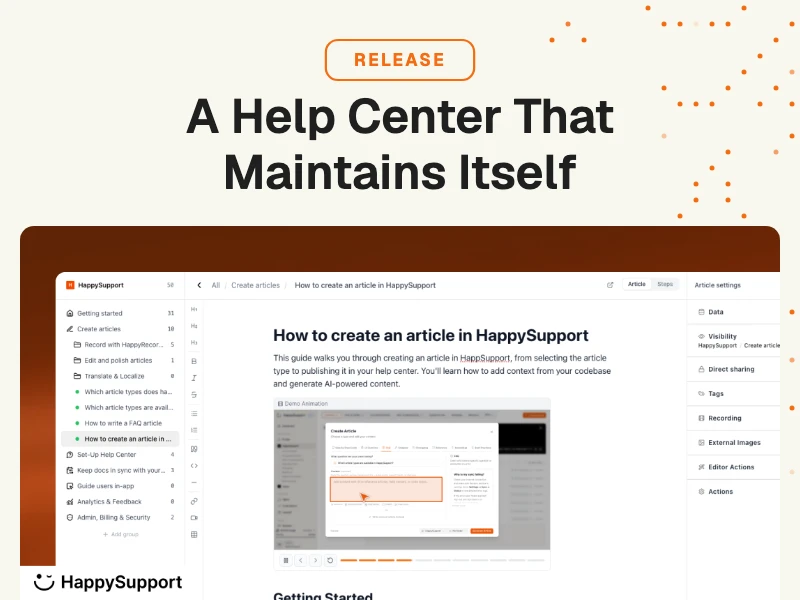
HappyAgent watches the product GitHub repo for changes affecting documented user flows and flags the affected articles automatically. HappyRecorder captures UI walkthroughs as DOM and CSS metadata so screenshots stay accurate through product redesigns. EU hosting in Germany standard, AVV-Vertrag included, DSGVO compliant. Built for B2B SaaS shipping weekly where manual maintenance does not scale.
Where HappySupport is not the right answer
Not a developer portal. Not an OpenAPI rendering tool. Not an internal wiki. Pair HappySupport with Mintlify or GitBook for the developer side, and with Notion or Confluence for the internal wiki side.
2. Mintlify and GitBook: developer portals with AI authoring
Both Mintlify and GitBook target the same buyer: a B2B SaaS company shipping a developer-facing product that needs a polished portal combining API reference, conceptual guides, and integration tutorials. Both ship MDX-based authoring, OpenAPI rendering, AI-augmented writing, and Git-based workflows.
Mintlify
Strongest on AI authoring (Writing Agent, Assistant, conversational search), the most polished default design, customers like Anthropic, Cursor, Perplexity, and Coinbase. Pro plan $250 per month for 5 seats.
GitBook
Strongest on Git Sync (bidirectional with GitHub and GitLab), the most complete AI layer of any managed platform per the GitBook team's own marketing, and slightly broader use-case coverage than Mintlify. Pricing moved to a two-part model in 2026: base site fees ($65 to $249 per month) plus per-user costs.
For the full head-to-head, see redocly vs mintlify and the wider best AI documentation tools comparison.
3. Redocly: the OpenAPI specialist
Redocly is the commercial platform built on top of Redoc, the open-source OpenAPI renderer with 25,000+ GitHub stars. For teams whose API specification is the source of truth and where deep OpenAPI 3.2, 3.1, 3.0, Swagger 2.0, AsyncAPI, and Arazzo handling matters, Redocly is the best-in-class choice. Pro at $10 per seat per month.
Redocly is the wrong choice if the documentation is mostly prose and the API reference is one section of many. Right choice if the API is the product.
4. ReadMe: interactive developer portals
ReadMe is built on the idea that API documentation should be an interactive playground, not a wall of text. Authentication flow, API key management, per-endpoint analytics, custom dashboards for SDK consumers. Customers include Pendo, Algolia, and Twilio.
ReadMe wins for API products where the developer experience inside the docs is a competitive surface. It loses to Mintlify and GitBook for prose-heavy portals where the API reference is one section among many.
5. Swagger UI and Redoc community: free OpenAPI rendering
Both are free, both render OpenAPI specs into developer-readable reference sites. Swagger UI ships with most API frameworks (FastAPI, Spring, Express, Django Rest Framework). Redoc community edition is the polished alternative.
Right for open-source libraries, small internal APIs, and any team that does not want to pay for a hosted documentation platform. Wrong for marketing-grade developer portals where the docs site is part of the brand surface.
6. Docusaurus: open-source React-based
Docusaurus is Meta's open-source documentation site generator built on React. It is free, self-hosted, MDX-based, and versioning is built in. Used by React itself, Babel, Jest, and many other open-source projects.
Right for open-source projects with an engineering team that prefers self-hosting over SaaS. Right for projects with multiple versioned releases where each major version needs its own docs snapshot. Wrong for teams that need an editor-friendly authoring experience for non-engineer contributors.
7. Sphinx: the Python documentation standard
Sphinx is the official documentation tool for the Python language itself, the Linux kernel, and most major Python open-source projects. Combines reference docs from docstrings with conceptual prose written in reStructuredText or Markdown (via MyST).
Right for Python projects. Right for long-form technical books that need cross-references, indexes, and PDF export. Wrong for non-Python teams without a strong reStructuredText background.
8. Notion: the internal wiki that ate the world
Notion has become the default internal wiki for many B2B SaaS companies. It is not a technical documentation tool in the classic sense, but it covers the runbook, RFC, design doc, and internal engineering wiki use cases at a baseline level.
Right for early-stage SaaS teams that want one tool for everything internal. Right for non-engineering teams (product, design, ops) that consume engineering documentation. Wrong for public-facing developer portals, OpenAPI rendering, or any documentation surface that needs versioning. See our wider Confluence vs Notion comparison.
9. Confluence: the enterprise default
Confluence is the most established enterprise internal documentation tool. Strong integration with Jira (incident links, ticket references), tight access controls, audit logs, SSO, SCIM. Used by enterprise engineering organizations as the runbook, RFC, design doc, and internal wiki layer.
Right for enterprises already on Atlassian. Right for engineering teams that need tight integration between docs and project work. Wrong for public-facing developer portals. Editor experience lags Notion and Mintlify materially.
10. Document360: the customer-facing technical documentation tool
Document360 sits in a different category from the developer-portal tools above. It is built for customer-facing technical documentation where the audience is power users, system integrators, and IT admins rather than software engineers. Strong versioning, multi-language support, Eddy AI, SSO at the Enterprise tier.
Right for technical SaaS companies with non-developer power-user audiences. Right for products with significant configuration surface (security tools, ITSM, networking). Wrong for products where the audience is software engineers consuming an API.
11. Slab: the developer wiki for small teams
Slab is positioned as the wiki for small engineering teams that need more structure than Notion but less complexity than Confluence. Strong search, Slack integration, simple permission model.
Right for engineering teams between 10 and 100 people that have outgrown Notion's wiki use case. Wrong for public-facing technical docs or anything that needs to be marketing-grade.
12. Doxygen: the multi-language reference generator
Doxygen reads structured comments from C, C++, Java, C#, Python, PHP, Objective-C, and Fortran source files and emits HTML reference documentation. The veteran of the category, still actively maintained.
Right for multi-language codebases. Right for C and C++ projects where Sphinx and Docusaurus are awkward fits. Wrong for marketing-grade developer portals.
Tool by use case
The maintenance problem nobody markets
Every tool above ships with a hosting layer, an editor, search, and theming. None of them ships with a mechanic for keeping documentation aligned with the running product as the product changes. The result is the universal failure mode of technical documentation: 6 to 18 months after launch, the docs lag the product.
Three approaches to the maintenance problem exist in 2026.
- Heroic manual maintenance. A dedicated docs team reviews every product release and updates affected docs. Works for teams with budget for a docs role. Scales poorly.
- Code-coupled docs (Swimm). Tie documentation to specific code snippets so that when the code changes, the doc surfaces for review. Works for internal eng docs. Awkward for customer-facing prose that abstracts over specific implementations.
- UI-state-coupled docs (HappySupport). Tie documentation to UI elements so that when the UI changes, the affected articles surface automatically. Works for customer-facing help centers. Does not replace developer-portal tools for API reference.
For the deeper analysis of why documentation goes stale and what to do about it, see the hidden cost of documentation decay.
HappySupport in the technical documentation stack
Most B2B SaaS companies need two documentation tools, not one. A developer portal (Mintlify, GitBook, Redocly, or Docusaurus) for API reference and SDK guides. A customer-facing help center (HappySupport) for the UI walkthroughs and the troubleshooting guides that ship to non-developer users.
HappySupport sits beside the developer portal. Keep Mintlify or GitBook for the API docs. Add HappySupport for the help center layer that the developer portal was never built to handle. HappyAgent watches the GitHub repo for changes that affect documented UI flows. HappyRecorder captures the UI walkthroughs as DOM and CSS metadata so screenshots stay accurate through redesigns. See how a self-updating help center works.
HappySupport does not replace Doxygen, Sphinx, JSDoc, Redocly, Mintlify, GitBook, or any other developer-facing tool. It sits beside them as the customer-facing layer. Pick the right developer-portal tool for the API. Add HappySupport for the help center.