.png)

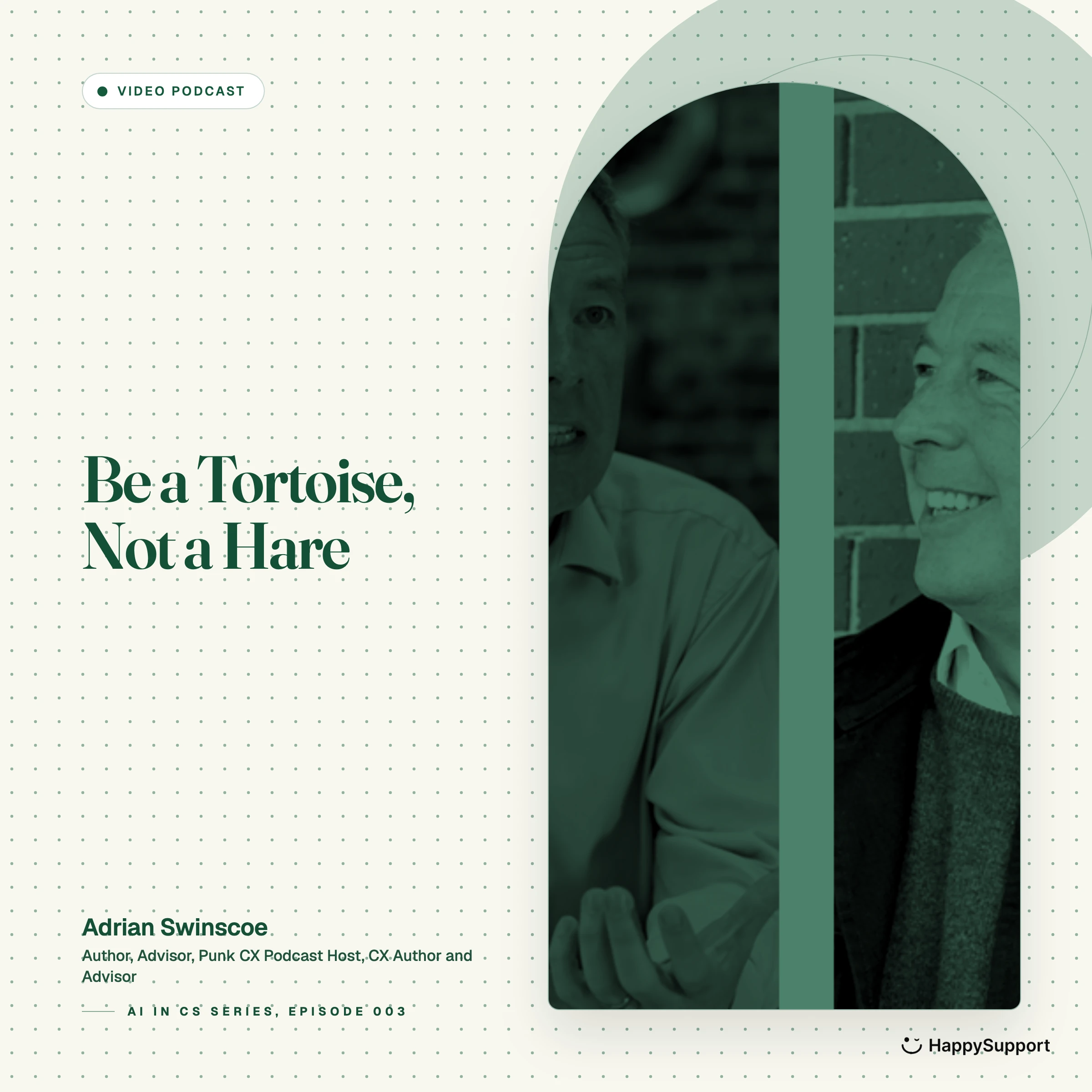
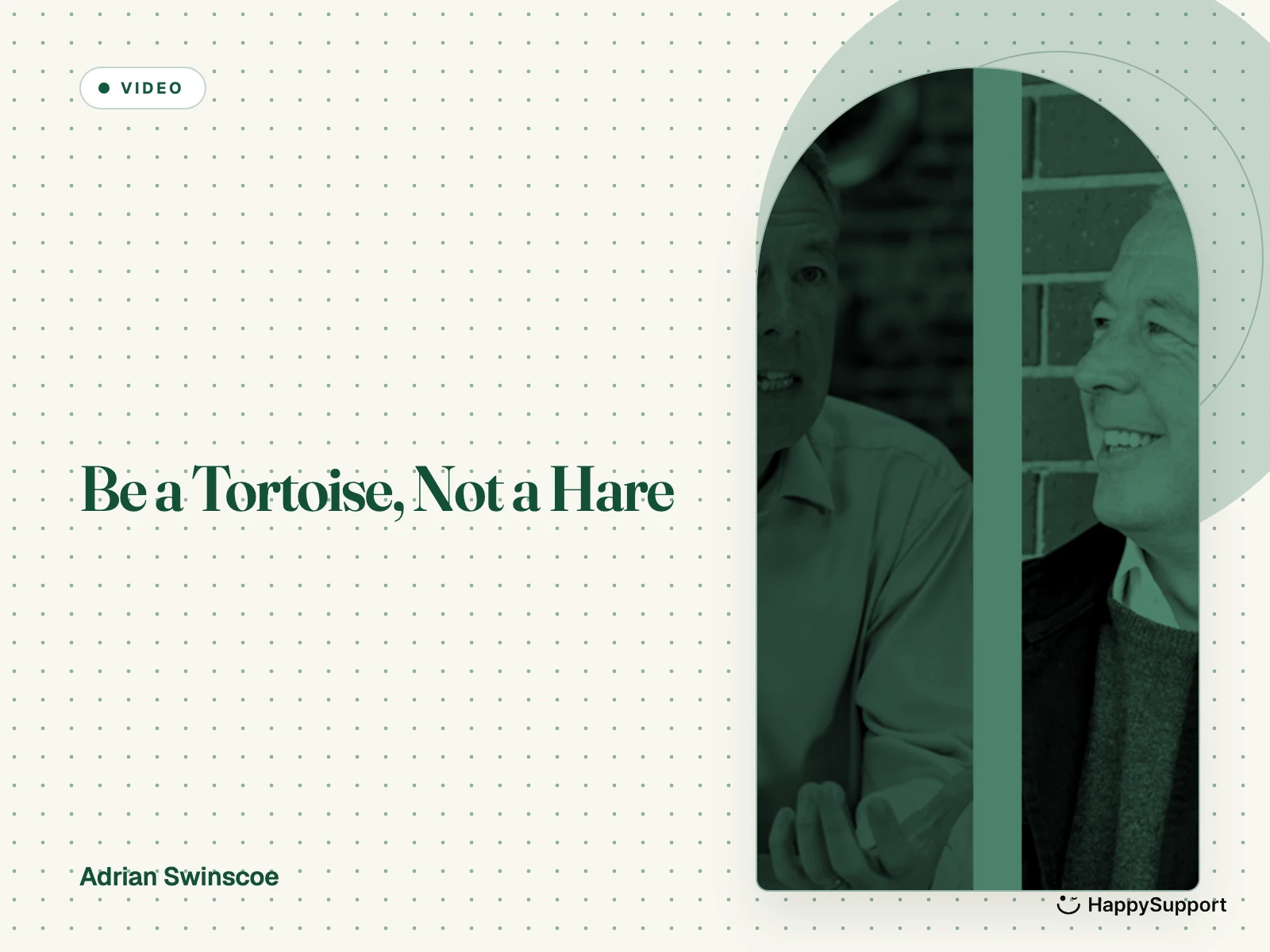
AI in CS Series, Interview #003. With Adrian Swinscoe, CX author, advisor, and host of the Punk CX Podcast. Author of How to Wow, Punk CX, and Punk XL. Contributor to CX Today and CMS Wire, and former Forbes contributor. 17 years researching and advising on customer experience, with 25+ years working across customer-focused business roles.
Adrian Swinscoe has spent the year publicly arguing that companies should not be "AI-first", do not need a separate AI strategy, and that most CX teams are bolting AI onto broken processes. He uses an Aesop fable to make the case: in the race between the tortoise and the hare, the tortoise wins because the hare burns out. Adrian thinks the same is happening in customer experience right now. Below, the case against AI-first labeling, the story of a company that turned the phones back ON instead of cutting headcount when AI freed up capacity, and the framework he uses to push CX leaders past the data-and-tech triangle into one that starts with the experience.
Q1. The Punk Thing in CX Right Now
Q: You wrote a book called Punk CX. What is the most punk thing happening in customer experience right now?
A: I wrote something recently inspired by the old Aesop fable about the race between the tortoise and the hare. You would think the hare would win. In the story the hare tears off into the lead, gets distracted, has a rest, falls asleep by the side of the road. The tortoise just keeps plodding on, plodding on, plodding along, passes the hare by, wins the race.
Right now we are in the middle of this massive technological period of evolution or revolution, particularly with AI. I see lots of people that are trying to be hares. They are just running around trying to do stuff. The more punk thing, the more contrary thing, is to be a tortoise. The people that are succeeding are the people slowing down. That can feel ironic given that punk is associated with speed and noise. But the essence of punk, not just in music but in attitude and thinking, is not being scared to do things differently. To go against the crowd. If the crowd is going that way, we go this way because that makes more sense.
Q2. The Company That Turned the Phones Back On
Q: You have an example that brings the tortoise approach to life. The company that used AI to free up capacity, then made a non-obvious decision with that capacity.
A: AI is doing a lot of things, but one of them is putting pressure on support teams to reduce costs and reduce headcount. Many people are rushing into it that way. I heard one story I thought was brilliant. An e-commerce firm, I think they were SaaS-based actually, took on AI to help their customers resolve queries quicker. They automated a lot of the very simple things. Customer outcomes improved on simple queries. A huge amount of capacity was freed up.
Rather than reducing the number of people in support, they thought: well, what are we going to do with that capacity? They decided they were going to turn the phones on. Before, they were so inundated with queries that the phone was an afterthought. Once AI handled the simple stuff, they could turn the phones on, do more outreach, spend more time with their clients, build better relationships. That is a really interesting way of describing the choices in front of every support team. Using AI in the right way, in a way aligned with your brand, can provide you with choice. You can choose to do different things with the capacity that it frees up.
Q3. Why "AI-First" Is a Mistake
Q: You have said that describing yourself as "AI-first" is a mistake. Explain.
A: Ten years ago, the big topic was big data and analytics. People wanted to be data-led, data-driven, data-first. I am seeing the same kind of language now: AI-first, AI-native. That is all great, but we also have to recognize that AI in its current form is just a tool.
If you think about it from a customer perspective, unless the product or service you are selling is depending on AI, do customers care? Or are you just signaling to the market? Say you are a publicly traded company and you go "we are AI-first." That is a signal to say to the market, look, we are innovative, we are on the leading edge, we are doing positive things. But from a customer perspective, if your service is not dependent on AI and is just supported by AI, does the customer care? The customer cares about what they get and how they get it.
I would imagine it will come to a point where every company becomes AI-native or has AI embedded in everything. So leaning in with "we are AI-first" or "AI-led" is a very temporary, very signaling thing. You become more focused on the technology than on the customer and what you actually want to do.
Q4. Where AI Should Live Inside the Company
Q: If you do not need a separate AI strategy, where does AI sit inside an organization?
A: Embedded. We need to stay true to our business strategy, our brand strategy. Any AI initiatives should be in service of that. Rather than sitting AI separately, it has to make sure it is saying: what are we trying to achieve? What can we use AI to do? There might be a sub-strategy in there. But to do AI as a separate thing again becomes the AI-first or AI-led idea. It needs to be in service of something.
In terms of ownership, CIO, risk-ops, CFO, everybody should be involved, because it all has consequences. It should sit with the person responsible for the business strategy, which goes to the CEO's office. Then the CFO matters because the economics of AI are not yet clear, particularly for companies relying on services from the frontier model providers. Token costs, usage costs, licensing costs, energy consumption: we have to understand all of that and how it enables the business strategy. That is the thing that pays everybody's bills.
Q5. What AI Already Does Well in Support
Q: Zoom out from the strategy debate. Where is AI actually adding value in customer service and customer experience right now?
A: Three places.
One: automation of simple customer queries. If you get it right with the right knowledge and the right integrations, customers do not want to be emailing or calling for answers to simple questions. Enabling self-service well is real value.
Two: AI used internally for support agents. When you have more complex queries or live interactions, using AI to suggest answers, surface history from previous conversations, propose potential solutions from your interaction corpus. Real use cases. Real productivity.
Three: analyzing data at scale to identify real problems. This is one of the most exciting and most underdeveloped areas. Surfacing insights from service and support, then piping them into product, operations, and elsewhere in the business to enable fixes on a quicker cadence. Service and support have always had the largest and fastest-growing real-time interaction database of any function in any business anywhere in the world. If you want to know what is going on with your customers, talk to the people in support. They will tell you everything. Through AI-driven analysis and automation, we are seeing convergence of functions across the connected enterprise.
Q6. Three Levels of Leadership in CX
Q: You said earlier that "experiences compel us." Walk through what you mean by the three levels of leadership.
A: Level zero is wandering around doing the thing, ignorant of what is going on. Level one is using data to inform. Reports, dashboards, structured data. Fine.
Level two builds on that. Stories move us. When you add unstructured data and qualitative data, you start adding color, context, nuance, voice. You are not just looking at data points and trends. You are starting to hear voices.
The third level: experiences compel us. When you visit, when you take the time out to listen to a customer trying to solve a problem, or you listen to a support agent in real time, you experience something. You cannot unfeel the way you feel when you hear that happen. If you have any pride about what you are trying to do, you cannot ignore it. Data is easy to ignore. Stories are easy to brush off. Experience compels you to do something different.
Q7. The Two Triangles for AI Decisions
Q: If a SaaS leader is sitting down to plan their AI roadmap right now, what framework would you give them?
A: Two triangles. I learned the first one from the Copenhagen Institute for Futures Studies. On one apex are forces pulling you into the future: the promise of technology, market changes, your own strategy. On a second apex are forces pushing you into the future: your strategy again, market expansion, regulatory changes. Those are the forces people tend to focus on. The third apex is the one most people miss: your present-day anchors. Your culture, your technological infrastructure, your AI literacy. You have to be realistic about where you are at, because that dictates how you can move into the future.
The second triangle has Experience on one apex, Technology on another, Data on a third. Most people end up focusing on the tech and the data. They forget those are inputs into the experience you want to deliver. I always say: envision the experience first. Think about how it works across the journey, how it changes for different parts of the journey, how it changes for different customers. At each point, what is the human and tech balance you want to achieve? Then ask: what data and technology do I need to enable that experience? When you have that, you have a much clearer idea of the technology choices and data choices that actually serve the customer.
Q8. Three Names
Q: Three voices our audience should be following right now.
A: Cory Doctorow. A journalist, sci-fi writer, advocate. He has been around for years. Fantastic thinker on the implications of AI broadly, not specifically in customer experience. Real food for thought.
Renate Munson. A younger voice in the experience space. Promoting an almost human-first approach. Doing a great job of putting empathy back into the work.
And Clare Muscutt and the Women in CX community. They are doing great work leading into the experience space and amplifying voices that are not heard as often as they should be. Worldwide reach. Representatives in Germany, across Europe, the UK, Ireland, North America. Definitely worth checking out for alternative perspectives.
Henrik's Outro
The Aesop framing is the part that stuck with me. Most CX teams are reading "AI-first" as the directive and rushing. Adrian is making a different argument: the directive is "customer-first" and AI is a tool that serves it. Slow down, define the experience you want, then build the data and tech stack that gets you there. The example of the company that used the capacity AI freed up to turn the phones back on, not to fire people, is the most punk thing I have heard in CX this year. If you lead a CX function in 2026, our State of Self-Service in SaaS 2026 survey wants your view on this.
Connect with Adrian: adrianswinscoe.com | LinkedIn | Punk CX Podcast | How to Wow, Punk CX, Punk XL