.png)

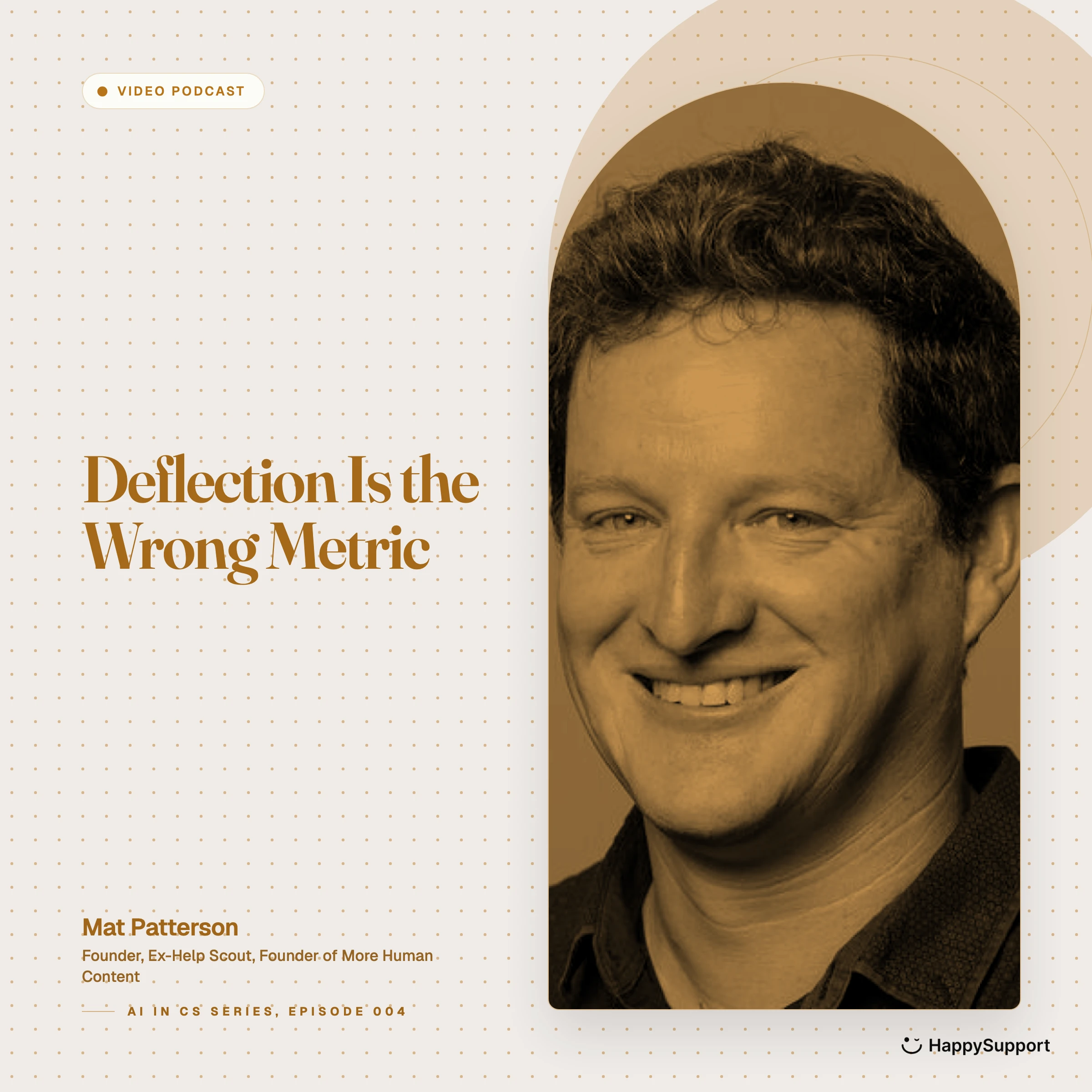
AI in CS Series, Interview #004. With Mat Patterson, founder of More Human Content. Ten years at Help Scout as the voice of The Supportive column. Twenty-plus years in customer service leadership. Based in Wollongong, Australia.
Mat Patterson spent a decade inside Help Scout writing about what good customer service looks like. He has now started his own venture, More Human Content. The transition gives him a fresh "what I would do differently" lens to bring to the AI moment. Below, the question every support pro is asking that nobody had to ask in 2018, why deflection is the wrong framing for the metric we should actually optimize, the case that there will never be a zero-person support team, and the moment AI starts making content trend to the mediocre middle unless you give it a point of view.
Q1. The Question Nobody Could Ask in 2018
Q: What is a question support pros are asking in 2026 that you would have laughed at six or eight years ago?
A: Anyone listening can probably guess. The question is: is this robot going to replace me?
In 2016 to 2018, when I started at Help Scout, we had chatbots. But they were very rules-based, pretty inflexible. Nobody thought the chatbots we had then could replace people. They could supplement people. Microsoft released that chatbot that turned out to be racist, do you remember? It was a fun time.
Whereas today, it is an open question. How much of what we have traditionally done as people in customer support is going to still need a person, and how much will be done by AI? I do not know that the answer is clear yet. But it is a real question in a way that it just was not ten years ago.
Q2. What to Tell Teams That Are Afraid
Q: What do you tell support teams who are afraid of being replaced?
A: It is a real feeling and I do not blame anyone for feeling it. We are all uncertain about how it shakes out.
My personal view in the longer term: people will still be needed to deliver customer service. The way the job is done will be different. There will always be space and a need for humans to connect with other humans. A lot of support is essentially: the answer already exists in a knowledge base somewhere and your job is to get it to the person. Big chunks of that can be done by a computer, no problem. But there is a lot of support that is "I need someone to listen to me and help me figure out what I actually need." Tons of those jobs will still be there. In the interim period while we figure out where those borders are, it is going to be chaotic. We have to hang on to what is important to us individually.
Q3. Deflection Is the Wrong Framing
Q: A lot of support teams chase deflection rate as their north-star metric. You think that is wrong. Why?
A: I understand the desire. If you can avoid a support ticket, you are saving money and time. Fair enough. I like money too. But I think deflection is fundamentally the wrong framing for customer service. We do not want to deflect people. We want them to get their answer.
That answer might come through AI. It might come through a person. It might be some combination of self-service, AI, and human. But if you are thinking deflection, you are not distinguishing between two completely different things: this person did not need to submit a support ticket because they got their answer, AND this person did not get their answer, they just gave up because they got sick of the process. Those are very different. They get lumped together under deflection. The metric we should track is: of the people who had problems, how many did we get help to?
Q4. The Skill That Wins in the AI Era
Q: If you boiled down the most important skill for support people in the next five years, what is it?
A: Curiosity. As a skill, or even as a mindset. It was important before AI. It is even more important now. We are going through this huge change and everybody is struggling with what it means. Being curious is the best way to find your path forward. And being curious about what the customers are going through, how to help them through their own transition: that is what builds the next generation of trust with the people you serve.
The other one is listening. AI is super good at reading everything. It can spot patterns and gaps that individual humans cannot. But people still need to listen carefully to one customer at a time. Both skills together is what wins.
Q5. Where AI Genuinely Helps Support Content
Q: You spent a decade thinking about support content. Where does AI actually add value in this work?
A: Two areas.
One is reading at scale. Early on if you have one or two people in support, you can almost read every conversation. Once you grow past a few people, no one's mind holds all the conversations anymore. Patterns and trends become invisible. AI is super good at reading everything all the time. It can spot the gaps for you. It can suggest "there appears to be an answer missing here." It can find similar questions already answered by your team and draft a new article from that. You are not starting from 0 percent. You are starting from maybe 80 percent. Huge time saver.
Two is automating the maintenance work. Once you identify the right answers and the documentation, there is just a bunch of work to keep it current. Product teams are getting the push to use AI, to release more often, to add features more quickly. How do we keep up on the documentation side? Going to be quite difficult. If product is using AI, support should use AI too. If you did a product release today, do you have to go take 27 screenshots to reflect the change, or can a computer do that for you? That seems like something a computer should be able to do.
Q6. The First System You Build for Support
Q: A new SaaS company is setting up customer service. What is the first thing they build?
A: Do not start with the system. Start by figuring out what experience you want customers to have when they need help. What should it look like? How should they feel? When someone gets support from us, they should feel like someone listened, they should feel understood. Write that down.
That informs the system. Then in 2026, I would assume the entry point to support is some kind of AI-mediated self-service tool. Most people needing help will start there. So you need a system that, based on a text corpus of customer service answers, can give people help in lots of different ways.
But do not assume zero people. I do not think a zero-person support team is going to exist. There will always be people. The question is how many and what they are doing. That depends on the product, the margins, and the experience you said you wanted to deliver.
Q7. The Mediocre Middle
Q: Your new venture is called More Human Content. Why does that matter as a business strategy, not just a values statement?
A: Small companies rush too quickly into acting like big companies. Big companies are not fun to deal with. They do not feel like a person anymore. They feel like rules and processes to navigate.
Being more human is staying close to the customer where you can. From a support perspective, when something goes wrong, it is not just a faceless machine you are trying to reason with. There is contact with a person who can listen, understand, take responsibility. That last one is the key. AI can be helpful but it cannot take responsibility. It cannot stand behind a decision. It does not understand why it made the decision in the first place.
Generative AI is producing a huge amount of content. If you rely on it for your customer-facing content, you trend to the mediocre middle. That is what AI does. It is not anyone's fault. It is the way the systems are trained. Companies that have a point of view, an opinion, a perspective will stand out. Differentiation is so important right now because everybody is using the same set of tools to generate copy, the same imagery. How do people stand out, how do they know why to go with you over anyone else? That is the work.
Q8. The 5-Year Bet
Q: Five years from today, where are we on the "AI replaces support" prediction?
A: I think we are going to look back and recognize that the people who were worried jobs would be eliminated will say "boy, they are still going to one day eliminate all the jobs." But it is not happening right now. Five years from now, it still will not be.
That said, the way the work is done changes. There are use cases where you do not need a person and that is fine. I have stayed in hotels that are a little too fancy where someone wants to show me where the TV is. I have flown halfway around the planet from Australia. I just want to be left alone. An automated solution there is perfect.
The shape of the team changes. The skills change. The number of people on certain types of tickets goes down. The number of people on the messy human-to-human tickets stays. Or grows.
Henrik's Outro
The deflection point is the one I will not stop thinking about. Half the metrics in support reporting today combine "they got an answer" with "they gave up." Mat is right that those are very different signals and we should separate them. The "more human content" frame as a competitive moat in a world of AI-generated mediocrity is the second piece I am going to steal. If you lead a CX function in 2026, our State of Self-Service in SaaS 2026 survey wants your view on that.
Connect with Mat: morehumancontent.com | LinkedIn | The Supportive column on the Help Scout blog