The promise of a help center is simple: customers find answers themselves, the support queue shrinks, the team spends time on problems that actually need a human. Most support leaders believe this promise. Most help centers don't deliver it.
The gap between "we have a help center" and "our help center deflects 30% of tickets" is almost never about article count. It's about accuracy. A customer who finds a help center article describing a workflow that no longer exists doesn't become a deflected ticket. They become an angry ticket that takes twice as long to resolve because the customer has already tried the wrong thing and is now frustrated.
This is the part of ticket deflection that most guides skip: the trust problem. A help center reduces support tickets only when customers trust it enough to check it before contacting support. Every stale article that gives wrong information chips away at that trust. The result is a help center that customers stop using precisely when it should be most valuable.
Why most help centers don't actually reduce ticket volume
High ticket volume isn't always a coverage problem. Before adding more articles, it's worth diagnosing what type of problem you actually have.
Support queues fill up for three reasons: questions your product hasn't answered anywhere, questions your product has answered somewhere customers can't find, and questions your product answered correctly at some point but the answer is now wrong because the product changed. The third category is the most expensive and the least discussed. It's also the one that self-service investment makes worse, not better. A stale help center gives wrong answers with more confidence than a support agent who would at least notice the product looks different from the documentation.
According to Zendesk's customer experience research, 69% of customers prefer to resolve issues independently when given accurate self-service resources. The operative word is accurate. Customers don't prefer self-service regardless of quality. They prefer it when it works. When it doesn't, they file a ticket and they remember the friction.
The distinction matters because most support leaders diagnose high ticket volume as a coverage problem ("we need more articles") when it's actually an accuracy problem ("the articles we have describe a product that no longer exists"). Writing more articles into a help center that customers have stopped trusting produces diminishing returns. Fixing the accuracy problem first changes the economics entirely.
What percentage of support tickets can a help center actually deflect?
A well-maintained help center deflects 25 to 40% of inbound support tickets under normal operating conditions. Teams with structured in-app contextual guidance layered on top of the help center see deflection rates in the 35 to 45% range, because contextual help intercepts the question at the moment of confusion rather than waiting for the customer to search.
The business case compounds quickly. According to benchmarks from SuperOffice's customer service research, live agent interactions cost dramatically more per contact than self-service channels. For a team handling 2,000 tickets per month, a 30% deflection rate eliminates 600 tickets. The capacity freed by those 600 tickets goes to complex issues that actually need a human, which improves both resolution quality and agent satisfaction.
But these numbers assume the help center is maintained. A deflection rate that starts at 30% and drops to 12% over six months as documentation drifts from the product isn't a net positive. It's a compounding liability. The KCS methodology, developed by the Consortium for Service Innovation, identifies knowledge article useful life at approximately six months. Without active maintenance, most articles drift from reality before the end of their first year.
Why help centers fail to reduce tickets: the trust and accuracy problem
Documentation accuracy degrades in a predictable pattern. A team ships a feature. Engineering merges a pull request. A menu item gets renamed. A workflow gets restructured. The help center has no idea any of this happened. The article describing that menu item continues describing a product that no longer exists, sitting at the top of search results, sending customers down a path that ends in failure and a support ticket.
The speed of shipping makes this structural. A team releasing bi-weekly cannot manually audit all affected documentation every two weeks. An article from six months ago describing a deprecated workflow will keep generating tickets indefinitely unless someone specifically hunts it down. This is what the hidden cost of documentation decay looks like at scale: not dramatic obsolescence, but a slow drift from reality that erodes the help center's usefulness article by article.
The compounding effect is what most guides miss. One wrong article generates tickets directly. It also trains customers to stop checking the help center before contacting support, which increases ticket volume across all categories, even the ones the help center does cover correctly. Trust, once lost through a stale article, has to be rebuilt through consistent accuracy over time.
8 tactics to reduce support tickets with your help center
These tactics work in rough order of leverage. Start with accuracy before adding volume.
1. Audit for the highest-volume ticket categories first
In most support queues, 20% of question types generate 80% of ticket volume. Identify those categories by tagging tickets for two weeks. Build or improve articles for those categories first, and keep them accurate above everything else. A help center with 10 excellent, accurate articles about high-volume topics deflects more tickets than a help center with 200 stale articles covering everything.
The audit also tells you whether your ticket volume is a coverage problem or an accuracy problem. If the high-volume categories have no articles, you have a coverage gap. If they have articles that customers read before filing tickets anyway, you have an accuracy gap.
2. Tie article updates to release cycles
The most reliable way to keep help center content accurate is to treat documentation updates as part of the release process, not a follow-up task. When a feature ships, the articles that describe that feature should be reviewed and updated on the same day. Not when someone notices tickets piling up.
This requires a defined product-to-support documentation handoff: a process where the support team knows what's shipping before it ships, has time to review affected articles at feature freeze, and publishes updates at the same time as the release. Teams that get this right treat documentation staleness as a release blocker, not a postmortem item.
3. Put help where users are, not where you put it
A help center that requires opening a new browser tab and searching costs more customer effort than one that appears inside the product at the moment of confusion. In-app contextual guidance, surfaces that detect where the user is and surface the relevant article or guided tour, consistently outperforms search-and-find help centers for activation and how-to use cases.
The reason is effort. Research from Harvard Business Review consistently identifies customer effort as the primary driver of support contacts. When documentation reduces effort, deflection rates rise. When it adds effort, wrong tab, wrong article, wrong instructions, customers abandon the help center and file a ticket.
4. Fix help center search before adding more content
Most help center search implementations are optimized for exact keyword matching. Customers search in natural language. The gap between "how do I export my data to CSV" and "data export" produces a poor search experience even when the correct article exists. A search failure rate above 15% (percentage of searches returning zero results) is a strong signal that the problem is findability, not coverage.
Search failure analysis is also one of the most direct sources of article ideas. Every zero-result search query is a documentation gap that customers have already identified for you.
5. Use analytics to find articles that generate tickets, not deflect them
The direct deflection rate formula for any article category is: help center article views divided by (article views plus tickets filed for the same category). If 1,000 people viewed an article and 800 filed a ticket for the same question, that article isn't deflecting tickets, it's confirming that the answer isn't in the help center, or confirming the wrong answer.
Articles with high view counts and high same-category ticket rates are your highest-leverage improvement targets. They're not failing because nobody reads them. They're failing because they don't solve the problem.
6. Track the article staleness index as a leading indicator
The staleness index, the percentage of your article inventory not updated in the last 90 days, predicts future ticket volume increases before they arrive in the queue. A staleness index above 40% in a product that ships bi-weekly means roughly half your help center is describing a product that changed weeks or months ago.
This metric is more actionable than deflection rate alone because it's a leading indicator. Deflection rate tells you what already happened. Staleness index tells you what's about to happen. Teams that track both can intervene before the trust erosion starts rather than diagnosing it after tickets have already spiked.
7. Add media that matches different learner types
Text-only documentation misses users who learn faster from video or visual step-by-step content. Screenshots, short GIFs showing exactly which button to click, and video tutorials for complex workflows all improve self-service resolution for users who struggle with text instructions. A help center with mixed media formats consistently outperforms text-only documentation on deflection metrics for procedural content.
8. Connect AI to documentation that's actually accurate
AI chatbots are the fastest-growing category in customer service infrastructure. The problem is the prerequisite: an AI chatbot connected to stale documentation doesn't deflect tickets. It deflects them incorrectly, at high confidence, which damages trust faster than no automation at all. The customer follows wrong instructions, fails, and files a ticket, now also frustrated by the wrong automated advice.
AI deflection only works when the underlying documentation is accurate. The data quality problem has to be solved first. Before connecting any AI layer to your help center, run a content audit to identify articles that describe features that no longer exist, workflows that have changed, and terminology that differs from the current product UI.
How to measure ticket deflection from your help center
Deflection measurement falls into two methods: direct and indirect. Both are useful. Together they give a complete picture.
Direct method: track the ratio of help center article views to ticket submissions by category. If 5,000 people viewed articles about account settings last month and 500 filed tickets about account settings, that's a 90% deflection rate for that category. If 5,000 viewed and 4,000 filed tickets, the category has an accuracy or coverage problem that's driving contacts rather than preventing them.
Indirect method: compare ticket volume to help center traffic over time. After improving an article or publishing a new one, watch for a corresponding drop in tickets for that question category over the following two weeks. No drop means the article has a coverage or accuracy problem. A drop confirms the article is working.
Three metrics to track consistently:
- Deflection rate by category: ticket volume per question type relative to help center article views for that type; shows where the help center is working and where it isn't
- Search failure rate: percentage of help center searches returning zero results; anything above 15% indicates a findability problem, not just a coverage gap
- Staleness index: percentage of the article inventory not updated in the last 90 days; the leading indicator for future deflection rate decline
The documentation freshness factor: why accuracy beats article count
The central insight that most ticket deflection guides miss: a help center that doubles in size but stays 60% stale will not double its deflection rate. It may not improve deflection at all. Documentation volume without maintenance produces a help center that customers learn not to trust, which undermines every other deflection investment.
The teams with the highest long-term deflection rates are not the teams with the most articles. They're the teams whose existing articles are most consistently accurate. This is a maintenance problem, not a writing problem. And it gets harder as shipping frequency increases.
The structural fix is connecting documentation maintenance to the engineering workflow. When a developer changes a UI element in a pull request, the documentation system should detect the change and flag or update the corresponding article before customers encounter stale content. This is what building a help center that keeps pace with the product actually requires: not just good writing practices, but a technical connection between the code that changes the product and the documentation that describes it.
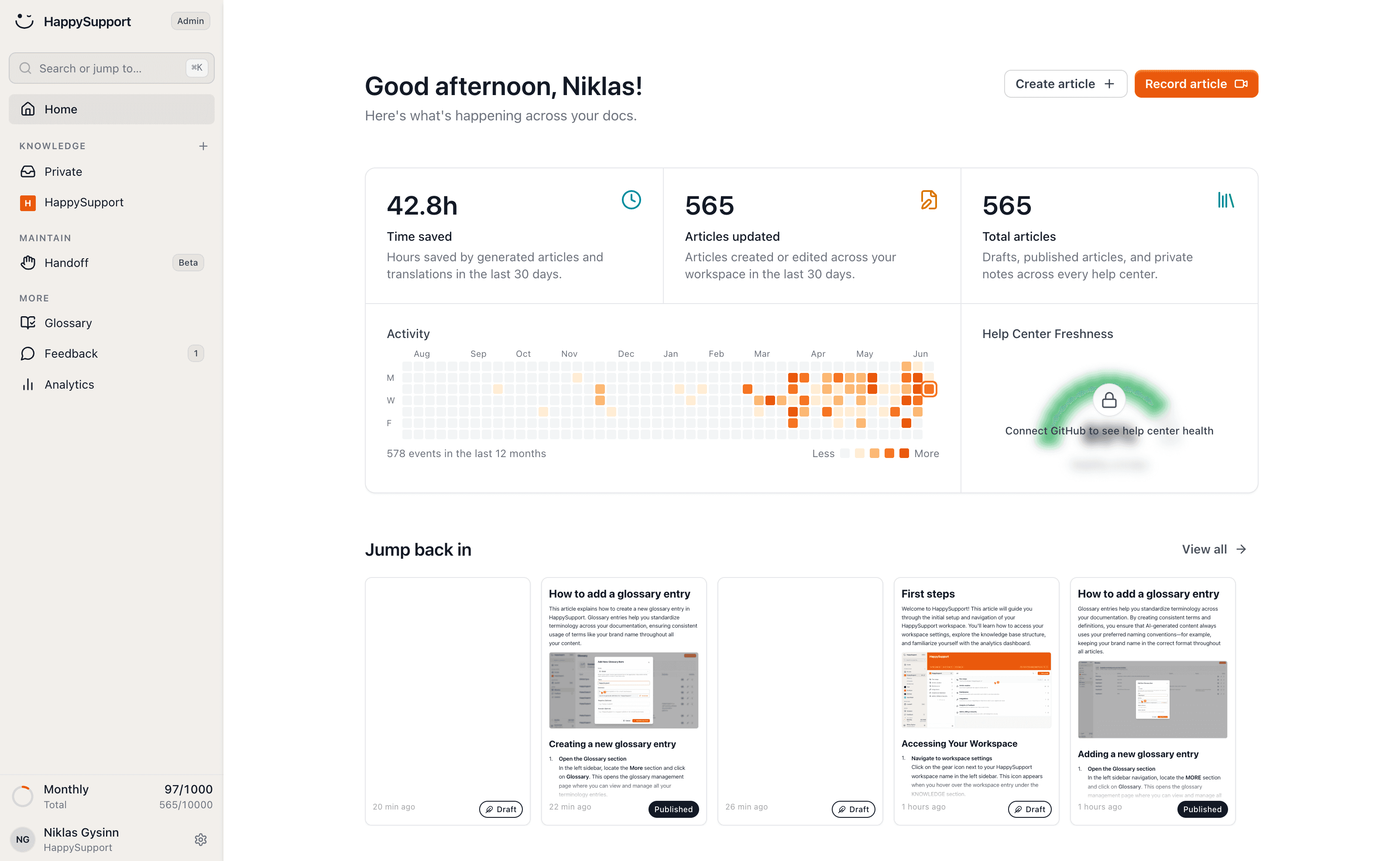
HappySupport's HappyAgent connects your GitHub repository to your Help Center. When a PR merges, the Support Lead sees which articles are flagged as potentially outdated based on what changed in the codebase: CSS selectors, DOM structure, UI strings. The documentation stays current not because someone remembered to update it, but because the update trigger is built into the engineering workflow. That's the difference between a deflection rate that grows over time and one that erodes with every release.
Building a self-service culture your team will actually maintain
A help center is infrastructure. Like any infrastructure, it degrades without maintenance. The teams that sustain high deflection rates over time treat documentation maintenance as a recurring responsibility, not a project that ends at launch.
Practically, this means three things. First, the Support Lead has direct publish access to the Help Center: no ticket to marketing, no engineering approval needed to update an article. Frictions that block updates ensure updates don't happen. Second, documentation updates are part of the definition of done for every feature release: a release is not finished until the affected articles have been reviewed. Third, the support team has a regular channel to push documentation gaps back to product, so the knowledge transfer from customers flows up the chain instead of staying buried in the ticket queue.
Teams that build these habits find that deflection rate becomes a lagging indicator of documentation health. When articles stay accurate, customers trust the help center. When customers trust the help center, they check it first. When they check it first, tickets fall. The flywheel runs in both directions. Once trust erodes, rebuilding it is slower than maintaining it was.
 Book a demo