

Help Scout Docs pricing is one of the simpler questions in the help-center market, because Help Scout publishes a clean tier table and does not hide its prices behind quotes. The complication is that Docs is not sold standalone. It comes bundled into Help Scout plans (Standard, Plus, Pro), and the value you get from Docs depends on which Help Scout plan you pay for. Most pricing articles list the three plans and stop. That table is accurate. It is also incomplete. The per-user math grows quickly, additional docs sites cost extra, the AI Answers add-on bills per resolution, and the published per-user price is the cheaper half of what you actually pay over three years. The other half is the labor of keeping Docs articles accurate after every product release, and no Help Scout pricing comparison surfaces it.
This article walks through every Help Scout plan, what each tier includes for Docs, the additional docs site cost, AI Answers pricing at $0.75 per resolution, the true total cost of ownership at 5 and 20 users over three years, and what to verify before you sign. Then a short alternatives section for teams that realize at the end that they are paying for a help center that publishes well but does not maintain itself.
What is Help Scout Docs?
Help Scout Docs is the knowledge base and help center module bundled into Help Scout plans. It is not sold standalone. To get Docs, you buy a Help Scout plan, and the Docs capabilities scale by tier: the number of docs sites you can run, whether Docs is included or paid as an add-on, and what AI features attach. Standard ($25 per user per month annually) includes Docs as a $10 per user add-on, while Plus ($45) and Pro ($75) bundle Docs at no additional cost.
Docs as a product covers article authoring, collections (the Help Scout term for sections), a public help center theme, search, custom domains, Beacon embedded help on your website, and on the AI Answers add-on a generative answer surface that pulls from your articles. What Docs does not do, the part the pricing page is silent on, is tell you when an article has gone stale because the product changed. That is the cost we will return to.
Help Scout plans and what each tier includes for Docs
The current Help Scout plan lineup as of 2026 has three paid plans plus a Free option for one user. Every price below is per user per month, billed annually. Monthly billing runs 16 percent higher. There is also a free trial available for all paid plans.
| Plan | Price (annual) | Docs included? | Docs sites | Other Docs notes |
|---|---|---|---|---|
| Free | $0 | Limited | 1 | 1 user, very basic Docs functionality |
| Standard | $25/user/month | Add-on at $10/user/month | 2 | Unlimited articles per site, Beacon basic |
| Plus | $45/user/month | Included | 3 | Custom domain, advanced reporting, multiple inboxes |
| Pro | $75/user/month | Included | 5 | Advanced security, HIPAA, custom roles, concierge onboarding |
What "Docs as add-on" on Standard actually means
Standard at $25 per user per month does not include Docs. To turn on Docs, you pay an additional $10 per user per month, raising the effective Standard price to $35 per user per month for any team that uses the help center seriously. A 5-user team on Standard with Docs pays $175 per month, or $2,100 per year. Plus at $45 per user per month, which includes Docs and adds a custom domain plus a third docs site, costs the same 5-user team $225 per month. The $50 per month gap is small enough that most teams that need Docs end up on Plus, not Standard.
What changes at Plus
Plus adds custom domain for Docs (run your help center at docs.yourcompany.com instead of yourcompany.helpscoutdocs.com), advanced reporting, multiple shared inboxes, and one extra docs site (three total). For most B2B SaaS teams running Help Scout seriously, Plus is the realistic floor, not Standard.
What changes at Pro
Pro is bought for procurement-grade controls, not Docs features. The reason teams pay $75 per user per month is HIPAA compliance, advanced security (IP allowlisting, SSO at upper tiers), custom user roles, audit logs, and concierge onboarding. Docs sites go up to 5, which matters for multi-brand or multi-product teams. For a 20-user team in a regulated industry, Pro is the floor.
Additional Docs sites and Beacon costs
Every Help Scout plan includes a fixed number of Docs sites: 1 on Free, 2 on Standard, 3 on Plus, 5 on Pro. Additional Docs sites beyond the included count bill at $20 per month each on annual billing, or $24 per month on monthly billing. For a team running one product on one brand, this is irrelevant. For a multi-product team or a team that wants a separate internal knowledge base alongside the customer-facing one, this line adds up quickly.
Beacon: free, but with a catch
Beacon is Help Scout's embedded help widget for your website or app, similar in spirit to Intercom's Messenger or Zendesk's Web Widget. Beacon is included on all paid plans. The catch is that Beacon Answers (the AI-powered answer surface inside Beacon) is the same product as AI Answers on the Docs side, and AI Answers is a paid add-on at $0.75 per resolution. So Beacon itself is free; Beacon's AI brain is metered.
AI Answers add-on at $0.75 per resolution
AI Answers is Help Scout's generative answer surface. It draws answers from your Docs articles and serves them inside Beacon, on the Docs site, or in agent reply suggestions. It is sold as an add-on across all paid plans, priced at $0.75 per successful AI resolution.
What $0.75 per resolution means in practice
A 5-user team with 2,000 monthly conversations and a 25 percent AI resolution rate generates 500 resolutions per month at $375, or $4,500 per year. That is more than the entire Plus license for 5 users at $2,700 per year, before AI Answers is even turned on. For Help Scout buyers, AI Answers is the line that determines whether the bundled-cheap-helpdesk economic case still holds. At low volume, it does. At high volume, AI Answers can become the largest single line on the invoice.
The AI Answers accuracy problem the pricing page does not mention
AI Answers reads from your Docs articles. When an article is six weeks behind the product, AI Answers will paraphrase the stale information back to customers in clean prose. The customer trusts the answer because the format suggests authority. The support team finds out two days later when the ticket arrives. This is structural to every AI-on-top-of-static-docs architecture: the AI is only as accurate as the source articles, and the source articles are only as accurate as the last manual update.
Help Scout Docs total cost at 5 and 20 users over three years
License cost is the visible line. AI Answers and additional docs sites are stacked variable lines. Maintenance labor is the invisible third one. Every Help Scout Docs deployment that survives past month six requires somebody to update articles when the product ships, audit dead content quarterly, fix screenshots after UI changes, and keep multi-site content aligned for teams running more than one docs site. For most SaaS teams shipping weekly, that work runs 6 to 10 hours per month per docs site. Fully-loaded support and docs labor at $75 per hour in the US, or 65 to 70 euros per hour in DACH, makes this a real number.
5 users, Plus plan, three years
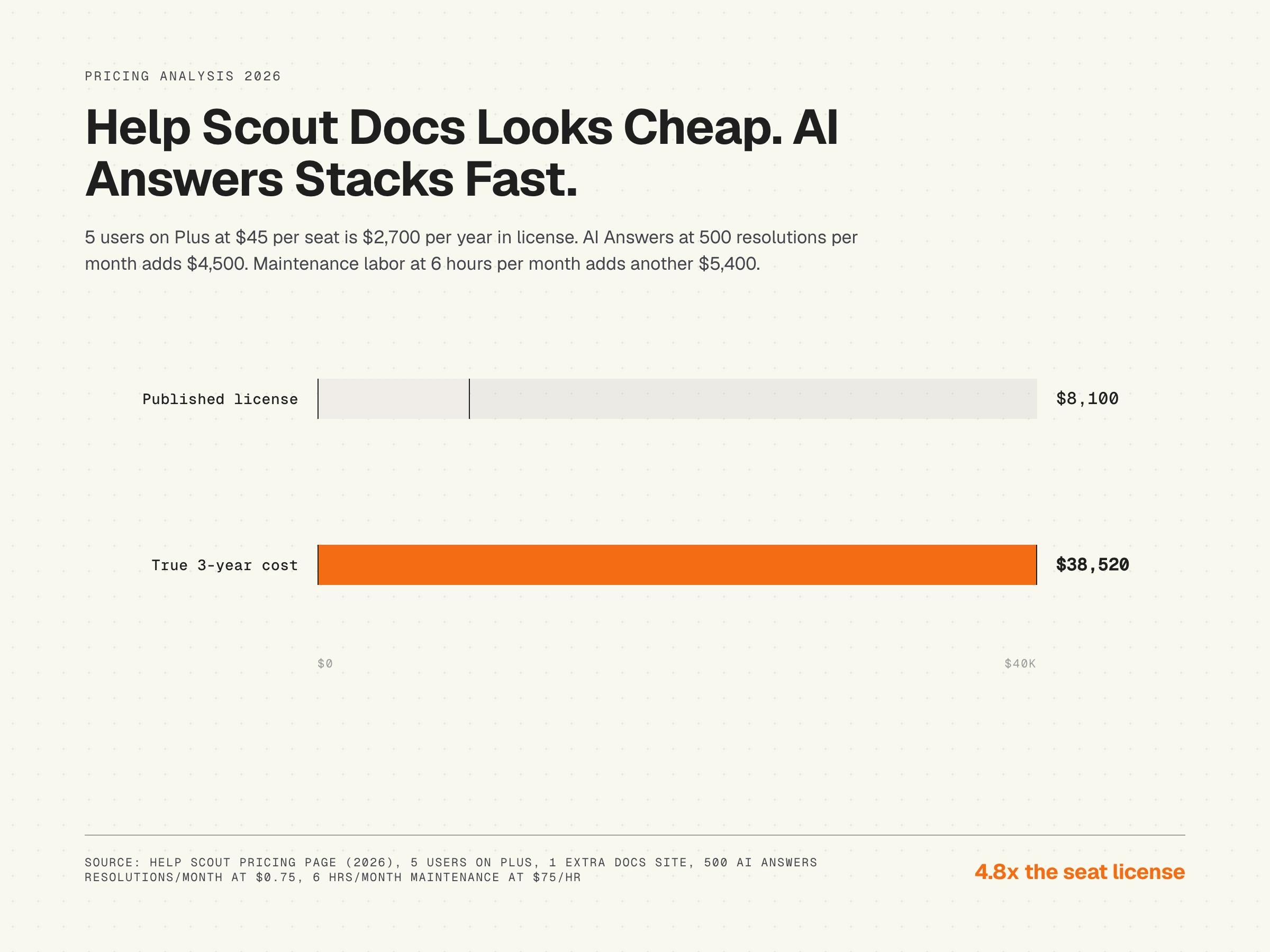
Plus license: $45 x 5 users x 36 months = $8,100. One extra docs site at $20 per month for 36 months: $720. AI Answers at 500 resolutions per month at $0.75: $13,500 over 36 months. Maintenance labor at 6 hours per month at $75 per hour: $16,200. Total: $38,520. License is 21 percent of the three-year cost. AI Answers is 35 percent. Maintenance is 42 percent.
20 users, Pro plan, three years
Pro license: $75 x 20 users x 36 months = $54,000. AI Answers at 2,000 resolutions per month at $0.75: $54,000. Maintenance labor for a multi-product team at 16 hours per month at $75: $43,200. Total: $151,200. Notice that AI Answers alone matches the entire license bill, and maintenance labor is the second-largest line at 29 percent of total.
The breakdown matters because it changes how you should think about the price. You are not buying a help center. You are buying a help center plus a recurring AI deflection commitment plus a labor commitment that scales with how often the product changes. If the product ships weekly and Docs articles fall behind, AI Answers gets confidently wrong, and the resolutions you paid $0.75 for become tickets you pay agent time to fix. Documentation decay is the hidden cost of every help center, and Help Scout Docs is no different from its competitors on this dimension.
The Docs maintenance cost no Help Scout pricing article mentions
Help Scout Docs is excellent at publishing. The editor is straightforward, the collections model is clean, and the Beacon integration is well-built. What Help Scout Docs is silent on is whether the articles it publishes are still correct three months after they were written. The platform has no concept of "this article references a UI element that no longer exists in your product." There is no link between code changes in your product and content drift in the Docs site. When the product team ships a UI change on a Tuesday, the Docs article is wrong on Tuesday afternoon. Nobody on the support side knows until AI Answers starts citing the stale paragraph back to customers, or until a ticket arrives.
This is structural, not Help Scout-specific. Every traditional help center has the same blind spot. The cost shows up as agent time fixing what AI Answers handed out wrong, as customer-success time correcting incorrect onboarding flows, and as the eventual cost of replacing every screenshot that broke after a product redesign. For teams shipping weekly, the maintenance interval needs to match the release interval. Most teams set up a monthly content review, fall behind by month four, and either accept the drift or hire a dedicated docs person.
Help Scout Docs hidden costs and what to verify before signing
The published per-user price is the floor. Six categories of cost stack on top before your effective spend reaches reality. Verify each one in writing before you sign a multi-year contract.
- Annual vs monthly billing. Annual unlocks the 16 percent discount. Monthly billing is offered but at list price. Multi-year deals can negotiate further but are uncommon at Help Scout's price band.
- Docs add-on on Standard. Standard at $25 per user per month does not include Docs. The $10 per user per month Docs add-on raises the effective Standard price to $35 per user. Verify whether you are quoted Standard with or without Docs.
- Additional docs sites. Each docs site beyond the plan's included count costs $20 per month on annual or $24 per month on monthly. Multi-brand or multi-product teams stack this fast.
- AI Answers resolution overage. AI Answers bills at $0.75 per resolution, uncapped. Set a hard ceiling in the contract or commit to a volume tier.
- HIPAA and SSO gating. HIPAA support, SSO at the enterprise level, and concierge onboarding are Pro-only features. Teams that need any of these cannot stay on Plus.
- Renewal increases. Help Scout has historically been gentler on renewal increases than Zendesk or Intercom (typical 8 to 12 percent), but verify your renewal cap in writing before signing.
When Help Scout Docs pricing makes sense, and when it does not
Help Scout Docs is the right choice for small to mid-market support teams that want a clean help center bundled with a helpdesk and pay less than they would for Zendesk or Intercom. Teams running one product on one brand with under 20 users get genuine value from the bundled simplicity. The Beacon integration is the strongest in this price band, and AI Answers at $0.75 per resolution undercuts Intercom Fin at $0.99 by 24 percent.
It is the wrong choice for multi-product, multi-brand, or multilingual teams. The additional-docs-site economics stack badly, and the helpdesk-and-docs bundle becomes more expensive than buying the help center standalone elsewhere. For an honest comparison of help center tools by team profile, Help Scout shows up as the strongest bundled choice for small SaaS teams and a worse fit for content-heavy or multi-product setups.
An open-access resource on the maintenance side of knowledge management is the Service Innovation Library, which covers the KCS (Knowledge-Centered Service) methodology and includes practical material on how to keep a help center current as the product evolves. KCS is platform-agnostic and applies regardless of whether you run Help Scout, Zendesk, or any other tool.
Help Scout Docs alternatives by team profile
Three honest alternatives to consider, depending on where you sit:
- Zendesk Guide. More expensive, stronger for support-led enterprises with multibrand and multilingual at scale. See our Zendesk Guide pricing breakdown for the comparable math.
- Intercom Articles. Pricier per seat, more aggressive AI deflection pricing through Fin. Good fit for messenger-led teams.
- HappySupport. Built for product-led SaaS teams shipping weekly. Different category from Help Scout: the focus is on keeping the help center current automatically as the product changes, not on bundling docs with a helpdesk.
HappySupport in this context
HappySupport is a different category of tool than Help Scout Docs. Help Scout Docs solves the bundled publishing problem: how do you get a help center attached to a helpdesk at a reasonable per-user price. HappySupport solves the freshness problem: how do you keep those articles accurate when the product ships every week. The architecture is DOM/CSS recording in a Chrome extension (HappyRecorder), which captures UI flows as code-selectors instead of pixels, paired with HappyAgent GitHub Sync, which watches the product repository for changes that affect documented flows and flags the affected articles for update. The maintenance labor line in the 3-year TCO model above is the line HappySupport is built to compress, and the AI Answers accuracy gap is the gap HappySupport closes by ensuring the source Docs are not the thing introducing the error. Read more on what a self-updating help center actually means.
 Talk through the numbers