.png)

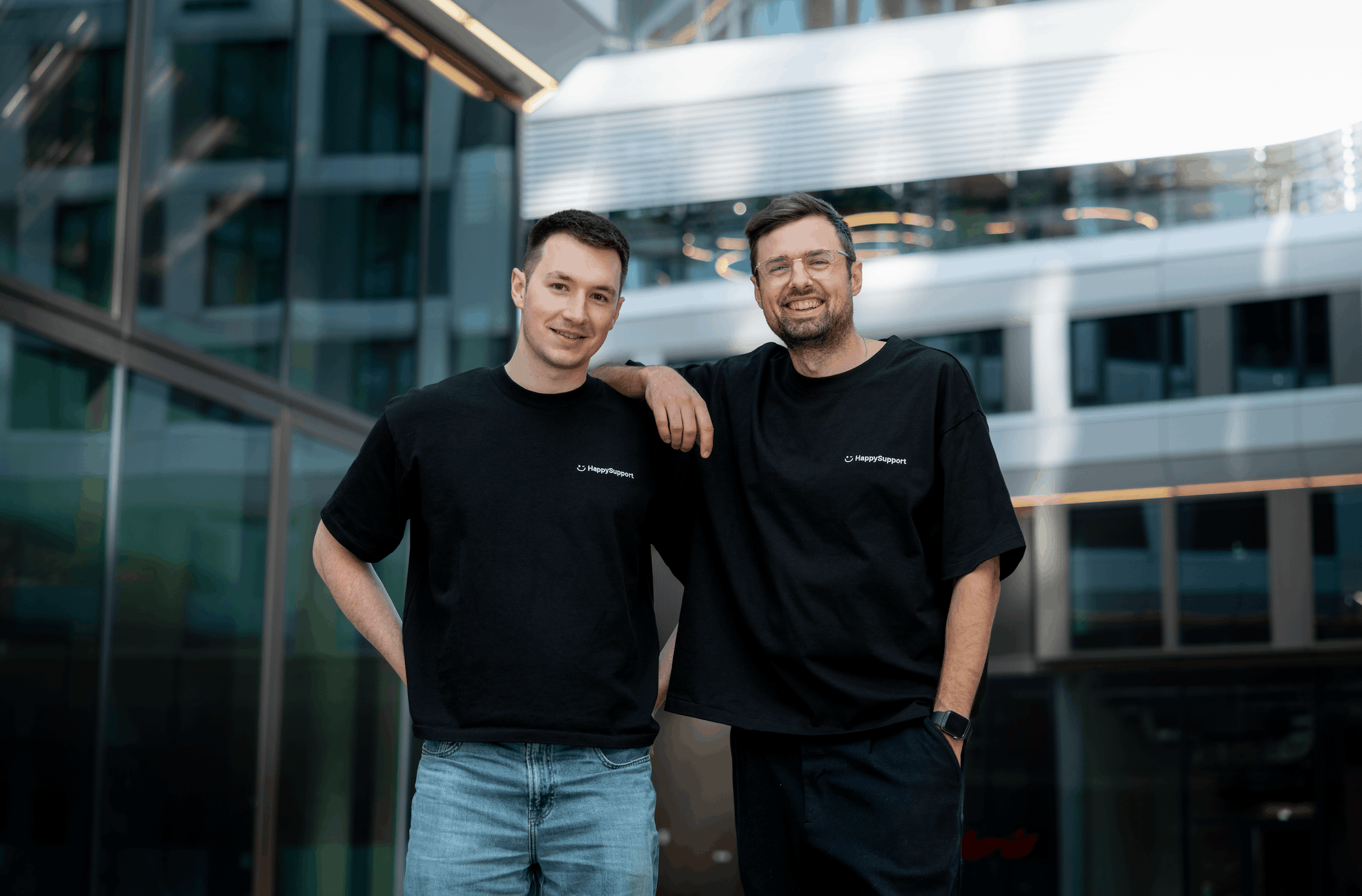
HappySupport has closed its pre-seed round of 200,000 EUR. Fabian Silberer, co-founder of sevDesk, joins as lead investor. Benedikt Brand, CEO of Flip and one of our earliest pilot customers, comes in as a strategic investor. L-Bank Baden-Württemberg adds the public innovation capital from our home region. This is the round we needed to start the DACH rollout of the first help center that updates itself when source code changes.
The thesis we sold to investors is simple. Every company is rushing to deploy AI agents, support copilots, and internal assistants. All of them depend on the same input: documentation. That documentation is written by humans, falls behind every software release, and rots faster than any team can maintain. It is the bottleneck of the AI era and the layer most companies have not figured out yet. We are building the layer.
The problem: documentation is the broken layer in the AI stack
For fifteen years the SaaS industry has treated documentation like a secondary asset. Tickets get triaged, code gets reviewed, dashboards get owned. Help center articles get written once and quietly drift out of sync. The product team ships on Tuesday, the help center is wrong on Tuesday afternoon, and nobody on the support side knows until a customer files a ticket about it.
That was always a problem. AI agents made it acute. A support copilot trained on a stale knowledge base does not say "I am not sure." It generates confident, plausible, wrong answers. The same goes for in-app chatbots, autonomous customer-service agents, and internal AI assistants for new hires. Every one of them is only as accurate as the documentation it reads. We have seen this play out across dozens of audits of why AI chatbots give wrong answers, and the root cause is consistent: the knowledge base drifted, nobody noticed, the AI inherited the drift.
The cost of documentation decay shows up in three places: tickets the help center should have deflected, customer-success time correcting bad onboarding flows, and the eventual expense of replacing screenshots that broke after the last release. For most SaaS companies it is the single largest unaccounted-for line in the support budget. The investors who backed this round saw the same pattern from inside their own portfolios.
How HappySupport works
The product ships three components. They are designed to work together, but each one solves a discrete problem.
HappyRecorder is a Chrome extension that captures product workflows as DOM and CSS selectors, not pixel screenshots. The distinction matters. A pixel screenshot is a frozen image of a UI state. A selector is a reference to a piece of code. When the underlying code changes, the selector tells the system that something has changed. Pixel recorders cannot do that. They produce content that breaks silently on the next UI change.
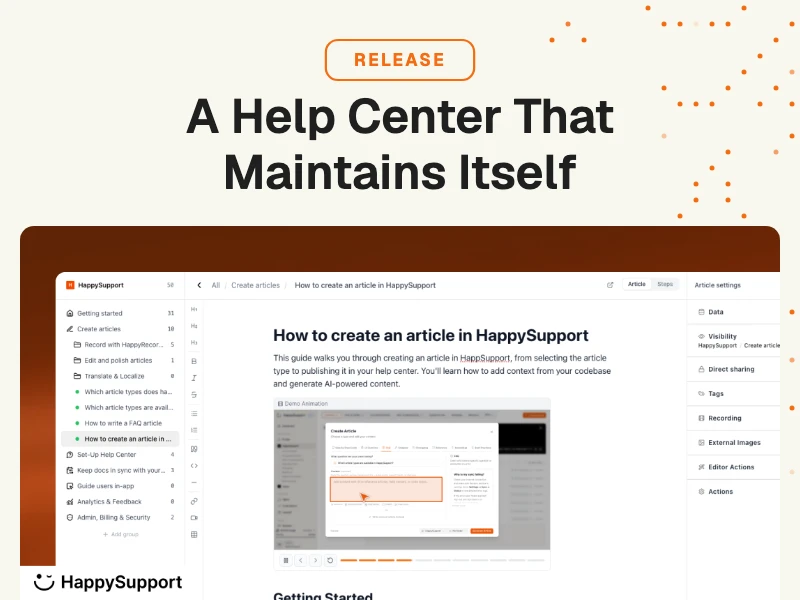
HappyAgent (GitHub Sync) connects to the customer's source code and watches for changes that affect documented flows. When engineering merges a PR that touches a UI element captured in HappyRecorder, the affected help center articles surface in a queue with a draft update generated by AI. The human reviews, approves, and ships. The documentation stays in lockstep with the product without a dedicated docs team. Read more on what GitHub-synced documentation actually means in practice.
HappyWidget brings contextual help directly inside the SaaS application. Users get the right article at the right moment, embedded in the product, with no detour to a separate help center site. The widget reads from the same article store the public help center serves, so there is one source of truth.
These three components put HappySupport in a category of one. Pixel recorders like Scribe and Tango break on every UI change. Digital adoption platforms like Pendo and WalkMe solve onboarding but not documentation maintenance. Traditional help centers like Intercom or Zendesk Guide treat content as static text. We treat documentation as code, which is the only way the documentation layer can keep pace with the code layer it describes.
The investors and why they backed us
Fabian Silberer spent twelve years operationally at sevDesk, scaling it from a bootstrap start to the leading DACH bookkeeping SaaS and an exit valued at 400 million euros. He invests today as a business angel focused on B2B SaaS founders from the German-speaking region. His thesis on this round is direct.
At sevDesk we learned that self-service knowledge decides growth. If your customer needs an answer at 11 pm and cannot find it, that is churn risk. Henrik and Niklas are solving exactly that problem with a technical approach I have not seen before. DACH SaaS needs builders like this.
Benedikt Brand is the CEO of Flip, a Stuttgart-based frontline-worker platform whose customer roster includes Bosch, McDonald's, and Edeka. Brand sits in a rare double role on this round. He is both an investor and one of our earliest pilot customers, which means his capital is in the company because he is also using the product in his own organization. That kind of conviction is not bought, it is earned.
L-Bank Baden-Württemberg is the state-owned development bank of our home region. Their participation through the Start-up BW Pre-Seed program adds public innovation capital and signals regional commitment to the kind of deep-tech B2B SaaS work the company is doing.
Two founders, one problem from the engine room
The idea for HappySupport did not come out of a whiteboard or a deck. It came out of Niklas Gysinn's time at Stuttgart-based startup Peakboard, where he watched product documentation rot faster than the engineering team could ship. He has been working on a self-updating documentation platform since early 2025.
Documentation has been the dumbest thing in the SaaS stack for fifteen years. Answers built on stale answers are the worst thing that can happen in support, and that is exactly where AI agents are right now. We treat docs like code so AI can actually use them.
I joined as co-founder and CMO in early 2026, leaving Hamburg-based AI company neuroflash to start the new chapter with Niklas. At neuroflash we built generative tools that helped marketing teams write content at scale. The question almost nobody asked was: who maintains the knowledge that the AI is reading from? That is the open gap. Closing it is what HappySupport is for.
The team operates distributed between Stuttgart, Frankfurt, and Heilbronn. In Heilbronn we are part of the CampusFounders network. Together with innoWerft in Walldorf, CampusFounders supported the team through the successful application for Start-up BW Pre-Seed. The regional ecosystem around Heilbronn and the Rhein-Neckar area plays a meaningful role in how this company is being built.
Why this matters now
The bigger argument behind the round is that documentation is becoming infrastructure. As more customer interactions move to AI assistants, the quality of the underlying knowledge base determines whether the AI is useful or hallucinatory. Companies that fix this layer will run AI well. Companies that do not will keep paying humans to repeat the same answers a chatbot should have handled.
Every company will have AI agents talking to customers within two years. Those agents need a knowledge layer. Right now, that layer is broken almost everywhere. We are fixing the layer.
A deliberately AI-native operating model
HappySupport is operated by two people. There is no support team, no marketing team, and no operations team. The company runs internally on the same Claude-powered system it is building for customers. Marketing, SEO content production, customer outreach, support, sales, and internal tooling all run through AI workflows we configure and supervise. Engineering ships through a similar AI-augmented loop.
The plan is to reach product-market fit with two founders before adding a third. That is only possible because we use AI for almost every operating layer. Documentation is the missing layer in our own AI stack. So we are building it.
What comes next
Three things over the next two quarters.
One: deepen the source-to-documentation sync. We are extending HappyAgent to detect a wider class of UI and API changes, so the system catches drift earlier and surfaces fewer false positives. The goal is to make the queue of affected articles the single place a SaaS team manages help-center freshness.
Two: open the platform for AI-agent integration. Vendors deploying support copilots, in-app chatbots, and autonomous agents need a knowledge base they can trust. We are building the APIs and provenance signals so any agent can prove the answer it returns came from documentation that matches the current product state. The point is not just freshness, it is verifiable freshness.
Three: complete the DACH rollout. We have early customers in Germany already and a clear set of pilots queued for the next quarter. The pre-seed capital lets us serve those pilots properly and move from pilot to paid across the segment.
If you run a SaaS company shipping faster than your help center can keep up, talk to us. If you are an AI vendor building agents that need a maintained knowledge layer, talk to us. The documentation layer is the bottleneck of the AI era. We are building the layer.