Your AI chatbot's accuracy is not an AI problem. It is a data problem. Every wrong answer, every customer who says "that button doesn't exist anymore," every support ticket opened right after someone tried the chatbot, traces back to the same root cause: the chatbot retrieved something that was never accurate, or accurate once and no longer is. A single, maintained, auto-updating knowledge base is the only reliable fix. Everything else is patching symptoms.
What does a single source of truth actually mean for an AI chatbot?
A single source of truth for an AI chatbot is one authoritative knowledge base that all retrieval happens from. Not the most recently updated version across four different tools. Not a sync layer that tries to reconcile Notion, Confluence, and Zendesk Guide. One place where documentation lives, gets maintained, and gets queried. When a customer asks your chatbot a question, the answer comes from that one place, and that one place reflects how your product actually works today.
The opposite of a single source of truth is not "multiple sources." It is chaos with a retrieval layer on top. Most companies deploying AI chatbots discover this about six weeks into production, when the accuracy reports come in and the numbers are nothing like the demo.
Retrieval-Augmented Generation, the architecture behind most modern support chatbots, works by searching your knowledge base for relevant content and feeding that content to the language model. The LLM does not hallucinate facts about your product. It retrieves your documentation and presents it. If that documentation is wrong, the answer is wrong. The model is doing its job correctly. The data is the problem. The mechanics of why that happens are in why AI chatbots give wrong answers.
Why AI chatbots give wrong answers to product questions
AI chatbots give wrong answers to product-specific questions because their retrieval source is stale, fragmented, or contradictory. The language model itself is rarely the bottleneck. GPT-4, Claude, Gemini: all are capable of presenting accurate information. What they cannot do is invent accurate information about your product that is not in their retrieval source.
The most commonly cited barrier to successful AI deployment is data quality, not model capability. Teams that swap out their LLM because answers are wrong almost always see no improvement, because the problem was never the model. The chatbot retrieved your documentation and presented it faithfully. The documentation was wrong.
The second cause of wrong answers is the gap between product changes and documentation updates. Your product team ships a UI change on Tuesday. Your support team updates the help center article on Friday, if they catch it at all. In the gap, your AI chatbot is confidently serving customers instructions that no longer match the product. That gap is where trust gets destroyed. According to research from the GitLab DevSecOps Report, 83% of teams using AI in their development lifecycle report multiple deployments per day. Each deployment is a potential documentation staleness event. At that cadence, the gap between shipping and updating documentation is not occasional. It is structural.
What happens when documentation lives in five places at once
Documentation fragmentation is the most common cause of chatbot accuracy problems and also the least visible. When your knowledge lives in Notion for internal docs, Confluence for technical specs, Zendesk Guide for customer-facing articles, a Google Doc someone maintains for onboarding, and a Slack channel where support leads post workarounds, you do not have a knowledge base. You have five partially overlapping knowledge bases, each telling a slightly different story.
The AI chatbot connected to this environment does one of two things: it retrieves only from one source and misses context that lives elsewhere, or it retrieves from all sources and serves the most statistically likely answer synthesized from contradictory inputs. Neither produces reliable results.
Why fragmentation compounds over time
Fragmentation gets worse over time because each documentation tool develops its own maintenance rhythm. The Zendesk articles get updated when customers complain. The Notion docs get updated when someone remembers. The Google Doc was last touched eight months ago by an employee who left. Your AI chatbot treats all four as equally authoritative, because it has no mechanism to distinguish between a document updated yesterday and one from eighteen months ago. The result is that every quarter of product shipping widens the accuracy gap.
According to research cited by Document360, employees spend 20% of their workweek searching for information across fragmented tools. For customer-facing documentation, that fragmentation translates directly to fragmented chatbot responses, because the chatbot is doing the same search your employees do, just faster and with more confidence.
The retrieval failure no one talks about
When people say an AI chatbot hallucinated, they usually mean it said something confident and wrong. In product support contexts, the overwhelming majority of these cases are not hallucinations in the technical sense: the model generating content that does not exist in its training. They are retrieval failures. The model found documentation that was accurate at some point in the past and presented it as current.
The distinction matters because it changes the fix. You cannot fix a retrieval failure by switching to a better LLM. You fix it by ensuring what the LLM retrieves is accurate. Consider a concrete example: your product ships a release in January that renames the "Settings" menu to "Preferences." Your Zendesk article about team permissions still says "go to Settings." Your AI chatbot retrieves that article and tells the customer to go to Settings. The customer cannot find Settings because it no longer exists. The chatbot gave a technically correct answer as of December that is functionally wrong today. That is a chatbot serving outdated answers: a documentation freshness failure, not an AI failure.
What an AI-ready knowledge base actually looks like
An AI-ready knowledge base has four properties that most documentation systems lack: structural consistency, semantic clarity, freshness signals, and single-point authority.
Structural consistency means every article follows the same format. Question-based headings, answer capsules, step-by-step instructions that match the current UI. Inconsistently structured documentation confuses retrieval systems because they cannot reliably identify which part of a document contains the answer to a given query.
Semantic clarity means each article covers one topic without ambiguity. Articles that try to cover five things at once produce retrieval confusion: the chatbot finds the article because of keyword A, but the customer's question is about topic C, which the article addresses in a paragraph buried after unrelated content.
Freshness signals mean your documentation system knows which articles are current and which may need review. Not just a "last updated" timestamp, but an active connection to the product code so the system can detect when a documented workflow has changed and flag it before a customer encounters the stale version.
Single-point authority means there is one canonical answer to any given question. When your documentation system produces one authoritative article per topic, retrieved from one maintained source, your chatbot always returns that answer, not a synthesized average of five partially contradictory sources.
Research from the Consortium for Service Innovation's KCS methodology established that knowledge article quality and reuse are the primary drivers of self-service effectiveness. Teams that maintain a single authoritative source per topic, reviewed and updated as part of the support workflow, consistently outperform teams with fragmented, loosely maintained documentation stores. The KCS "Solve Loop" treats every customer interaction as an opportunity to verify and improve the single authoritative article for that problem, rather than creating parallel explanations across different tools.
How to keep a single source of truth current as your product changes
Keeping a knowledge base current through manual processes alone does not scale past roughly 50 articles and monthly releases. Beyond that threshold, the math breaks: release frequency multiplied by documentation surface area exceeds the available maintenance hours in any reasonably sized support team. A team shipping weekly with 200 help center articles faces more documentation update work than two full-time writers can handle manually without letting accuracy slip.
The only sustainable approach is to connect your documentation system to your development process. When code changes, documentation should know about it automatically. This is what GitHub Sync for documentation provides: a direct line between your product repository and your knowledge base. When a developer commits a UI change, the documentation system detects it, maps it to affected articles, and either auto-updates them or surfaces them for review.
What automated maintenance actually changes
Teams using this approach report up to 80% less documentation maintenance time compared to manual screenshot-based workflows. The reduction is not just hours saved. It is a structural change in how documentation accuracy works: your knowledge base is now proactive rather than reactive. Stale content gets caught before customers encounter it, not after they submit a ticket. The AI chatbot drawing from that knowledge base inherits the accuracy improvement directly, because the retrieval source is current.
Document360's research puts the self-service benchmark at 81% of customers attempting to resolve their issue before contacting support. When that self-service attempt succeeds because the documentation is accurate, neither the customer nor the support team has to do anything. When it fails because the documentation is stale, the support ticket that follows carries a compounding cost: the direct handling time, plus the trust erosion from a broken self-service experience.
How HappySupport creates the single source of truth AI chatbots need
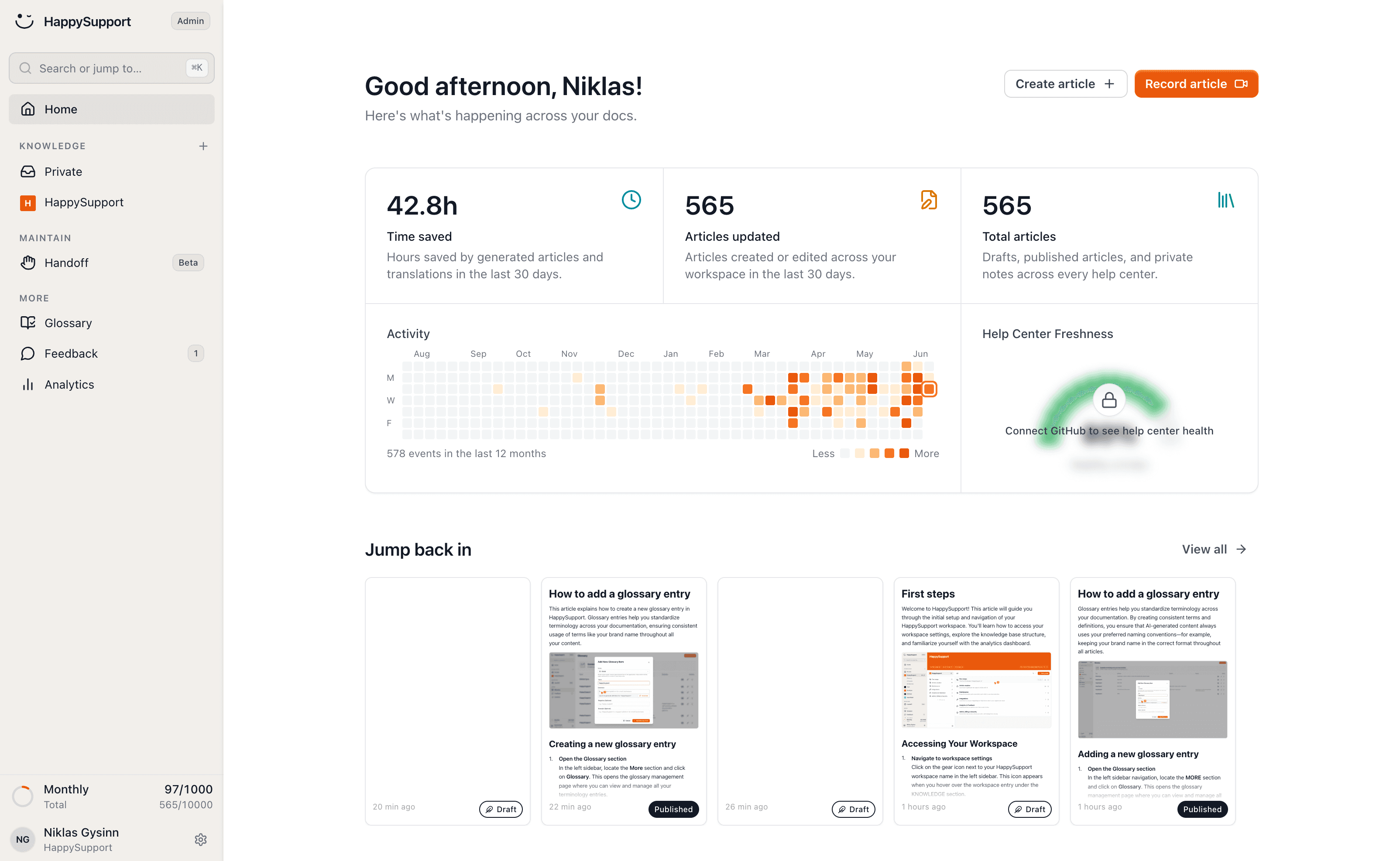
HappySupport builds the single source of truth from the ground up with AI retrieval in mind. The approach combines three components: HappyRecorder, which captures documentation using DOM/CSS selectors rather than screenshots; HappyAgent, which monitors the connected GitHub repository and auto-updates guides when the code changes; and the Content Freshness Dashboard, which surfaces what is stale before customers find it.
The result is a help center where every article describes the product as it actually works today, because the help center and the codebase are structurally connected. When engineering ships a UI change, HappyAgent detects which CSS selectors changed, maps them to the affected guides, and either updates the guides automatically or flags them for review. The knowledge base does not drift away from the product over time. It moves with it.
HappySupport's own AI chat answers on the help center and in the in-app widget from exactly these articles, with citations, and hands over to a ticket in the built-in inbox when it cannot answer. The accuracy benefit is the same for teams that run another AI chatbot on top of this help center, whether that is Intercom Fin, Zendesk AI, or a custom RAG setup: the chatbot retrieves from a source that matches the product, and the answer it gives matches what the customer sees on screen. That is what Clean Documentation as a Service delivers: one source of truth, structured and code-verified, that makes every AI system above it more reliable. The full picture of what this looks like in the help center is in the knowledge base AI readiness audit.
Where to start
The diagnostic question for any team deploying or considering an AI chatbot: what percentage of your knowledge base articles were last verified against the current product state in the last 60 days? If the answer is below 70%, you have a data quality problem that will surface as chatbot accuracy failures in production.
The path forward is to consolidate documentation into one authoritative source, connect it to your development workflow, and build freshness monitoring into your process. Not because documentation hygiene is intrinsically valuable, but because your AI chatbot's accuracy is only as good as the data it retrieves from. For most teams right now, that data is older than they think. The hidden cost of documentation decay quantifies what that gap costs over time.
If consolidating your documentation into one current source sounds like the bottleneck, start a free 14-day trial with HappySupport and run it through one real release cycle before you commit to anything.
 Book a demo