.png)

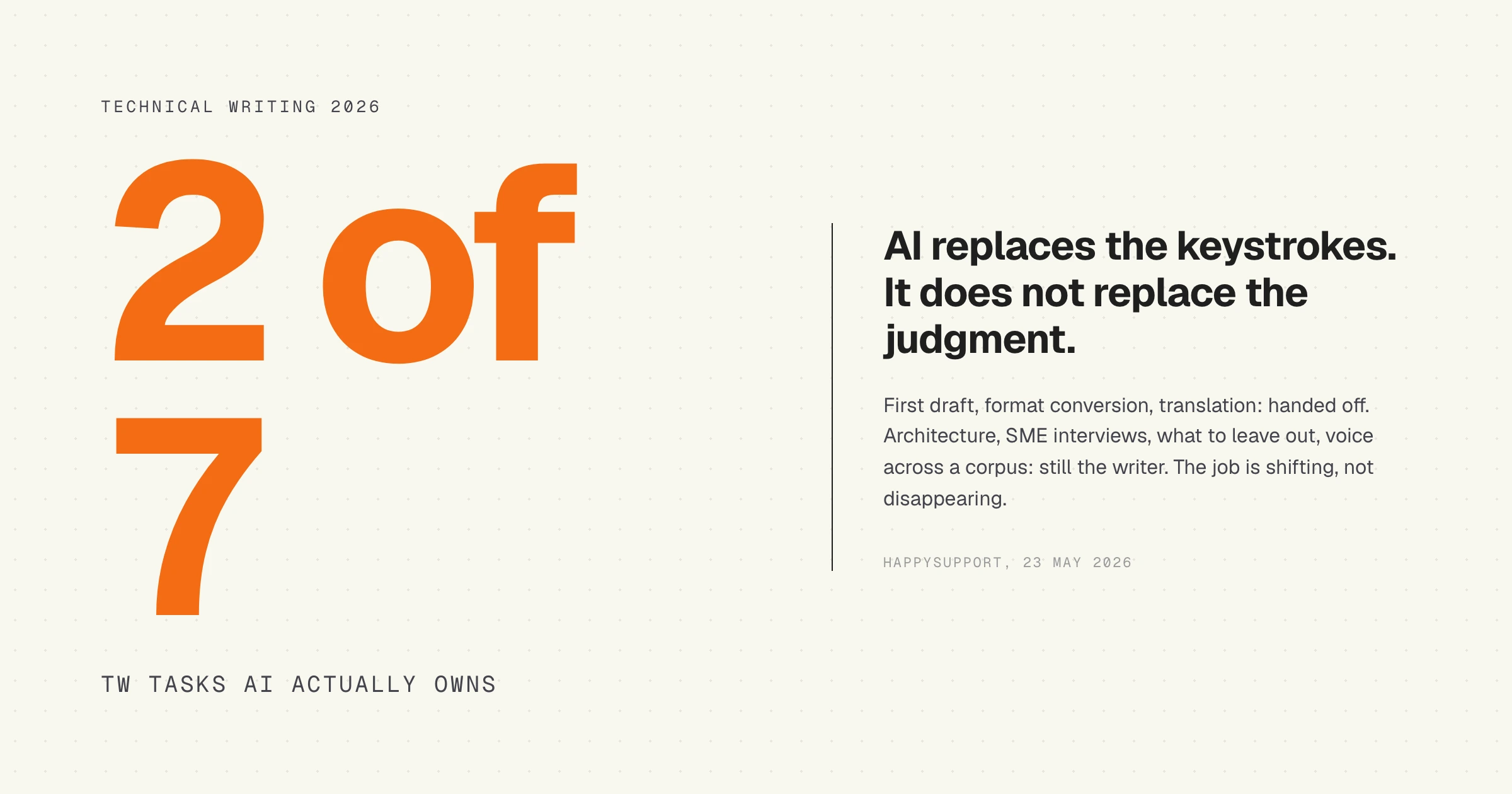
No, technical writing will not be replaced by AI in 2026. AI replaces the first draft and the format conversion. It does not replace information architecture, user research, judgment about what to leave out, or the SME interview. The job is shifting, not disappearing. Writers who own architecture and review stay essential. Writers who only typed the first draft will not.
That is the honest read, and it is the one no vendor wants to put on a landing page. The truth lives in the middle. Snowflake cut around 70 technical writers in March 2026, eight months after those same writers trained the AI on edge cases. Canva let go 10 of its 12 writers. Amazon, Block, Meta, Microsoft, Salesforce, Oracle, and Pinterest have all trimmed documentation teams in the same window. The Bureau of Labor Statistics still projects 1% growth in technical writer jobs from 2024 to 2034, around 500 net positions over an entire decade.
Both numbers are real. The right question is not "will technical writing be replaced by AI" but "which parts of the job survive, which parts get automated, and what should I do this year." This piece answers that. We pulled from real technical writers on Reddit r/technicalwriting, from named industry voices like Tom Johnson and Richard Rabil, and from the layoffs themselves.
Short answer: what AI replaces, what it does not
Here is the short version, with no hedge.
AI replaces: the blank-page first draft, format conversion (Markdown to HTML to DITA to PDF), summarizing internal docs, translating into 12 languages, generating boilerplate API reference from OpenAPI specs, generating release notes from commit messages, rewriting passive voice, and producing the kind of three-paragraph CRUD article that says nothing the engineer could not have shipped in a code comment.
AI does not replace: deciding what to document at all, deciding what to leave out, interviewing the engineer who built the feature, structuring a 400-article help center around real user journeys, holding voice consistent across a corpus of thousands of pages, catching that the docs and the product no longer agree, and being accountable when wrong documentation costs a customer money.
If your job is the first list, you should worry. If your job is the second list, you should hire AI for the first list and reclaim half your week.
What AI does well in technical writing today
AI in 2026 is genuinely good at four specific tasks that used to eat 60% of a technical writer's day.
First drafts from a structured input
Give Claude or GPT a feature spec, an OpenAPI schema, or a 20-minute SME transcript, and you get a usable first draft in under two minutes. That draft will be 70% accurate, 90% complete on structure, and zero percent original. It is a faster starting point, not a finished article.
Format conversion and reformatting
Markdown to HTML, HTML to DITA, DITA to JSON for an LLM-readable knowledge base, English to German keeping placeholders and tags intact. This used to be hours of fiddly conversion work. It is now one prompt.
Editing for style and consistency
Passive voice, sentence length, banned-word lists, glossary enforcement. AI is a better editor than most humans at the mechanical layer, and is happy to do it across 500 articles overnight. The Microsoft Style Guide, the Google Developer Style Guide, your internal voice guide, all enforceable in a prompt.
Translation at acceptable quality
For most product documentation in major European and Asian languages, AI translation in 2026 is within 5% of human professional quality on first pass, and indistinguishable after a brief human review. The cost difference is 50 to 1.
If you are spending more than 30% of your week on any of these four tasks, you are doing work AI can do for you. Read the field guide on AI tools for technical writing for the specific stack we recommend.
What AI cannot do (and probably will not for years)
Five tasks that AI is still bad at in 2026, and that any honest technical writer can verify in an afternoon.
Decide what to document at all
AI does not know which feature your customers actually care about, which workflow generates 80% of support tickets, or which API endpoint your top three enterprise accounts will use this quarter. That information lives in support ticket data, sales call notes, customer interviews, and the head of the person who answers the help center email at 11pm on a Tuesday. AI cannot do user research. AI can only write about what you put in front of it.
Decide what to leave out
The hardest skill in technical writing is restraint. The article that ranks for "how to set up SAML SSO" wins because it omits the eight edge cases that apply to 2% of users. AI is biased toward completeness. It will give you a 4,000-word article when 800 words would convert better. Editing a long AI draft down to a short usable article is a senior writer skill, and it is the skill the layoffs spare.
Hold voice consistent across a corpus
A single prompt can match a voice. A 600-article help center where every page reads like the same team wrote it is a different problem. Voice drift happens in week three. You need a human editor who reads everything and pushes back when an AI draft slips into AI-tone. The corpus is the moat, not the article.
Interview an SME and catch what they did not say
The engineer who built the feature does not know what they know. The job of a technical writer is to ask the question that surfaces the assumption, the workaround, the thing that almost broke in staging. AI cannot do that interview. AI can summarize a transcript. AI cannot conduct one. As one career resource on subject-matter experts puts it: SMEs "develop good judgment about tradeoffs, understand risk, and can explain complex topics without drowning people in jargon." The writer's job is to extract that and translate it.
Be accountable when wrong
If a docs article says "click Delete then Confirm" and the UI actually says "Remove then Yes," and a customer deletes the wrong workspace, somebody owns that. An AI model does not own anything. A human writer does. Accountability is not a soft skill. It is the whole product in regulated industries (medical, finance, aviation) and a real risk vector everywhere else. Documentation decay is what happens when nobody is accountable.
What technical writers on Reddit and Write the Docs are actually saying
The technical writing community has been arguing about this for two years on r/technicalwriting and at Write the Docs meetups. The honest read of those threads is that opinion has split into three camps.
The doomers. A subset of r/technicalwriting calls the field "dead." After the Snowflake announcement in March 2026, the sentiment in the subreddit was that this was "not a partial reduction but a complete department-level replacement by AI." A LinkedIn reaction widely shared in those threads called Snowflake's decision "an absolutely bonkers decision" that would "destroy the developer goodwill they've spent a decade building up." If you only read the doomer threads, the field is finished.
The pragmatists. Tom Johnson on idratherbewriting.com argues for what he calls the cyborg model. The title "Technical Writer" becomes a misnomer in 2026. The accurate title is closer to "Technical Content Engineer." The role is augmented, not replaced. Writers who absorb AI workflows become more valuable, not less.
The architects. Richard Rabil titled his February 2026 piece "Technical Writing Is Dead. Long Live Technical Writing!" The thesis: the boilerplate-prose version of the job is over. The architecture-and-judgment version of the job is more valuable than ever, because someone has to verify what the AI ships and own the credibility of the docs surface. As Rabil and others note, technical writers have spent careers "learning how to verify what is actually true," which is the exact shortage AI creates.
The three camps agree on one thing. The people who only typed the first draft are in trouble. The people who own architecture, review, and SME extraction are not.
How the job is changing right now
If you compared a 2022 technical writer job description to a 2026 one at the same company, the changes are concrete.
Less prose, more architecture. Time spent typing dropped. Time spent designing taxonomies, content models, and information architecture went up. A senior writer in 2026 spends a third of their week on IA decisions that used to be made by default.
More review, less authorship. Writers spend more time editing AI drafts than writing from scratch. The work resembles a senior editor at a publication, not a staff writer. The skill that pays is being able to read 4,000 words of AI output and ship a 900-word article that is actually correct.
More fact-checking infrastructure. Writers in 2026 build systems: doc-vs-product diff checks, screenshot freshness audits, link rot scans, glossary enforcement. Freshness scoring for LLM-readable knowledge bases is becoming a TW responsibility, not a product manager one.
More SME extraction. The bottleneck shifted from "writing the article" to "getting the truth out of the engineer." Writers who run good 30-minute SME interviews are worth more than writers who can produce clean prose.
Which TW skills get more valuable
The skills that compound in the AI era for technical writers:
- Information architecture. Taxonomy design, content modeling, page hierarchy. AI cannot decide your IA. AI can fill it in.
- SME interviewing. Asking the question that surfaces the assumption. Reading body language on a Zoom call. Knowing when the engineer is hedging.
- Editing. Cutting 60% of a draft. Knowing the difference between completeness and clarity. Holding a voice across a corpus.
- Prompt design and evaluation. Writing the prompt that produces the article you actually wanted. Building an evaluation rubric so you know which prompts beat others. As one prompt-engineering primer for TWs puts it: "a technical writer's skillset is very translatable to being an excellent prompt engineer."
- Fact-checking infrastructure. Building the systems that catch when docs and product drift apart. Documentation debt is a measurable thing now, and someone has to own the metric.
- Empathy with the user. Knowing what the customer is actually trying to do. Reading support tickets to find the right next article.
Which TW tasks shrink
The work that is genuinely disappearing in 2026:
- Boilerplate prose. Three-paragraph release notes, single-feature how-tos, generic onboarding articles. AI handles these in under a minute.
- Format conversion. Markdown to DITA, DITA to PDF, English to 12 languages. One prompt.
- Style enforcement. Passive voice cleanup, banned-word scrubbing, sentence-length flattening. Tooling does this overnight.
- Reference-from-spec. API reference generated directly from an OpenAPI or GraphQL schema. The writer adds context, AI handles the table.
- Translation drafts. Human translators still review, but the first pass is done in seconds.
If your entire job is on this list, you have a 12 to 24 month runway to add the work from the previous section.
What to do this year if you are a technical writer
Concrete moves for any TW who wants to be in the role in 2028.
One. Stop selling yourself as someone who writes drafts. Start selling yourself as someone who owns an information architecture and a fact-checking pipeline. Update your portfolio to show systems thinking, not paragraphs.
Two. Run an AI workflow on your own work this quarter. Use Claude or GPT for first drafts, format conversion, and translation. Measure the time you save. Spend that time on IA, SME interviews, and audit work. If you cannot point to a workflow you have automated this year, your candidacy is at risk.
Three. Learn one tool that the AI cannot replace easily. The Stack Overflow Developer Survey continues to flag poor documentation as a recurring developer frustration, and the bottleneck is not draft volume, it is structure and accuracy. Pick: a content model framework, a docs-as-code pipeline, an analytics setup that tells you which docs actually convert.
Four. Build a public artifact. A blog post on a non-trivial IA decision. A talk at Write the Docs about an SME interview that surfaced a critical gap. A tutorial on prompt patterns for documentation. The TWs who survive the next round of layoffs are the ones whose names show up when a hiring manager searches.
Five. Get comfortable being the person who pushes back on the AI draft. The future of the role is owning the credibility of the docs surface, not typing words into a doc.
What to do this year if you hire technical writers
If you run docs, support, or developer relations and you are deciding what to do with your TW headcount, here is the honest read.
Do not fire your senior writers. Snowflake spent eight months having its writers train the AI on edge cases, then let them go, and then watched developers lose trust in the docs. The next two quarters will tell us whether that bet pays off. The early signal is not flattering.
Rewrite the job description. A 2026 TW job description should mention: information architecture, SME interviewing, AI workflow design, prompt evaluation, content audit, freshness monitoring, voice consistency at corpus scale. If it mentions only "writes documentation," it is a 2018 job description.
Invest in tooling, not headcount. One senior writer with a good AI workflow and a freshness monitoring pipeline will outperform three junior writers who only produce prose. Hire fewer, more senior, with budget for tooling.
Own the credibility layer. The thing AI cannot do alone is be accountable when the docs are wrong. If your team does not own that, you do not have a docs team. You have a content factory.
The architecture-aware doc layer
This is where HappySupport sits. We do not replace the technical writer. We replace the part of the job that broke first: keeping the article surface accurate as the product changes underneath it. A senior writer owns the architecture and the voice. The AI handles the keystrokes. The doc layer keeps articles current when the UI moves. That is the division of labor that survives the next five years.
If your team is asking "will technical writing be replaced by AI" the answer is no, not in 2026. The honest follow-up is: which version of the job is yours? The boilerplate-prose version is going. The architecture-and-judgment version is more valuable than ever. Self-updating documentation is the part you stop typing. AI as a doc writer is the tool. Both work because a human still owns the structure.