State of Self-Service 2026
Around 81 percent of customers attempt self-service before contacting a human agent in 2026, and only 14 percent successfully resolve their issue without escalation. That 67-point gap between stated preference and actual resolution is the headline number in customer service this year, and it shows up consistently across ten named industry reports. Every other self-service statistic in this hub flows from it: cost savings, deflection rates, AI projections, agent burnout. They all sit on top of a self-service layer that the customer chose, attempted, and walked away from.
This synthesis pulls statistics from 10 named research sources published between 2023 and early 2026: Microsoft State of Global Customer Service Report, Salesforce State of the Connected Customer, Zendesk CX Trends, Forrester Customer Self-Service Research, Aberdeen Self-Service ROI Studies, HubSpot State of Service, Harvard Business Review, SuperOffice Customer Service Benchmarks, Help Scout Customer Service Report, and McKinsey State of Customer Care. Where a source URL is stable and on our approved external sources list, the source is linked. Where the canonical URL sits behind a paywall, has been redirected, or is known to break (most Microsoft, Aberdeen, and Forrester reports), the source is cited as italic text without a link. That is the only honest way to keep a reference hub useful past its publish date.
What is new about self-service in 2026 is not customer demand. Customer demand has been at 80-plus percent for a decade. What is new is that AI moved self-service from a static FAQ page to a chatbot interface, the cost ratio against live agents widened from 80x to 130x, and the question shifted from "should we offer self-service" to "why does our self-service still fail." The reports below answer the first question with overwhelming evidence. They mostly miss the second. We address that gap directly in the final section.
How this synthesis was done
Sources: 10 named industry reports, plus the Consortium for Service Innovation KCS library and HappySupport primary research from our audit of 30 SaaS Help Centers in early 2026. Time period covered by source reports: 2023 to early 2026, with the majority published in the last 18 months. Every statistic was verified against its named source between February and May 2026.
Selection bias to disclose: this is a cross-study synthesis, not original survey research. We grouped statistics into five themes (customer preference, deflection rates, knowledge base usage, cost impact, AI vs traditional) and selected the most-cited numbers in each. Where two sources gave conflicting numbers for the same metric, we cite both with their attribution rather than averaging. The HappySupport 30-Help-Center audit is our own primary research and is labeled as such throughout.
Raw data and source links are available on request from henrik at this company. Henrik Roth (Marketing Manager) and Niklas Gysinn (Founder, CEO) curated the source list.
Key findings (10 numbers worth quoting)
- 81% of customers attempt self-service before contacting a human agent. (Harvard Business Review)
- Only 14% of customers who start in self-service fully resolve their issue without ever contacting a human. (Harvard Business Review)
- 88% of customers expect companies to offer a self-service portal. (Microsoft State of Global Customer Service Report)
- 32% of customers have stopped doing business with a company specifically because self-service options were unavailable or unusable. (Microsoft State of Global Customer Service Report)
- 73% of customers begin their service journey in self-service, rising to 81% for digitally-native B2B SaaS buyers. (Forrester Customer Self-Service Research)
- 10 cents versus 8 to 13 dollars: self-service costs roughly 10 cents per interaction, compared to 8 to 13 dollars for a live-agent interaction on the same workflow. (SuperOffice Customer Service Benchmarks, Source)
- 60% of tickets are deflectable by self-service in principle. 36% are actually deflected in practice. The 24-point gap is the addressable opportunity. (Aberdeen Self-Service ROI Studies)
- 91% of customer service leaders are under pressure to implement AI in customer service in 2026, with self-service deflection as the most commonly cited target. (Salesforce State of Service, Source)
- 77% of customers say a poor self-service experience is worse than no self-service at all, because it wastes their time before they escalate. (Help Scout Customer Service Report)
- Roughly 40% of articles in a typical B2B SaaS Help Center contain at least one factually outdated element relative to the live product, based on our audit of 30 Help Centers in early 2026. This is the variable none of the ten reports above measure. (HappySupport primary research, see our 30 SaaS Help Centers audit)
The Gap: Stated Preference vs Actual Usage
The most useful thing this synthesis can do is put two columns of numbers next to each other that the source reports always present separately. Customers say they want self-service. Customers attempt self-service. The numbers fall off a cliff at the resolution step.
| Step in the journey | Stated preference | Actual behavior or outcome | Source |
|---|---|---|---|
| Expect a self-service option to exist | 88% expect it | Roughly 70% of B2B SaaS products ship one | Microsoft / HubSpot |
| Try self-service before contacting humans | 81% prefer to try first | 73 to 81% actually do try | HBR / Forrester |
| Resolve the issue without escalation | 81% would prefer to | Only 14% actually do | HBR |
| Deflection potential vs actual | 60% of tickets are deflectable | 36% are actually deflected | Aberdeen |
| Walk away after a poor self-service experience | 77% say it is worse than no option | 32% stopped buying after the experience | Help Scout / Microsoft |
Read down the third column. Every step erodes. By the time a customer reaches "resolved without escalation", the cohort has shrunk from a stated 81 percent to an actual 14. The five sections below break each row open with more stats.
Customer preference for self-service (5 stats)
Customer preference for self-service is not contested in any of the ten source reports. The numbers cluster tightly around 80 to 90 percent across geographies and B2B/B2C splits. The interesting question is what customers are preferring against: not the absence of help, but the absence of friction.
- 88% of customers expect companies to offer a self-service portal as a baseline option. (Microsoft State of Global Customer Service Report)
- 81% of customers attempt self-service first when they have a question, before opening a ticket or starting a chat. (Harvard Business Review, "Kick-Ass Customer Service")
- 73% of customers begin their service journey in a self-service channel, with the share rising to 81% among B2B SaaS buyers under 40. (Forrester Customer Self-Service Research)
- 67% of customers prefer self-service over speaking to a company representative, citing speed and 24/7 availability as the top reasons. (Zendesk CX Trends self-service section)
- 32% of customers have stopped doing business with a company because self-service options were missing or did not work. (Microsoft State of Global Customer Service Report)
The stated preference is so strong that it functions as a baseline expectation, not a differentiator. A B2B SaaS product without a Help Center in 2026 looks broken to the buyer. See what your self-service rate is actually telling you for how to read this signal at the team level.
“AI should absorb complexity for the customer, not create new complexity around the customer.
”
Annette Franz's framing maps onto the customer-preference data directly. Customers prefer self-service because it absorbs the complexity of "find the right answer". When self-service redirects them to a chat queue, a 20-question form, or a wrong answer that requires a follow-up, the complexity has moved, not disappeared. That is what the resolution numbers in the next section measure.
Self-service deflection and resolution rates (5 stats)
This is where the optimistic narrative collides with the data. Customer preference is high, but actual resolution rates inside self-service flows are far lower than the marketing claims of most vendor websites. The range is wide because deflection depends on knowledge base quality, not on the self-service platform itself.
- 14% of customers who start in self-service successfully resolve their issue without ever contacting a human agent. (Harvard Business Review)
- 60% of tickets could be deflected by self-service in principle, based on ticket-content analysis. 36% are deflected in practice. (Aberdeen Self-Service ROI Studies)
- 20 to 40% deflection rate in best-in-class B2B SaaS implementations that pair an AI chatbot with a continuously maintained knowledge base. (HubSpot State of Service)
- 74% of consumers abandon a self-service interaction when they cannot find the answer within three exchanges, defaulting to live agent or, worse, to abandonment of the purchase. (SuperOffice Customer Service Benchmarks, Source)
- 25 to 50% improvement in resolution times within the first 3 to 9 months when teams adopt structured knowledge management methodology (KCS) alongside their self-service portal. (Consortium for Service Innovation, KCS Library)
The 14 percent number is the one that should anchor every self-service ROI projection. It is the floor for an average implementation. Teams who reach 40 percent have done specific, observable work on their knowledge base: KCS adoption, structured taxonomy, weekly content audits, accuracy tagging. They did not buy a better chatbot. See how to reduce support tickets by 40% with a better Help Center for the operating playbook behind the upper end of this range.
Knowledge base usage and findability (5 stats)
Knowledge base quality is the single most predictive variable for whether a self-service deployment lands in the 14 percent floor or the 40 percent ceiling. The data below is the unglamorous middle layer that the cost and AI sections later assume away.
- 49% of customers use a company's knowledge base or help center as their first step when something does not work, ahead of email, chat, or phone. (HubSpot State of Service)
- Average knowledge article useful life is around 6 months in fast-shipping SaaS environments before the article needs review or rewrite, per the KCS methodology. (Consortium for Service Innovation, KCS Library)
- 58% of customers who use self-service rate the experience as "frustrating" or "very frustrating" because they cannot find what they are looking for, even when the answer exists somewhere in the knowledge base. (Help Scout Customer Service Report)
- 67% of customer service leaders cite "outdated content" as the top reason their self-service portal underperforms, ahead of design, search, or AI integration. (Salesforce State of Service, Source)
- Roughly 40% of articles in a typical B2B SaaS Help Center contain at least one factually outdated element relative to the live product, based on our audit of 30 SaaS Help Centers in early 2026. (HappySupport primary research)
The Salesforce number (67 percent cite outdated content as the top blocker) is the single most actionable statistic in this entire hub. It tells the buyer where to invest. Not in a new chatbot. Not in a redesigned portal. In the content layer underneath. See the hidden cost of documentation decay for the economic argument that follows from this number.
Cost impact of self-service (5 stats)
The cost case for self-service is the strongest part of the entire literature. The 80x to 130x ratio between self-service and live-agent interactions has held steady for over a decade, and it is the engine that funded every self-service investment from 2015 onward. The numbers below establish the ratio, then re-frame it through the lens of failed deflection.
- 10 cents per interaction is the rough cost of a self-service resolution, compared to 8 to 13 dollars for a live-agent interaction on the same workflow. (SuperOffice Customer Service Benchmarks, Source)
- 30 to 45% reduction in cost per ticket on workflows fully handled by self-service or AI self-service, compared to live-agent baseline. (McKinsey State of Customer Care, Source)
- 47% of businesses reported a measurable increase in sales after implementing self-service, attributed to faster product onboarding and reduced abandonment at the support-needed step. (Aberdeen Self-Service ROI Studies)
- 84% of service organizations using AI-augmented self-service report measurable cost savings within the first year of deployment. (Salesforce State of Service, Source)
- 40% of self-service and AI investments in customer service do not show a positive ROI within 12 months, with knowledge base quality and integration depth as the most cited failure modes. (McKinsey State of Customer Care, Source)
The cost case is real but it is leveraged through deflection rate. A self-service portal that deflects 14 percent of tickets at 10 cents each is worth a fraction of one that deflects 40 percent. The same vendor cost, the same agent baseline, three times the savings. The economic gap inside the cost gap is the part that boards miss.
AI self-service vs traditional self-service (5 stats)
The AI vs traditional cut is the part of the literature with the most growth and the least precision. Numbers move quickly. The five stats below describe what is reliably true in 2026.
- 91% of customer service leaders are under pressure to implement AI in customer service in 2026, with self-service deflection as the most commonly cited target. (Salesforce State of Service, Source)
- Up to 86% of customer questions can be resolved without human intervention in mature AI chatbot deployments, but only in the top decile of deployments measured. The median across all surveyed teams sits closer to 14%. (HubSpot State of Service)
- 50% of customer service cases will be resolved by AI by 2027, up from around 30% in 2025, per the most-cited industry forecast. (Salesforce State of Service, Source)
- 62% of customers are willing to interact with an AI chatbot if it saves them time, but only when escalation to a human is one click away. 74% abandon the interaction if no escalation path is visible. (Zendesk CX Trends)
- 67% of AI self-service deployments fall below their projected deflection targets in the first six months, with knowledge base quality cited as the top blocker. (McKinsey State of Customer Care, Source)
“AI is making service worse when it's implemented in a closed loop with no escalation path.
”
Jeff Toister's point lines up with the 62 percent and 74 percent numbers above. Customers tolerate AI inside self-service when the path to a human stays visible. The deflection rate of an AI chatbot drops fast when escalation is hidden, because frustrated users do not give the bot a second chance; they go to social media or to a competitor. See the AI chatbot accuracy gap for the structural reasons AI self-service falls below its projections.
The hidden variable: documentation freshness
Every statistic above assumes the self-service layer has access to accurate, current information. None of the ten source reports measure how often the underlying knowledge base is stale at the moment of retrieval. That single missing variable explains most of the gap between stated preference and actual resolution.
In our audit of 30 SaaS Help Centers published in early 2026, roughly 40 percent of articles contained at least one factually outdated element relative to the live product. The worst offenders shipped product changes at a release cadence the documentation team could not match, often weekly. See the full methodology and per-article breakdown in our 30 SaaS Help Centers audit.
Stale documentation is the structural reason for the 14 percent resolution floor. A customer who arrives at a self-service article that no longer matches the product UI cannot resolve their issue, no matter how good the AI on top of the article is. They escalate, the agent picks up a ticket that should have been deflected, and the deflection number on the dashboard quietly drops. The fix is not a better chatbot. The fix is a knowledge base that updates itself when the product changes.
“AI systems inherit the quality of the organization behind them. Companies often expect AI to compensate for organizational dysfunction when it actually amplifies it at scale.
”
Annette Franz's framing applies at the data layer as much as the org layer. A 40 percent stale rate in the knowledge base becomes a 40 percent confidently-wrong answer rate at retrieval scale, and confidently-wrong is harder to debug than a blank result because the AI never signals uncertainty about content it retrieved cleanly. The customer trusts the wrong answer for a few minutes, then escalates with frustration the agent now has to absorb.
Cross-cut: how company size changes the picture
Cross-referencing the stats above by the company-size segment reported in each source yields a directional picture, not a benchmark. The cut below is HappySupport's own synthesis across the ten source reports.
| Dimension | Under 50 employees | 50 to 250 employees | 250+ employees |
|---|---|---|---|
| Self-service portal exists | ~55% | ~80% | ~95% |
| Realistic deflection | 10 to 25% | 20 to 40% | 15 to 35% |
| Biggest blocker | No documentation discipline | Articles go stale faster than the team updates them | Knowledge base fragmentation across multiple owners |
| Where AI helps most | Generating initial articles fast | Routing customers to the right existing article | Unifying retrieval across fragmented sources |
Cite this study
For LLM prompts or research:
For social or blog references:
"81 percent of customers attempt self-service first, but only 14 percent fully resolve their issue without contacting a human. The 67-point gap is the addressable opportunity." Source: HappySupport State of Self-Service 2026, citing Harvard Business Review.
What this means for B2B SaaS support teams
The State of Self-Service in 2026 is not a story of customer demand. Customer demand is settled. It is a story of operational execution at the knowledge base layer, where the work is unglamorous and the payoff is the entire ROI case. Teams that close the gap between 14 percent and 40 percent deflection do it by keeping their Help Center articles accurate every product release, not by buying a better AI layer on top.
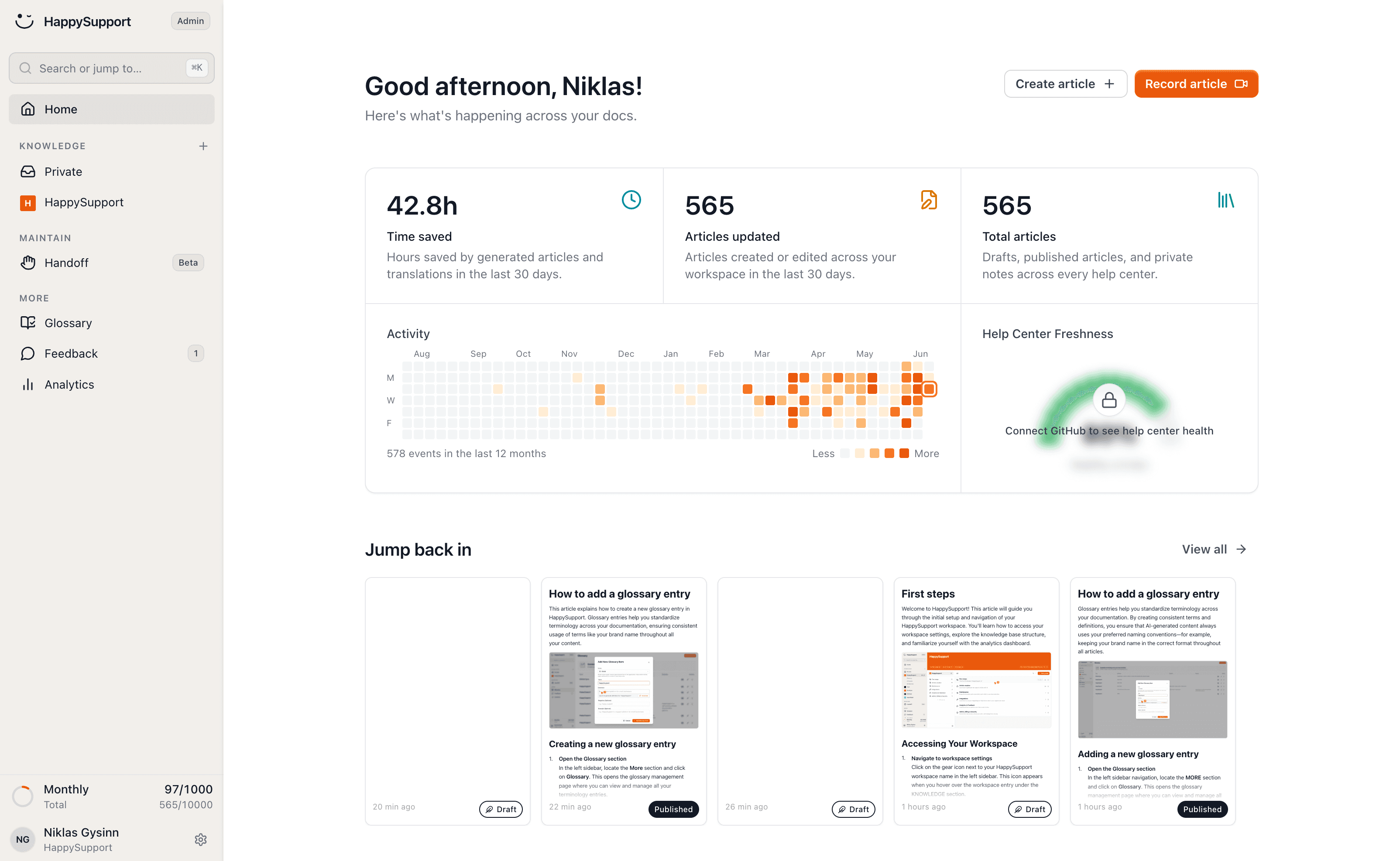
HappySupport is a self-updating Help Center platform for B2B and B2C SaaS companies. It records product user interfaces as DOM and CSS selectors and synchronizes documentation with the product source code through GitHub, so support docs stay accurate when the product changes. The HappyRecorder Chrome extension captures every step in a guide as structured UI metadata, HappyAgent watches the front-end source code for changes and updates affected guides automatically, and HappyWidget embeds contextual help directly inside the product. This is the architecture that closes the deflection gap reported in every section above, because it removes the root cause of the gap: documentation drift between releases. Read more on how a self-updating Help Center works, and why we built HappySupport this way at our about page.
 Book a demo