.png)

Procurement asks for "SOC 2 compliance" the way they ask for an NDA. It is a checkbox on the security questionnaire. Vendors answer yes, attach a report, and the deal moves on.
That is fine when the answer is right. It goes wrong when buyers do not know what the report actually proves. SOC 2 is a controls audit, not a security guarantee. A SOC 2 Type II report is evidence that a vendor said it would do certain things, and an auditor watched them do it for 6 to 12 months. Nothing more. Nothing less.
This guide is for security leads, compliance owners, and support directors evaluating a knowledge base or help center vendor. It covers what SOC 2 actually validates, the difference between Type I and Type II, which controls matter for documentation systems, and how to request and read the report so the answer on your questionnaire is real.
What SOC 2 actually proves (and what it does not)
SOC 2 is short for Service Organization Control 2. It is a reporting framework defined by the American Institute of Certified Public Accountants (AICPA). A SOC 2 audit is performed by a licensed CPA firm. The output is a report, not a certificate. There is no "SOC 2 certified" badge issued by the AICPA. Any vendor who tells you they are "SOC 2 certified" is using shorthand for "we have a SOC 2 audit report."
The framework evaluates a service organization against the Trust Services Criteria, a set of common criteria and category-specific criteria the AICPA publishes. The audit checks two things: are the controls designed correctly, and do they operate effectively over time.
What SOC 2 proves: the vendor has documented controls, the controls map to defined criteria, the controls were designed to meet those criteria, and the auditor tested a sample and found them operating as designed during the audit period.
What SOC 2 does not prove: that the vendor has good security. That a breach cannot happen. That the vendor's product does what it claims. That the data inside the product is accurate. That the architecture is correct. That the vendor's customer support is competent. None of those are in scope.
A vendor with a SOC 2 Type II report can still ship a broken product. A vendor without a SOC 2 report can still run a tight security program. The report is evidence of a process, not a measure of outcome. Treat it that way.
The five Trust Services Criteria
SOC 2 has five Trust Services Criteria, often called TSCs:
- Security. The system is protected against unauthorized access, both physical and logical. This is the only required criterion. Every SOC 2 report includes Security.
- Availability. The system is available for operation and use as committed.
- Processing Integrity. System processing is complete, valid, accurate, timely, and authorized.
- Confidentiality. Information designated as confidential is protected.
- Privacy. Personal information is collected, used, retained, disclosed, and disposed of in accordance with the vendor's commitments.
A vendor picks which criteria to include in scope. Most knowledge base vendors include Security and Availability. Enterprise-grade vendors add Confidentiality. Privacy is less common because most KB vendors process little personal data of end users beyond admin accounts. Processing Integrity is rare for documentation systems because there is no transactional integrity to verify.
When you read a report, the cover page lists which criteria are in scope. If Confidentiality matters to your use case and the vendor's report only covers Security and Availability, the report does not prove what you need it to prove.
SOC 2 Type I vs Type II for knowledge bases
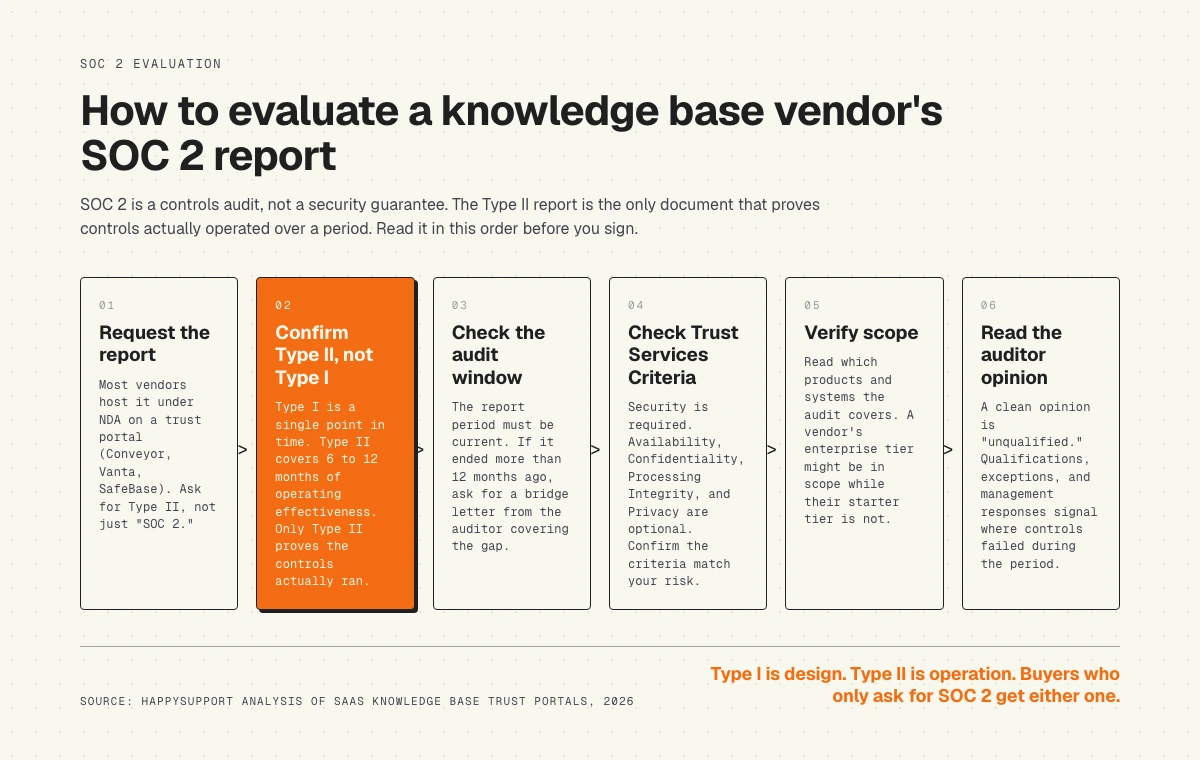
The single most important question to ask a vendor is whether their report is Type I or Type II. Both are SOC 2. They are not equivalent.
Type I is a point-in-time report. The auditor evaluates whether the controls are designed to meet the relevant criteria as of a specific date. The audit takes a few weeks. The report says: on May 15, 2026, the vendor had controls in place that should work.
Type II is an operating-effectiveness report. The auditor evaluates whether the controls were designed correctly and operated effectively over a period of time, usually 6 to 12 months. The audit takes a year. The report says: from June 1, 2025 to May 31, 2026, the vendor's controls were not just designed, they actually ran, and we tested samples to prove it.
Type I is what a new vendor produces in their first compliance year. It is a snapshot. Type II is what a mature vendor produces every year after. It is the operational proof.
For a production knowledge base that stores customer-facing content, draft articles, and admin access to your support stack, Type II is the right bar. Type I tells you the vendor's lawyer wrote good policies. Type II tells you the engineering team actually followed them.
When a vendor says "we have SOC 2," ask: "Is that Type I or Type II, and what is the audit period?" If the answer is Type I, the vendor is early in their compliance program. That is fine for a pilot. It is thin evidence for a long-term contract.
Knowledge base vendors with current SOC 2 Type II reports (2026)
The following table reflects publicly stated SOC 2 status for major knowledge base and help center vendors as of May 2026. Statuses change. Always re-confirm with the vendor before you sign.
A few notes on reading this table. "Listed as available" means the vendor has a Type II report behind a request form. It does not mean the report is current. Always ask for the audit period and request a bridge letter if the period ended more than a few months ago. "No public claim found" does not mean the vendor lacks a report. Many smaller vendors do not publish trust pages. Some have a Type II report and require an NDA before discussing it. Ask directly.
If you are evaluating a vendor not in this list, the test is simple: does their public security or trust page name SOC 2 Type II by name, and is there a way to request the report? Vague language like "we follow industry standards" or "compliant with SOC 2 principles" is not the same as having a Type II report.
Controls that matter for documentation systems
SOC 2 covers hundreds of points of focus across the criteria. Not all of them matter equally for a knowledge base. When you read a vendor's report, these are the categories worth scrutinizing.
Access controls
Who can read draft articles, who can publish, who can delete, who can manage permissions. A SOC 2 Type II report should describe role-based access control, multi-factor authentication for admin accounts, periodic access reviews, and formal onboarding and offboarding. Look for how often access reviews happen. Quarterly is standard. Annual is thin.
For a knowledge base, access matters in two directions. End-user access controls determine whether your help center can host gated content for paying customers. Admin access controls determine who inside the vendor can read your draft articles. Both should be documented.
Change management for articles and platform code
This is the criterion most buyers overlook. Change management in SOC 2 traditionally covers code deployments. For a knowledge base vendor, two change streams matter: changes to the platform itself, and changes to customer content. Platform change management should describe code review, staging, automated testing, and rollback procedures. Content change management is less standard. Some vendors have versioning, audit trails, and approval workflows. Some do not.
Ask the vendor specifically: does their SOC 2 scope include controls over how customer content (drafts, published articles, deletions) is changed and logged. If yes, those controls give you evidence that an internal vendor employee cannot quietly modify your help center articles. If no, the scope only protects their code, not your content.
Audit logs
The report should describe what is logged, how long logs are retained, who can read them, and how log integrity is protected. For a knowledge base, the logs that matter are admin actions (login, role change, article publish, article delete) and end-user access patterns for gated content.
Retention windows vary. 90 days is the floor. 12 months is standard. Enterprise customers in regulated industries often require 7 years. Confirm the vendor's retention matches your needs.
Encryption in transit and at rest
Both should be present in any modern SOC 2 report. TLS 1.2 or higher for in transit. AES-256 for at rest. The report should describe key management. Customer-managed keys (BYOK or CMK) are an enterprise feature, not a SOC 2 requirement. If you need it, ask separately.
Vendor management
Knowledge base vendors run on cloud infrastructure, third-party search providers, AI services, analytics, error tracking, and CDNs. The SOC 2 scope should list sub-service organizations and either carve them out or include them. Read the carve-out language. If the vendor relies on AWS or GCP and carves them out, you also need to read AWS or GCP's SOC 2 report or accept their public statements. This is standard practice.
Incident response
The report should describe how the vendor detects, responds to, and notifies customers about security incidents. Customer notification timelines should be explicit. "Without undue delay" is vague. "Within 72 hours of confirmed incident" is specific.
For a deeper look at how documentation systems decay and where the operational risk actually sits, our piece on the hidden cost of documentation decay covers the controls gap that SOC 2 does not address.
How to request and read a SOC 2 report
Most vendors do not publish their SOC 2 Type II report publicly. The report contains controls language, sub-service organization details, and sometimes management responses to exceptions. Vendors protect that under NDA.
The standard request flow:
- Find the vendor's trust portal. Common platforms: Conveyor, Vanta Trust Center, SafeBase, Whistic, OneTrust Trust Center. URL patterns are
trust.[vendor].comor[vendor].com/trustor[vendor].com/security. - Submit a request with your company name, role, and email. Some portals require domain verification.
- Sign the mutual NDA. Most are click-through. Some require countersigning.
- Download the report. Some portals time-limit the link.
What to look for once you have the report in hand:
Section I is the Independent Service Auditor's Report. The opinion paragraph is what matters. The two phrases to look for are "in our opinion" followed by either an unqualified statement (the controls were operating effectively) or a qualified statement (with exceptions). A qualified opinion is not necessarily disqualifying, but you need to read the exceptions and decide whether they are material to your use case.
Section II is Management's Assertion. The vendor's own statement of what was in scope. Read which Trust Services Criteria are covered. Confirm the audit period dates.
Section III is the Description of the System. This is the most useful part of the report for a buyer. It describes the architecture, the controls, the sub-service organizations, the products in scope, and the data flows. Read it. If the description does not match the product you are buying, the report does not cover your use case.
Section IV is the Description of Tests of Controls. The auditor's tests, the population they sampled from, the sample size, the results. Read for "exception" or "deviation." If the auditor found exceptions, the vendor will provide a management response.
Section V (if present) is Other Information. Sometimes the vendor includes complementary user entity controls (CUECs). These are the controls you, the customer, are responsible for. Read them. They are usually obvious (manage your own user accounts, set strong passwords) but occasionally include something surprising (back up data exported from the vendor's system).
Bridge letters
SOC 2 Type II reports cover a defined period that ends on a specific date. The next year's audit will cover a new period starting after that date. There is a gap between the end of one period and the issuance of the next report. That gap can be three to nine months.
A bridge letter (also called a gap letter or interim letter) is a short document from the vendor stating that no material changes have occurred to the control environment between the end of the audited period and the date of the letter. It is not an audit. It is a vendor representation. It bridges the gap.
If a vendor's most recent SOC 2 Type II report ends more than six months before today's date, ask for a bridge letter. If they cannot produce one, that signals their compliance program is not actively maintained.
Common SOC 2 misunderstandings
Procurement and security teams routinely confuse SOC 2 with adjacent frameworks. None of these are the same thing.
Not ISO 27001. ISO 27001 is an international standard for information security management systems (ISMS). It is a certification, not a report, and it is issued by accredited certification bodies. ISO 27001 is more management-system-focused. SOC 2 is more controls-evidence-focused. Many vendors hold both. They overlap but are not interchangeable. Some European buyers prefer ISO 27001 because it is a global standard. Some US buyers prefer SOC 2 because it is more common in the SaaS market.
Not HIPAA. HIPAA is US healthcare legislation. It applies to covered entities and business associates handling protected health information (PHI). HIPAA compliance is a self-attested status, not a certification, and it requires a Business Associate Agreement (BAA) between the vendor and the customer. A vendor can be SOC 2 Type II and not HIPAA-compliant. A healthcare buyer needs both.
Not GDPR. GDPR is European privacy law. It applies regardless of where the vendor is based, if they process personal data of EU residents. A SOC 2 report that includes the Privacy criterion overlaps with some GDPR controls, but Privacy in SOC 2 is scoped to the vendor's commitments, not to GDPR specifically. A vendor with SOC 2 Type II that does not include Privacy criterion has no SOC 2 evidence of GDPR compliance.
Not SOC 1. SOC 1 covers controls relevant to financial reporting (ICFR). SOC 2 covers controls relevant to the Trust Services Criteria. They are different reports for different audiences. A knowledge base vendor will rarely need SOC 1 unless their product directly affects customer financial statements.
Not a guarantee. This is the most important misunderstanding. SOC 2 proves the vendor has a controls process. It does not prove the controls are sufficient, that the design is right, that the implementation is correct, or that the vendor cannot be breached. A SOC 2 Type II report is a starting point for due diligence, not an endpoint.
For buyers thinking about how a vendor's documentation accuracy plays into compliance posture, our analysis of knowledge base AI readiness covers the operational controls that SOC 2 does not reach.
The doc-accuracy gap: SOC 2 does not require accurate documentation
This is the part most knowledge base buyers miss. SOC 2 controls cover access, change management, encryption, vendor management, incident response, and availability. They do not cover whether the articles in your help center are still true.
A SOC 2 Type II audited vendor can hold a help center where 40% of the articles describe a product workflow that shipped a different way in last month's release. The audit does not check for that. The auditor verifies that changes to articles are logged, that the people who made the changes were authorized, that the system was available, and that the data was encrypted. The audit does not verify that the content matches the product.
Doc accuracy is not a SOC 2 control. It is a product control. The way you achieve it is by closing the loop between product changes and documentation changes. If your knowledge base is a separate system from your codebase, that loop is manual. Manual loops break under shipping velocity.
Our piece on how a self-updating help center works walks through the architecture for closing that loop. The short version is that articles need to be aware of the code they describe. When the code changes, the article either updates automatically or flags itself for review. Without that wiring, SOC 2 compliance protects the access and encryption but does not protect the accuracy.
The same principle applies to how knowledge base content is structured for downstream AI consumption. Our analysis of knowledge base structure for AI chatbots covers the metadata and freshness signals that determine whether stale content gets cited as fact. SOC 2 does not check for any of that.
This is the gap. SOC 2 keeps the wrong people out of your help center. It does not keep wrong information inside.
How HappySupport handles SOC 2 and the accuracy gap
HappySupport runs a SOC 2 Type II program covering Security, Availability, and Confidentiality. The report is available under NDA through our trust portal. Customers can request the report, the bridge letter, and the executive summary. We publish the audit period date and the auditor name in the report. Hosting is on AWS in the EU region. Data is encrypted in transit (TLS 1.3) and at rest (AES-256). Access uses role-based controls, mandatory MFA for all admin accounts, quarterly access reviews, and full audit logs with 12-month retention.
The SOC 2 program covers our platform. The product itself covers the accuracy gap. HappySupport's articles are tied to the code that ships in the underlying product. When the product changes, the affected articles surface for review. The link between code and documentation is technical, not procedural. That is the layer SOC 2 cannot reach, and the layer most help centers do not have.
If you are evaluating knowledge base or help center vendors and you care about both compliance and operational accuracy, our writeup on the best knowledge base software in 2026 compares the trade-offs across the major options. Compliance is one column. Accuracy is the column that often goes missing.
Frequently asked questions
What is SOC 2 Type II for a knowledge base?
A SOC 2 Type II report is an independent auditor's evaluation of a knowledge base vendor's security and operational controls over a 6 to 12 month period. It proves the vendor's controls were both designed correctly and operating effectively throughout the audit window. For a knowledge base, the relevant controls cover access, change management, encryption, audit logs, and incident response.
Is SOC 2 required for healthcare knowledge bases?
SOC 2 is not required for healthcare, HIPAA is. SOC 2 and HIPAA are separate frameworks. A healthcare buyer needs a vendor that supports both: a SOC 2 Type II report for general security controls, and a Business Associate Agreement plus HIPAA-compliant configuration for protected health information. Many vendors offer both. Confirm before signing.
How do I request a SOC 2 report from a vendor?
Most vendors publish their SOC 2 Type II report behind an NDA on a trust portal (Conveyor, Vanta, SafeBase, Whistic). Find the trust page at trust.[vendor].com or [vendor].com/security, submit a request with your company information, sign the click-through NDA, and download the report. If no portal is visible, email the vendor's security or sales contact and ask directly.
What is the difference between SOC 2, ISO 27001, and HIPAA?
SOC 2 is a US-originated controls reporting framework based on the AICPA Trust Services Criteria. ISO 27001 is an international certification for information security management systems. HIPAA is US healthcare legislation governing protected health information. They are not interchangeable. SOC 2 reports show controls evidence. ISO 27001 certifies the management system. HIPAA defines legal obligations for handling PHI. A mature vendor often holds all three.
Which knowledge base tools have current SOC 2 reports?
As of May 2026, Help Scout, Zendesk, HubSpot, Intercom, and Document360 publish SOC 2 Type II availability on their trust pages and provide reports under NDA. KnowledgeOwl and Helpjuice do not have public SOC 2 Type II statements at standard security URLs and should be asked directly. Vendor compliance status changes. Always confirm the audit period and ask for a bridge letter if the report is more than six months old.