.png)

Product documentation lives in a awkward middle layer. Internal product specs sit in Notion or Confluence. Customer-facing user guides sit in a help center. Release notes go in a third place, usually a marketing CMS. When the product manager owns specs, the technical writer owns guides, and marketing owns release notes, the same feature gets documented three times in three different voices, and the customer-facing version is the one that decays fastest.
This guide ranks ten product documentation software tools by how well they handle that middle layer: PM-authored, user-consumed, kept current as the product ships. Document360, Help Scout Docs, GitBook, Notion, Confluence, Slite, Tettra, Userpilot, Pendo, and HappySupport. Generic wiki tools and in-app guidance platforms get included because product teams use them anyway, even though neither category was built for the job.
What is product documentation software?
Product documentation software is a platform for authoring, publishing, and maintaining the user-facing documentation that explains how a product works: feature overviews, how-to guides, troubleshooting articles, release notes, and onboarding flows. The category overlaps with help center software and knowledge base platforms but is distinct from internal product management tools (specs, roadmaps, PRDs) and from developer-facing API documentation.
The audience question matters. Internal product documentation (PRDs, design decisions, sprint notes) serves the engineering and PM team. External product documentation (user guides, in-app help, release notes) serves customers. Some teams try to use one tool for both, with permission tiers; most end up running two tools because the editorial voice and update cadence are genuinely different.
The PM-to-support handoff problem
Every SaaS product team eventually hits the same wall. A new feature ships. The PM wrote a spec in Notion. The release notes go into a marketing tool. The customer support team needs a help center article so they can answer the tickets that will land in two days. Nobody owns the help article. The PM has moved on to the next feature. The support team writes it themselves, two weeks late, and it does not match the actual UI because the UI shifted between the spec and the ship.
SuperOffice's customer service benchmark report puts the cost of a self-service interaction at around $0.10 against $8 to $13 for a live ticket. Every undocumented feature is a tax on the support team paid in tickets. Product documentation software exists to lower that tax. The tools that handle the PM-to-support handoff well solve three things: a single source of truth that the PM can edit, a publish-to-customer layer that the support team controls, and an alert system that tells someone when the product changes underneath an article.
10 product documentation software tools in 2026
The ranking below is by category fit, not by overall score. The right tool depends on team size, product type, and how separated your PM and support functions are.
1. Document360
Documentation-first knowledge base with strong AI search and multilingual support across 50+ languages. Custom pricing typically starts around $199 per month for Standard and climbs to $800+ for Enterprise. Best for product teams whose primary need is structured, customer-facing user guides and release notes at scale. Weakness: not a ticketing system, so it sits next to your helpdesk rather than replacing one.
2. Help Scout Docs
Knowledge base layer built into the Help Scout helpdesk. Free for 5 users, then $25 per user per month. AI features include draft replies, summarization, and conversational AI for the help center. Best for SMB and SaaS teams that want tickets and product documentation in one platform. Weakness: enterprise governance is limited and the documentation editor is lighter than dedicated tools like Document360.
3. GitBook
Cross-functional documentation platform with Notion-like visual editing and Git sync. Free tier for small teams, paid plans from $65 per month per site. Ships with an AI Agent that reviews docs for gaps and outdated content. Best for product teams where both PMs and engineers contribute to documentation and the same platform needs to handle internal docs and customer-facing product help. Weakness: heavier than a pure help center tool, and the AI Agent flags issues reactively rather than catching them at the source.
4. Notion
All-in-one workspace, widely used as a product documentation hub for startup teams. Free for individuals, $10 per member per month for teams, $18 per user per month for the Business plan with AI agents. Best for early-stage startups that want one tool for PRDs, sprint notes, and internal product documentation. Weakness: not built as a customer-facing help center, public publishing is limited, and analytics on what customers read is absent.
5. Confluence
Atlassian's enterprise wiki, used widely for product specs and internal documentation. Free for 10 users, then $6.05 to $11 per user per month on Standard. Best for product teams already in the Atlassian ecosystem who need to link product documentation to Jira tickets and engineering specs. Weakness: the editor and permission model were not designed for customer-facing help articles, and most teams end up publishing externally to a separate tool.
6. Slite
Lightweight team knowledge base with AI search, designed as a Notion alternative for product and ops teams. From $8 per member per month. Best for product teams that want a clean internal documentation tool without Notion's feature sprawl. Weakness: customer-facing publishing is not the primary use case, and the publish-to-public flow is minimal.
7. Tettra
Internal knowledge base with strong Slack integration, designed for product and support teams that want to surface answers inside Slack instead of forcing people into a wiki. From $4 per user per month on Basic, $7.50 on Scaling. Best for product teams that already live in Slack and want internal product docs accessible without switching apps. Weakness: not designed as a customer-facing help center, so external documentation needs a second tool.
8. Userpilot
In-app product documentation and onboarding tool that overlays guides on the live product. Pricing from $249 per month, scaling with monthly active users. Best for SaaS products that want product documentation delivered inside the UI as tooltips, walkthroughs, and contextual help. Weakness: it complements rather than replaces a help center, and pricing climbs fast with MAU growth.
9. Pendo
Enterprise product experience platform with documentation, in-app guides, analytics, and feedback in one suite. Custom pricing, typically five figures monthly. Best for mid-market and enterprise SaaS teams that want product documentation tied to product analytics and user feedback in a single platform. Weakness: cost, complexity, and the analytics-first design means the help center layer is less polished than dedicated tools.
10. HappySupport
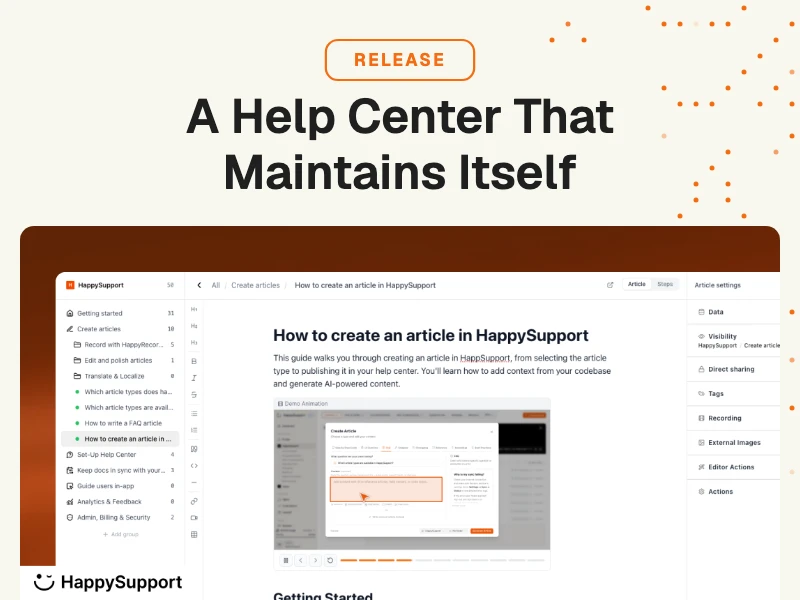
AI-native product documentation built around the maintenance problem. The HappyRecorder Chrome extension captures workflows as DOM and CSS selectors instead of screenshots, so the system detects when an underlying UI element changes. The HappyAgent GitHub Sync layer connects the help center to the product code repository, flagging articles whose source has shifted. Pricing starts at $299 per month with no per-user fees. Best for SaaS product teams shipping weekly without a dedicated technical writer. Weakness: smaller integration catalog than Zendesk or Confluence, fewer enterprise governance features today. See how self-updating help centers work.
Product documentation software pricing comparison
Pricing splits four ways: per-user (Notion, Confluence, Help Scout, Slite, Tettra), flat platform fees (Document360, HappySupport), MAU-based (Userpilot, Pendo), and free with paid tiers (GitBook, Notion). The cost that does not appear in the price chart is the labor cost of keeping articles current.
The hidden cost is the writer time. A 150-article product documentation library with weekly releases costs 6 to 10 hours a week to keep current, which at a $60 per hour fully loaded rate is $19,000 to $31,000 a year. That is the budget a maintenance-native tool replaces. The math sits in our piece on documentation decay.
Key features that actually matter
The features that move metrics are narrower than the marketing pages suggest.
Templates for product documentation patterns
Feature overview, how-to guide, troubleshooting article, release note, FAQ. Templates reduce blank-page paralysis and keep voice consistent across 200 articles written by ten different people. Document360, GitBook, and Help Scout ship templates out of the box. Notion and Confluence require building your own template library.
AI search and conversational answers
Customers ask questions in plain language and get answers grounded in the source articles. Multilingual support across 30 to 100+ languages is now standard at the higher tiers. Document360 ships answers in 50+ languages, Help Scout includes translation in core tiers, Userpilot's AI features focus on in-app rather than help center search.
Versioning and release notes
Product teams ship features, and version-aware documentation lets users on v1 see v1 docs while v2 customers see v2 docs. GitBook handles this well. Document360 ships with versioning built in. Notion and Confluence require manual workarounds.
Analytics on what users read
Search analytics surface what users searched for, what they clicked, and where they gave up. Dead-end queries point to content gaps. Pendo and Userpilot turn this into a product feedback loop. Document360 and Help Scout provide solid search analytics inside the help center. Notion and Confluence do not.
Why generic wikis fail at product documentation
Confluence and Notion are great internal wikis. Most teams reach for them because the team already pays for them and the editor is familiar. They fail at customer-facing product documentation for four reasons. First, the publish-to-public flow is an afterthought; both tools assume an internal audience. Second, the branding and styling controls are minimal, so the customer-facing page looks like an internal doc. Third, search analytics for external users do not exist. Fourth, neither tool was designed to handle the cadence of weekly product releases against a 200-article library.
The pragmatic split is internal documentation in Notion or Confluence, customer-facing documentation in a dedicated tool. Our piece on help center vs knowledge base walks through the split in more detail.
How to choose product documentation software
Three questions filter the field faster than any feature checklist.
Who maintains the content?
PM-owned: Document360, GitBook, or Notion (for internal specs). Support-team-owned customer help: Help Scout Docs, Document360, or HappySupport. No dedicated owner and product ships weekly: tools that detect staleness automatically are the only realistic option.
Internal or external?
Internal product specs: Notion, Confluence, Slite, Tettra. External user guides: Document360, Help Scout, HappySupport. Both audiences: GitBook handles this best with permission tiers, but most teams end up running two tools because the editorial voice is genuinely different.
How often does the product change?
Monthly or slower releases: any tool keeps up with manual effort. Weekly releases: docs-as-code with structured templates is the floor. Daily releases with significant UI churn: maintenance discipline dominates everything else, and tools that flag stale content automatically pull ahead.
The HappySupport approach
Every other product documentation tool on this list assumes a human keeps the articles current. HappySupport assumes the opposite. The HappyRecorder Chrome extension captures product workflows as DOM and CSS selectors at the moment a help article is written. When a developer ships a UI change, the system compares saved selectors against the live product and flags every article that no longer matches. The HappyAgent GitHub Sync layer reads the product repository, links code changes to affected help center articles, and surfaces what needs review before customers hit a stale page. The result is product documentation that stays accurate at the speed your product ships, instead of the speed your support team can audit. For SaaS teams shipping weekly without a dedicated technical writer, this is the dimension every other tool misses. See how self-updating help centers work and the GitHub Sync architecture.