.png)

A knowledge base for healthcare SaaS has to clear a higher bar than any other vertical. Most procurement teams know the first half of that bar. HIPAA. A signed BAA. Audit logs. Encryption at rest and in transit. Role-based access. The buyer's checklist is well-worn.
The second half almost never makes it onto the checklist. Clinical accuracy. Workflow correctness. The article a customer-service rep, an implementation manager, or a nurse informaticist opens at 2 a.m. has to be current. An outdated dosing protocol, a stale workflow guide that still references a deprecated EHR field, an integration article that points at an endpoint the vendor retired six months ago, these would be patient-safety risks if a clinician or a clinical-adjacent user acted on them. HIPAA does not require any of this to be accurate. The Security Rule covers the wire and the storage. It does not cover whether the article is correct.
This guide is the vertical complement to the broader HIPAA compliant knowledge base piece. That article maps the BAA landscape across knowledge base vendors. This one is healthcare-specific: what HIPAA actually requires of your knowledge base, the unspoken clinical-accuracy requirement, a vendor checklist that mixes regulatory and freshness controls, and a 90-day implementation plan that treats documentation drift as a safety event, not an SEO problem.
Nothing here is legal or clinical advice. Consult your privacy counsel, your compliance team, and your clinical-safety team before treating any vendor claim or this article as the answer to a procurement or risk question.
Why healthcare SaaS needs a different knowledge base
Most B2B SaaS verticals can frame their knowledge base as a customer experience problem. Tickets, deflection, time to resolution, content reuse. Healthcare SaaS has the same problems plus two compounding ones: a regulator (HHS, plus the state attorneys general who enforce HIPAA in practice) and a safety surface (the chance, however small, that a stale article ends up informing a clinical decision).
The regulatory surface is well documented. The U.S. Department of Health and Human Services Security Rule sets out administrative, physical, and technical safeguards for any system that creates, receives, maintains, or transmits electronic protected health information. If your knowledge base ever stores PHI, even a single screenshot with patient initials in an internal article, the Security Rule applies. The penalty tiers are public. The OCR enforcement actions are public. Most healthcare SaaS founders we talk to already know this part. They have an inside counsel or a fractional Chief Privacy Officer who has briefed them.
The safety surface is the part nobody puts in the procurement spec. Help center articles are not patient-care documents. They are product documentation. But healthcare SaaS sits adjacent to clinical workflows. A guide for revenue cycle managers about ICD-10 coding shortcuts. A workflow article that walks a triage nurse through configuring an inbound message rule in your platform. A release note explaining a change to medication-reconciliation logic. These articles influence decisions made by people whose decisions touch patients. An article that is wrong, or right last quarter but wrong this quarter, can ripple.
The honest framing is that most help center articles in most healthcare SaaS products will never touch a patient. Reset-password guides, billing administrator how-tos, single sign-on setup notes, none of these are clinical. But the moment a single article describes a workflow that a clinical or clinical-adjacent user will follow, the freshness of that article becomes a control. Not a marketing nice-to-have. A control. Most procurement teams have no language for this, because most vendors have no answer for it.
What HIPAA actually requires of a healthcare KB
HIPAA does not contain a clause that says "your knowledge base must do X." The regulation predates SaaS by nearly two decades. What HIPAA does have is the Security Rule, and the safeguards in the Security Rule apply to any system handling electronic PHI. For a knowledge base, that translates to a recognizable set of requirements.
First, a signed BAA. A Business Associate Agreement is the contract that names the vendor as a HIPAA Business Associate and binds them to the same direct liability the 2013 Omnibus Rule created. Without a BAA, a covered entity cannot legally share PHI with the vendor. Most knowledge base vendors that sign BAAs do so only at their Enterprise tier, with an explicit add-on, or after a sales review. Verify directly. Vendor tier requirements change.
Second, access controls. Role-based access at minimum, ideally with separate clinical-reviewer roles, and the ability to scope an article or a category to a specific group. The Security Rule's "minimum necessary" principle applies to any internal article that contains PHI.
Third, audit logs. Every read of a PHI-containing article, every edit, every publish, every permission change. Retained for at least six years per the HIPAA documentation retention rule. The audit log has to survive operator deletion, which means it cannot live in the same surface the article lives in.
Fourth, encryption. AES-256 at rest is the de facto standard, TLS 1.2 or higher in transit. Most reputable vendors clear this floor. Verify it is on by default, not an Enterprise toggle.
Fifth, breach notification. The BAA defines the timeline. HIPAA requires notification within 60 days of discovery. Vendor SLAs that exceed this break the BAA's enforceability.
Sixth, versioning. Every published version of every article has to be reconstructible, with timestamps and authorship, for at least the documentation retention period. This matters if a deprecated article is later cited in a complaint, an investigation, or a malpractice claim.
Seventh, optionally but increasingly expected, IP allowlisting, single sign-on with SCIM provisioning, and an option for customer-managed encryption keys. These are not strict HIPAA requirements. They are what enterprise healthcare procurement teams ask for. If the vendor cannot offer them, the deal stalls in security review.
None of this is legal advice. Run any vendor claim through your privacy counsel and your security team before signing a BAA or trusting a "HIPAA compliant" badge in marketing copy.
The unspoken requirement: clinical accuracy
HIPAA does not require your knowledge base to be accurate. The Security Rule does not have a "freshness" clause. There is no audit control in any SOC 2 or HITRUST framework that says "articles describing clinical workflows must be current." The compliance frameworks were designed to protect PHI from unauthorized access, not to ensure the documentation describing your product is correct.
This is the unspoken requirement. And in healthcare SaaS it sits one tier above HIPAA in real-world consequence, even if it sits a tier below in regulatory weight.
Consider a hypothetical. A revenue cycle SaaS product ships a change to how denials are categorized in its inbound 835 parser. The release notes are updated. The customer-facing setup guide is not. A billing supervisor at a customer hospital opens the setup guide six weeks later, configures rules based on the old categorization, and starts auto-routing denials to the wrong queue. Nothing in this story violates HIPAA. The vendor signed a BAA. The article is encrypted at rest. The audit log captured the read. But the article was wrong, and the wrongness propagated into a workflow that affected which claims got worked and when. In a high-volume hospital, that is real revenue and real time-to-payment.
Now substitute a clinical workflow for a revenue cycle workflow and the stakes shift. An outdated guide that describes how to configure medication-reconciliation logic, a release note that fails to mention a change to allergy-checking behavior, a help article that walks an implementation lead through configuring an EHR-integration field in a way the vendor changed last quarter. These would be patient-safety events if a clinical user followed them. They are not, today, anyone's HIPAA problem. They sit outside the regulation entirely.
The reason this matters for procurement is that no vendor will solve a problem the contract does not name. If your knowledge base RFP asks for BAA, SOC 2, audit logs, and encryption, every Enterprise-tier vendor will check the boxes. None of them will commit, in the contract, to keeping the articles accurate. The contract has no language for that. Most vendors have no operational answer for it either. So the freshness problem becomes the customer's problem, owned by a Support Lead or a Documentation Manager who reports into Engineering or Customer Success and who has neither the time nor the tooling to keep pace with product releases.
The vendors who do answer this problem do so with a freshness mechanism. Auto-recording the UI so screenshots update with the product. Linking articles to source code so an article touching a deprecated field surfaces for review the moment that field is removed. Versioning at the article level with retention. Knowledge-Centered Service practices borrowed from the Service Innovation library, which treat documentation as a continuously-improved knowledge asset rather than a one-time deliverable. These mechanisms do not replace HIPAA. They sit on top of it.
Healthcare KB vendor checklist
This is the eight-item checklist we use when reviewing a knowledge base for a healthcare SaaS team. It blends regulatory and freshness controls. Both halves matter.
The first seven items are the regulatory floor. The eighth item is the one most procurement processes miss and the one most vendors have no answer for. If a vendor's answer to "how do articles stay current" is "your team owns that," they are telling you the truth about their tooling. They are also telling you that the freshness control will sit on your team's shoulders permanently.
Vendors with BAA plus healthcare-grade controls
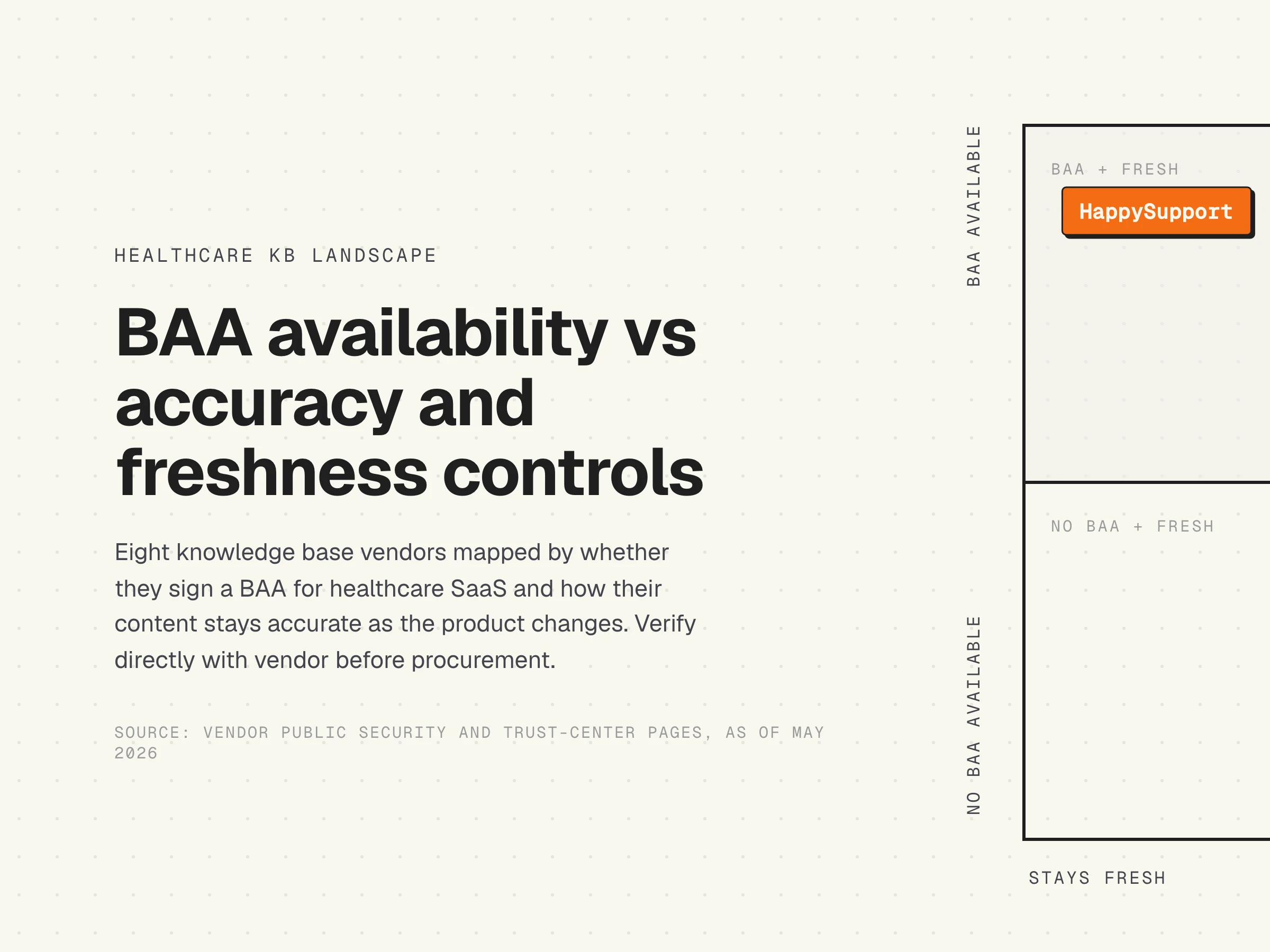
The table below maps four knowledge base vendors commonly evaluated by healthcare SaaS teams. Every cell reflects what the vendor publishes on their public security or trust-center pages, or what they confirm via sales channels, as of May 2026. Verify directly with the vendor. Tier requirements, add-on names, and BAA terms change.
Two notes on this table. First, the BAA cells marked "verify with sales" reflect what is not on the vendor's public security page as of May 2026. Several of these vendors do sign BAAs when asked, and one or two have it gated behind a security review or an add-on that is not named on the marketing site. Always get the executed BAA in writing before any PHI is uploaded. Second, the freshness-controls column is where every vendor outside HappySupport currently lands at "manual review cadence." That is not a knock on those vendors. It is what their tooling supports. If your team has the bandwidth to run a quarterly accuracy review on every PHI-adjacent article, manual cadence is workable. Most teams do not have that bandwidth. Documentation decay is the predictable result, and we have written about the hidden cost of documentation decay at length.
Vendors to skip for healthcare
Some vendors that work well for other B2B SaaS verticals do not clear the bar for healthcare. As of May 2026, verify with each vendor before procurement.
Notion. Notion historically has not offered BAAs on its standard tiers per its publicly listed compliance pages. Notion Enterprise has expanded compliance offerings, but BAA terms remain a contract-level question. Most healthcare SaaS teams that try to use Notion as their customer-facing knowledge base discover this during their first PHI-adjacent procurement review. Verify the latest BAA stance with Notion sales before assuming it is available.
GitBook. Developer documentation platform with limited public HIPAA stance. Suited to API and developer reference, less suited to a customer-facing healthcare help center where PHI may appear in screenshots or internal articles. Verify with vendor.
HubSpot KB. HubSpot signs BAAs in some contexts (the Marketing Hub and certain Service Hub configurations). The current BAA scope across HubSpot's product surface is not always clear from the marketing site. If you are running HubSpot for CRM and CMS already, talk to your account team about which products are covered.
Generic wikis. Self-hosted MediaWiki can be made HIPAA-aware, but the burden is fully on your team. Atlassian Confluence Cloud has expanded its compliance program, but BAA scope and tier requirements should be verified directly. Outline does not publicly advertise HIPAA support.
None of this means these tools are bad. It means they were not built for healthcare SaaS procurement. If you are evaluating one of them for a healthcare context, build verification into your procurement timeline.
A 90-day healthcare KB implementation plan
The plans we see work best across healthcare SaaS teams of 20 to 150 people break into three 30-day phases. Each phase ends with a deliverable a Support Lead or a Documentation Manager can show the security and compliance teams. The plan assumes you are picking a vendor and migrating, not building one from scratch.
Days 1 to 30: BAA, scope, and content inventory
Sign the BAA with the chosen vendor before any content is migrated. Get the executed copy in writing. Run an internal content inventory of the existing help center. Tag every article by category, by audience (customer-facing, internal-only, partner-facing), and by whether it contains or could contain PHI. Most teams discover that 80 to 90 percent of articles have no PHI exposure. That subset can move first. The remaining 10 to 20 percent need a PHI review before they migrate. If you do not have a privacy reviewer in-house, this is the phase to engage a fractional Chief Privacy Officer.
Define your clinical-adjacent article taxonomy. Which articles influence workflows that touch patients, even indirectly? Tag them. These are the articles where freshness becomes a control, not a nice-to-have. The output of this phase is a content inventory spreadsheet with PHI, clinical-adjacent, and routine tags applied to every article.
Days 31 to 60: Migration, access controls, and audit log validation
Migrate the routine, non-PHI articles first. Configure RBAC roles for clinical-reviewer, content-author, support-agent, and admin. Set audit log retention to at least seven years (one year past the HIPAA documentation retention floor, to give yourself slack). Validate the audit log by deleting a test article, then attempting to recover from the log. If the log cannot reconstruct the test deletion, escalate to the vendor before any PHI-containing content moves.
Set up your single sign-on, SCIM provisioning, and IP allowlist. Most healthcare SaaS teams treat this as a one-time setup. Treat it as a recurring review. New hires, role changes, and departures all touch RBAC, and HIPAA audits ask for the access logs.
For deeper context on auditing your existing knowledge base before migration, our walkthrough on knowledge base AI readiness audits covers the freshness side, which compounds into the migration plan.
Days 61 to 90: Clinical-adjacent review, freshness mechanism, and go-live
Run the clinical-adjacent articles through a clinical reviewer. This is the cohort tagged in Phase 1. The reviewer's job is not to approve every article; it is to flag articles that describe a workflow a clinical or clinical-adjacent user would follow. Those articles need a freshness SLA tied to product release cadence. If the product changes weekly, the SLA cannot be quarterly.
Wire your freshness mechanism. If your KB vendor supports source-code linkage (HappySupport's GitHub Sync model is the only one we know of in this category as of May 2026), connect it. If not, build a manual freshness review into your engineering release process. Every product release that touches a clinical-adjacent workflow triggers a doc review. No release goes live without the docs reviewed. This is operationally painful and most teams cut corners under pressure. The corner-cutting is the freshness problem.
Go-live happens when the audit log, the BAA, the RBAC roles, the freshness mechanism, and the clinical-adjacent review process are all in place. Most teams underestimate the freshness mechanism and overestimate the BAA. The BAA is a one-time signature. The freshness mechanism is a forever process.
Common healthcare KB mistakes
BAA fatigue. The BAA is the start line, not the finish line. It opens the door to handling PHI. It does not close any other gap. Most healthcare SaaS teams sign the BAA, exhale, and stop investing in the knowledge base. Three months later the articles describing the workflow that the BAA was supposed to protect are already drifting.
SOC 2 confusion. SOC 2 is an assurance framework. HIPAA is a federal regulation. SOC 2 Type II tells you the vendor has consistent controls. It does not bind them to handle your PHI under HIPAA. You need both. The BAA is the legal hook. The SOC 2 report is the technical evidence backing the BAA.
Unverified claims. "HIPAA compliant" is a marketing phrase. It is not a certification. There is no body that certifies a vendor as HIPAA compliant. The phrase typically means the vendor will sign a BAA. Verify with the executed BAA copy, not the badge on the homepage.
Freshness ignored. An OCR audit will not flag your outdated dosing-workflow article. Your customer's clinical-safety officer might. Treat freshness as a procurement requirement even though no regulator demands it. The vendors who can meet it will save your team years of compounding manual work.
Wrong org owner. Documentation that lives in the engineering team's backlog deprioritizes whenever a sprint slips. Documentation that lives with the Support Lead or the Documentation Manager, with a clear interface into the engineering release process, holds its own deadlines. The org chart matters more than the tool for the freshness side. Our walkthrough on building a SaaS knowledge base goes deeper on the team structure question.
How HappySupport fits
HappySupport is built for SaaS teams whose product changes faster than their documentation can keep up. The HappyAgent component links every article to the source code through GitHub Sync. When a developer renames a field, deprecates an endpoint, or changes a workflow, the articles touching that change surface for review automatically. No manual quarterly audit. No "we'll catch it in the next sprint."
For healthcare SaaS specifically, the BAA is available at the Scale tier. Audit logs capture every edit, every publish, every permission change. Encryption at rest and in transit is on by default. Data residency is EU by default (Frankfurt and Nuremberg), with US options available on request. SOC 2 Type II attestation is in progress; verify the current status with sales before signing.
HappySupport sits beside your existing customer support stack. Intercom, Zendesk, Help Scout, HubSpot, Front, Freshdesk. It is not a ticketing replacement. It is the help center layer. The ticketing system handles inbound conversations. HappySupport keeps the articles those conversations cite accurate, every release.
If you are evaluating a healthcare knowledge base, the highest-leverage question to ask any vendor is the freshness question. Not "do you sign a BAA" (most Enterprise-tier vendors do). Not "do you have SOC 2" (most do). Ask "how do articles stay current when the product changes weekly." That answer reveals whether the vendor has the operational tooling to support a healthcare workflow, or whether the freshness problem will sit on your team's shoulders for the next decade.
Consult your compliance and clinical-safety teams before any procurement decision. Nothing in this guide is legal or clinical advice. The right answer for your team depends on your risk analysis, your existing business associate relationships, and the scope of PHI in your systems.