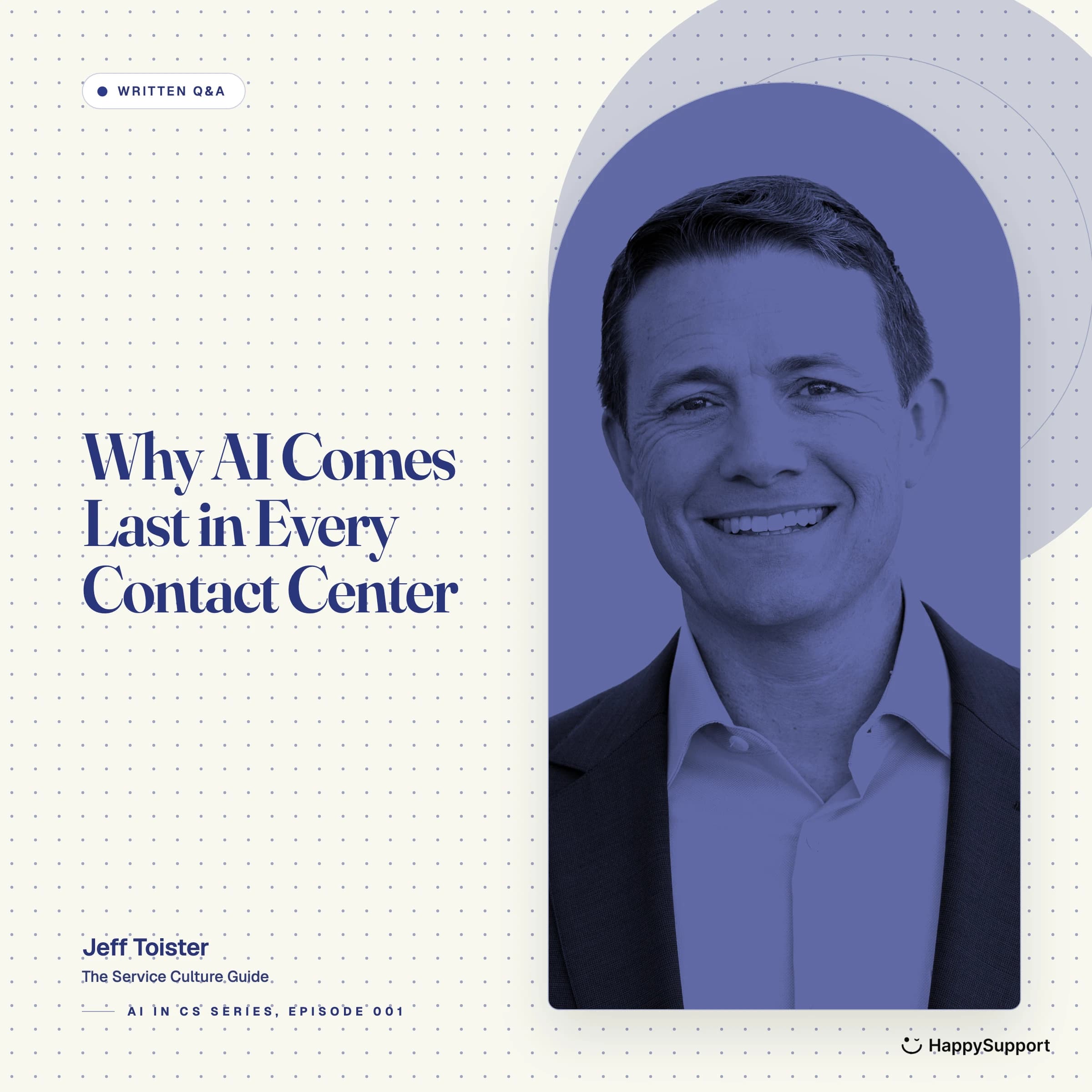
AI in CS Series, Interview #001. With Jeff Toister, author of five books on customer service, instructor for over a million LinkedIn Learning takers, and publisher of the Customer Service Tip of the Week newsletter for more than ten years.
Jeff Toister has spent thirty years training customer service teams. His latest book is Human Service: The Skills That AI Can't Replace. He thinks AI is genuinely useful in contact centers, and he thinks most companies are sequencing the work wrong. Culture, process, training, AI. In that order. Below, the case for putting AI last. The new systemic obstacles he sees nobody naming. And the agent named Betty who reshaped his whole approach to leadership.
HOT TAKES
Six unfiltered opinions from Jeff Toister.
Culture first. Process second. Training third. AI last.
The most successful customer-facing AI meets three conditions: the customer is confident, the operations are routine, the results are predictable.
83% of customer service employees work with at least one toxic coworker.
AI in a closed loop with no escalation path makes service worse, not better.
Training is wasted when you skip culture and best practices first.
When you want to improve a team, go to the source. Find your Betty.
Q1. The Legacy Check
Q: You wrote five books on customer service. Which idea from your first book are you most embarrassed by today, and which one has aged better than you expected?
A: Whoa. Question one and you're already looking for the hot gossip and juicy takes.
I'm not embarrassed by any of the ideas in Getting Service Right. The book identified 10 unexpected and counterintuitive obstacles to great customer service. Every obstacle was based on research, field observations, and my own experience training thousands of customer service employees.
The book itself has aged well. All 10 obstacles are still challenges in many organizations today. I'm still on a mission to create more awareness around these issues and help leaders make it easier for employees to provide great customer service.
Q2. The New Systemic Obstacles Nobody Is Naming
Q: You wrote that the real reasons employees don't consistently deliver good service are systemic, not individual. In a 2026 contact center where half the workflow is AI-assisted, what are the new systemic obstacles that nobody is naming?
A: Let's start with a clarification. Individual employees are absolutely responsible for the customer service they provide. Systemic challenges account for some of the reasons they fall short, like a toxic culture that discourages people from helping customers or chronically failing systems. Some employees are able to rise above these challenges better than others.
There are also employees who are not well-suited to customer service work. For example, I did a study that found 83 percent of customer service employees have at least one toxic coworker. These are employees who harass others, steal, intentionally provide poor service, and engage in other harmful behaviors.
The increasing use of AI has certainly created or at least amplified some service obstacles. One is customer-facing AI that does not provide an easy escalation path to human help. Customers get frustrated when they're forced to use AI, especially if they don't feel AI is helping them. That frustration often gets directed at human agents when customers are finally able to connect with someone. It's hard to do your job when you are getting yelled at for something outside of your control.
Another obstacle is what I call "work flow interference." There are contact center systems that use a lot of AI-generated prompts to guide agents on what to do or say. These can sometimes be helpful for newer agents, but contact center leaders tell me they're incredibly distracting and annoying to more seasoned agents who don't need a constant barrage of nudges while they're serving customers.
Q3. Where Service Culture Lives When AI Handles the First 30 Seconds
Q: You wrote the playbook on how to make employees obsessed with customer service. When AI handles the first 30 seconds of every interaction, where does culture actually live? In the AI script, in the human handoff, somewhere else?
A: Culture is present in all of those places.
A service culture is an organizational culture where there is a collective way employees think about providing outstanding service, act to provide it, and understand how and why they do it.
This includes the design and implementation of AI and other systems. For example, I know a customer-focused leader who implemented AI in his contact center to improve customer experience. That's a service culture decision, where the use of AI is carefully designed and monitored to ensure it's helping customers.
Q4. AI Helps. AI Quietly Hurts.
Q: What do you think are the biggest pain points in customer service where AI can actually help, and which ones is AI quietly making worse?
A: The most successful customer-facing AI focuses on automating CRaP.
- Confident: customers are confident using AI
- Routine: regular transactions that make it easy to train and monitor AI
- Predictable: AI can consistently deliver good results
One example where AI is doing a great job is handling simple, routine transactions. A company that offers roadside assistance for truck drivers implemented an AI voice agent to handle assistance calls and dispatch a mechanic. These are generally simple calls that don't require human intervention. By using AI, the company reduced abandoned calls by 85 percent. It also saw contact center agent retention improve by 50 percent since agents now had more bandwidth to help customers who truly needed them.
AI is making service worse when it's implemented in a closed loop with no escalation path. Customers don't want to be forced to use AI. It's especially frustrating when AI is unable to solve their issue and then refuses to connect them with a human agent.
Q5. The Skill 2026 Teams Are Weakest At
Q: Over a million people have taken your LinkedIn Learning courses. From the questions and feedback you see, what's the skill customer service teams are weakest at in 2026 that they were strong at in 2020?
A: My Phone-Based Customer Service course has grown in popularity since 2020. Phone skills in general are a growing challenge in customer service. There's a different way of communicating with people over the phone since you can't see the person on the other end of the conversation.
In 2020, people were already using the phone less and less. That year, there was a huge shift towards video calls when people wanted to connect with family, friends, or coworkers. That makes the phone even more critical since it's not a skill many people practice in their daily lives.
Q6. The 90-Day Playbook: Culture, Process, Training, Then AI
Q: If a contact center leader has 90 days, fixing culture, fixing training, fixing process, or deploying more AI, what's the right order? Where do most teams get the order wrong?
A: Contact center leaders should start with culture because culture guides everything employees do. Culture is a collective way of thinking and acting, so it influences every other decision. What do you need your processes to do? What training do employees need? Can AI help, and if so, what help do you need? All of those are driven by culture.
When it comes to working on culture, what leaders really need to do is establish a clear customer experience vision. This is a shared definition of an outstanding customer experience that gets everyone on the same page. Leaders should work with their team to establish a vision and make sure every employee knows it.
Processes come next. This is how employees will execute the vision in their daily work. In strong service cultures, processes represent best-known practices that help everyone operate at a consistently high level.
Training is the next step. It should help employees develop the knowledge, skills, and abilities to deliver great service. This includes training employees to follow best practices. The reason training comes after process is you need to document your best practices first so you know what to train your employees to do.
Of the four, AI comes last. AI is just a tool. How contact centers use AI should be shaped by the culture, the processes they use, and the service employees are trained to provide.
The biggest mistake I see contact centers make is skipping culture entirely. Many also skip documenting best practices and start with generic training. Training is wasted when you don't have a culture to back it up and you haven't defined the best practices you want employees to follow.
Q7. The Tip He Has Not Retired
Q: Your Customer Service Tip of the Week goes to 10,000+ professionals. What's a piece of conventional wisdom you used to send out that you would not write today?
A: I've been sending out my newsletter for over ten years. Each quarter, I carefully review the tips I send. I have not retired a single tip for being outdated.
The tips in my Customer Service Tip of the Week newsletter are intended to be timeless. They're all core skills that are proven to work. Many recipients find the weekly tips are reminders of skills they already know, but might not be using as consistently as they should.
Q8. The 2031 Bet: Burnout, Empowerment, and the Job That Gets Harder
Q: It's 2031. The "customer service representative" job either looks fundamentally the same, or has been split into "AI prompt operator" and "complex case escalation specialist." Which one happens, and what tips the scale?
A: I'm terrible at predictions, but I can share what I've seen in over 30 years of customer service training. Customer service jobs are getting more complex. This pre-dates the explosion of AI. Other forms of automation have gradually removed simple transactions from many customer service roles, leaving more complex ones for human agents.
The big question is whether companies are preparing their agents for the growing complexity. I did a study on contact center agent burnout that found 59 percent of agents were at risk of burnout. The biggest factor that made agents more resilient to burnout and lowered their risk was empowerment. Agents who are given the tools, resources, and authority to provide great service in today's complex environment are most likely to thrive.
This is an area where AI can provide a tremendous advantage. For example, AI tools can help agents quickly find the right answer to a customer question. This enables the agent to be an expert in the eyes of the customer instead of wasting precious time hunting for information.
Q9. Three Names: Jeppesen, Goodman, Nelson
Q: Three names. One service leader doing something that surprised you in the last 90 days, one author or researcher whose latest piece changed how you think, and one young voice in CX you would tell your audience to follow this year.
A: There are too many people to name, so I'll just go with top of mind based on recent conversations.
Brian Jeppesen is the Director of Contact Centers at Fertitta Entertainment. He's doing a lot with AI in his contact center, but all of it is focused on making the guest experience better. I was able to interview Brian for my latest book, Human Service: The Skills That AI Can't Replace. The insights he shared were really valuable.
One researcher whose work really influenced me is John Goodman, Vice Chairman of Customer Care Measurement and Consulting. John and I had the same editor when I wrote my first book. I quoted him so much in the first draft that my editor had to tell me to find some other sources to mix it up. His classic book, Strategic Customer Service, was especially helpful.
A young (but not inexperienced) voice in CX to follow is Kate Nelson. Kate offers witty takes on customer experience with an emphasis on technology, particularly AI.
Q10. The Sixth Book: Finding Betty
Q: If you were writing a sixth book in 2027, what would the title be and what's the chapter you would build the whole book around?
A: Oof. Writing a book is a lot of hard work and I just finished my fifth one. It's hard to imagine writing another one, let alone so soon.
If I had to write a book it would probably be called Finding Betty. The chapter I'd build the book around is the story of how I found an agent named Betty and how that completely changed my approach to customer service leadership.
The short version is I was a contact center training supervisor tasked with helping over a thousand agents in five contact centers improve performance on one KPI. I wasn't sure where to start, so I looked at the data. One agent, Betty, was absolutely crushing it. I scheduled some time to sit side-by-side with her so I could listen to her take calls, see her approach, and ask questions. My time with Betty unlocked the keys to helping all agents improve, and the "Betty approach" quickly generated big results.
The experience taught me that when you want to improve something, the first step is to go to the source and watch the work being done.
Connect with Jeff: toistersolutions.com | LinkedIn | Human Service: The Skills That AI Can't Replace
This interview opens HappySupport's expert series on self-service and customer experience. More conversations and research from the series live on the HappySupport blog.
 Book a demo