.png)


Screenshot documentation has a shelf life. The moment your product ships a new release, the pixel snapshot your tool took last month is already wrong. For companies shipping weekly, that's not a maintenance problem; it's a structural one. DOM/CSS recording takes a fundamentally different approach: instead of capturing what your UI looks like, it captures what your UI is in the codebase. That distinction changes everything about how documentation ages.
How screenshot documentation tools actually work
Screenshot-based documentation tools record your UI as a sequence of images. When you click through a workflow, the tool takes a pixel snapshot at each step and stitches those snapshots into a step-by-step guide. Tools like Scribe and Tango have made this fast: you complete the workflow once, and the guide is generated automatically in minutes.
What gets captured (and what doesn't)
A screenshot captures coordinates, colors, and layout at a specific moment in time. The tool knows a button exists at position (450, 280) on screen, that it's orange, and that it contains the text "Export Report." It does not know that this button maps to a <button data-action="export-report"> element in your React component tree. There is no connection between the image and the code that produced it.
This is the core constraint of screenshot-based documentation: the tool captures appearance, not identity. A screenshot of your settings menu is a JPEG. The word "Settings" exists only as pixels. There is no programmatic way to know, from the image alone, whether that menu still exists in your product, whether it's been renamed, moved, or split into two sections.
When screenshot tools work well
For certain use cases, screenshot tools are fast and appropriate. Internal SOPs covering stable workflows, one-off onboarding materials, and process documentation for tools your team controls work fine with screenshots. If a workflow changes twice a year, the manual update burden is manageable.
The friction point appears when the underlying product ships frequently. For customer-facing help center documentation at a B2B SaaS company, that friction is constant. The Stack Overflow Developer Survey consistently ranks outdated or incomplete documentation as the top frustration developers face when using software. Screenshot-based documentation is the primary reason that frustration exists.
What DOM and CSS recording actually captures
DOM/CSS recording captures the structural identity of UI elements, not their appearance. When HappyRecorder logs a step in your workflow, it stores the CSS selector chain for each element you interact with, something like [data-action="export-report"] or #settings-nav .btn-primary. That identifier describes what the element is in your codebase, not where it sits on screen or what color it happens to be today.
The difference between a pixel and a selector
The DOM (Document Object Model) is the hierarchical structure of every element on a web page. Every button, input field, menu item, and modal in your product has a position in this tree. A CSS selector is the address of a specific element within that tree.
Consider a "Submit" button. A screenshot tool records that a button-shaped object appeared at a certain screen position. A DOM/CSS recorder stores form#onboarding-step-3 button[type="submit"], which is the element's actual identity in the code. When a developer renames the form's ID in a later sprint, the documentation system knows exactly which guides reference that selector. The screenshot tool has no idea anything changed.
Why selector identity outlasts pixel appearance
CSS selectors survive most routine UI changes. A button that moves from the left side of a toolbar to the right, and the selector still works. A form that gets restyled with new colors and typography, and the selector still works. Even a label change from "Settings" to "Preferences," if the developer updates both the visible text and the underlying selector consistently, can be detected and handled automatically.
Pixel coordinates don't survive any of those changes. The moment a button shifts position or a menu item changes its label, every screenshot showing that element is wrong. The guide still displays. It just no longer matches reality.
Why screenshot documentation breaks with every release
The documentation maintenance problem is a math problem. The DORA State of DevOps research consistently finds that high-performing software teams deploy multiple times per day. Even teams at the mid-tier ship weekly. If each release touches an average of five to ten UI elements, and each touched element could invalidate one or more guide steps, the backlog grows faster than any team can manually audit and fix it.
The silent staleness cycle
Screenshot-based documentation fails silently. There's no alarm when a guide becomes outdated. A customer follows your help center article step-by-step, reaches step four, and sees a settings menu that no longer looks like the screenshot. They open a support ticket. Your team closes it, then goes to find and update the stale guide, if they remember to. Meanwhile, the next twenty customers hit the same wrong screenshot before anyone notices.
This is what documentation decay costs SaaS teams over time: not a single bad guide, but a gradual erosion of trust in the entire help center. Research from the Consortium for Service Innovation's KCS methodology library describes knowledge articles as living documents. Their value depends on remaining accurate, and accuracy is only maintained through consistent, demand-driven review at the point of use. Screenshot tools make that review a manual, invisible burden.
The compounding debt at scale
A team maintaining 50 help center articles with weekly releases faces a compounding problem. After six months, if each release touches even two articles on average, that's 50+ stale-guide events. Not all of them get caught immediately. Some persist for weeks. Your support team discovers most through customer tickets.
Updating a single multi-step visual guide (re-recording the workflow, replacing each screenshot, adjusting annotations) takes roughly 45 minutes to an hour per guide when done carefully. For a team handling five stale articles per month, that's four to five hours of monthly maintenance on content that should already be correct. Over a year, that's 50 to 60 hours of work that produces zero new documentation.
The "remove screenshots entirely" failure mode
Research on documentation teams shows a consistent pattern: teams that cannot keep up with screenshot maintenance eventually stop using them. They remove images from guides, revert to text-only instructions, and accept that the documentation is thinner than it should be. This is screenshot decay's end state: not bad documentation, but less documentation.
This matters especially in 2026, when AI-powered support agents from Zendesk, Intercom, and others retrieve from your knowledge base to answer customer questions. An AI agent that retrieves from text-only documentation is retrieving from incomplete documentation. The visual context that would help users recognize the right screen simply isn't there.
How DOM/CSS recording handles UI changes
When HappyRecorder captures a workflow, it stores both the rendered screenshot and the CSS selector chain for every interactive step. The screenshot is generated from the structural data, not stored as an independent image. When the underlying selectors change, the system knows which steps are affected and can act on that knowledge.
GitHub Sync: connecting documentation to your codebase
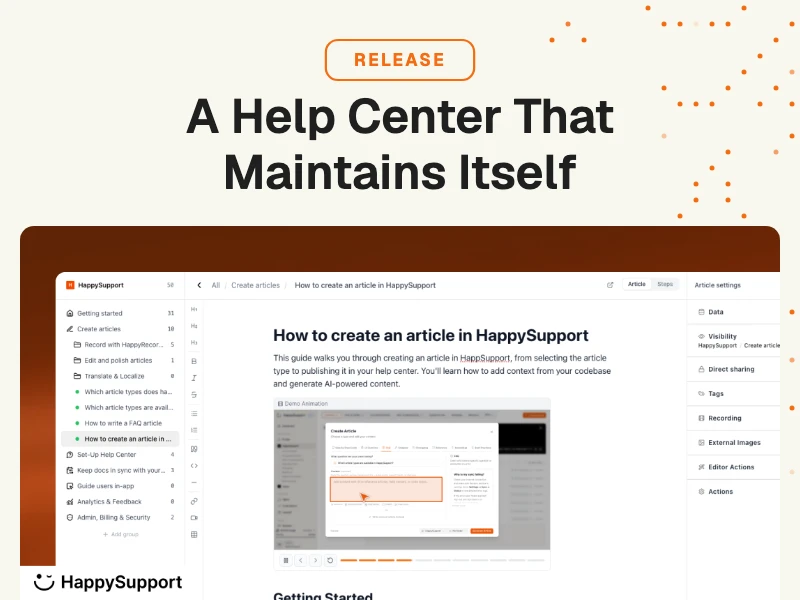
HappySupport's self-updating help center works through HappyAgent, which monitors your GitHub repository. When a developer commits a change that modifies a CSS selector matching a stored guide step, HappyAgent triggers one of two responses depending on the type of change:
- Auto-update: For simple changes (a button's label renamed, a data attribute updated), the agent rewrites the affected step automatically and logs the change in the Content Freshness Dashboard. No human required.
- Stale-content flag: For structural changes (a workflow reorganized, a modal moved to a different page, a form split into two steps), the agent flags the guide and notifies the assigned team member with context about what changed in the commit.
This is categorically different from what screenshot tools can offer. A screenshot tool cannot connect to your GitHub repo because it has nothing to look for. It stored an image, not an identifier. There's no selector to match against commit diffs.
What the Content Freshness Dashboard shows
Instead of discovering staleness through customer tickets, the Content Freshness Dashboard gives your support team a live view of which guides are current, which have been auto-updated since the last commit, and which need manual review. The workflow changes from reactive (fix after the customer complains) to proactive (flag before the customer sees it).
This distinction has a direct impact on self-service success. When customers trust that your documentation is accurate, they use it. When they've been burned by stale guides before, they skip the help center and go straight to support. Every broken guide accelerates that behavioral shift, and once customers lose confidence in self-service, they rarely come back to it.
Speed, quality, and maintenance burden compared
Both approaches are fast at creation time. A screenshot tool and a DOM/CSS recorder both produce a step-by-step guide in minutes. The difference shows up over time.
Creation speed
For initial documentation creation, screenshot tools have a slight edge in accessibility: no technical setup required, no Chrome extension configuration, just install and record. HappyRecorder adds minimal friction: a one-time Chrome extension install and a GitHub connection during onboarding.
The guides produced look similar from the outside. Both generate annotated step-by-step walkthroughs with screenshots. The difference is internal: one stores pixels, the other stores selectors.
Maintenance burden over time
This is where the gap opens significantly. Camunda, a process automation company, documented their experience automating screenshot updates using TestCafe end-to-end tests. Their user guide contained 94 screenshots. Updating them manually consumed "a day or two per release." Their automation solution, which re-captures screenshots during CI runs, recovered that time almost entirely.
That's the best-case scenario for screenshot automation: a well-resourced engineering team building custom CI tooling to run tests and re-capture images on every deployment. Most SaaS support teams don't have that infrastructure, and shouldn't need to build it themselves.
DOM/CSS recording eliminates the category of work entirely for routine changes. The documentation system detects what changed in the codebase and handles it. Support teams keep their time for writing new content rather than replacing outdated screenshots.
Documentation quality under pressure
Teams working under release pressure cut corners on documentation maintenance. Screenshots get skipped, updates get deferred, guides go stale for longer than they should. With DOM/CSS recording and GitHub Sync, the maintenance cycle isn't a manual task that gets deprioritized under pressure. It's an automated process that runs regardless of team bandwidth.
When screenshots are still the right tool
Screenshot tools aren't obsolete. They're the wrong choice for a specific use case: customer-facing, frequently updated, product-dependent documentation. For other use cases, they're genuinely fast and appropriate.
Use screenshot tools when: you're documenting internal processes that change infrequently; you're creating one-off training materials with a defined shelf life; you're documenting third-party software you don't control (and therefore can't connect to GitHub); or you need to move fast without any setup overhead.
The honest assessment: if your product ships weekly, screenshot tools create a maintenance liability that grows every sprint. The time you save recording goes back into re-recording after each release. The break-even point comes quickly.
There's also a nuanced point worth making about screenshot philosophy. Technical writers debate whether screenshots should be used at all in certain types of documentation. Some argue that behavior-based writing like "navigate to the export function" survives UI changes better than visually dependent writing like "click the orange button in the top-right corner". DOM/CSS recording resolves this tension: the guide can be both visual and resilient, because the visual is derived from structural data, not from a fragile pixel snapshot.
Choosing the right approach for your SaaS team
The decision comes down to two variables: how often your product ships, and how customer-facing your documentation is.
The AI support dimension
An important factor many teams underestimate: if you're running an AI support chatbot (Zendesk AI, Intercom Fin, or any system that retrieves answers from your knowledge base), the accuracy of that chatbot depends directly on the accuracy of your documentation. Screenshot-based documentation gives an AI agent visual references but no structural context. When a screenshot is outdated, the AI retrieves content that no longer matches the product. The chatbot gives a wrong answer. The customer doesn't know whether to trust it.
DOM/CSS-recorded documentation tells the AI system not just what the article says, but whether the selectors it's based on still match the current product state. That structural metadata is what separates documentation that degrades AI performance from documentation that enhances it.
The question to ask before deciding
How many product releases happened in the last 90 days? If the answer is more than three, the documentation maintenance math doesn't work with screenshots unless you've built CI automation to re-capture images automatically. And if you're already investing in CI tooling to keep screenshots current, you've essentially built a brittle version of what DOM/CSS recording does natively.
The underlying principle
Screenshot documentation tools were built for a slower product world. They're good at capturing a moment. The problem is that SaaS products stopped having stable moments years ago.
DOM/CSS recording is built for how SaaS products actually ship: fast, continuously, with UI changes in every sprint. The documentation it produces isn't tied to a pixel snapshot of last month's interface. It's tied to the code structure underneath, which means it can evolve with your product rather than fall behind it.
For teams serious about self-service success, the question isn't whether screenshot documentation breaks. It does, predictably, on a schedule you can calculate. The question is whether you build your help center on a foundation that requires constant repair, or one that handles the repairs automatically.
HappySupport is built entirely on the DOM/CSS recording model. The HappyRecorder captures every step as structured metadata — CSS selectors, element IDs, DOM position — rather than pixel images. When your product ships a change, HappyAgent compares the current application state against what was recorded and identifies exactly which steps are affected. No manual re-recording required for most changes. If you're evaluating documentation tools specifically because screenshot-based guides break after every release, HappySupport was built to solve that problem at the architecture level.