.png)

Most support teams discover the documentation maintenance trap the same way. They build a help center, spend weeks getting the articles right, and then the product ships a new release. Then another. Within three months, the help center describes a product that no longer quite exists. The team tries to catch up. They schedule reviews, add documentation tasks to release tickets, hire a writer. Nothing keeps up. The trap is not the work. The trap is the architecture.
Manual documentation maintenance assumes that humans can detect product changes faster than changes accumulate. At the shipping cadences B2B SaaS teams run today, that assumption stopped being true a long time ago. The result: help center articles that describe old workflows, chatbots that give wrong answers, and support agents who route around the knowledge base because they know it cannot be trusted. The financial consequences of that failure are laid out in the hidden cost of documentation decay.
This article explains what the documentation maintenance trap is, how teams fall into it, why common solutions do not work, and what a structural fix actually looks like.
What is the documentation maintenance trap?
The documentation maintenance trap is the operational state where product changes generate documentation debt faster than any manual process can resolve it. Teams hire more writers, schedule more reviews, and build more documentation workflows. The debt still grows. The trap is structural: any solution built on humans detecting and fixing changes will fail at shipping velocities above roughly one release per month.
Naming the trap matters because the standard diagnoses are wrong. This is not a staffing problem. It is not a tooling problem in the sense most tools address. It is an architectural mismatch between how product changes happen (automatically, via code commits) and how documentation updates happen (manually, via writers reading release notes). The fix has to close that architectural gap, not patch around it.
The trap shows up in predictable patterns. Support team members find themselves perpetually catching up on a backlog that never shrinks. Product teams ship features faster than the docs can describe them. Customers learn not to trust the help center and file support tickets instead. Every new hire reduces the average article age for one quarter, then release velocity resets the clock.
How release velocity breaks manual documentation maintenance mathematically
Release velocity breaks manual maintenance because the ratio of changes to review capacity crosses a breaking point long before teams notice. The numbers are public and consistent across the industry.
According to the GitLab 2023 DevSecOps Survey, 65% of software teams release at least once per week. Elite teams tracked in Google's DORA State of DevOps research deploy multiple times per day. Meanwhile, the Knowledge-Centered Service framework from the Consortium for Service Innovation estimates the average knowledge article has a useful life of roughly six months before it needs revision.
Run the arithmetic. A team shipping 50 releases per year, where each release touches three to five documented features, generates 150 to 250 article-review obligations annually. A writer working full time on documentation maintenance can credibly update 8 to 12 articles per week at quality. That is 400 to 600 updates per year. One writer barely keeps pace with current velocity. Double the release cadence and you need two writers. Triple it and you need three. Cost scales linearly with shipping speed, but revenue and team size rarely do.
The deeper problem: writers cannot detect most of what needs updating. They can only update what they know is broken. Changes nobody flagged are changes nobody fixes. Which means the accuracy of your documentation trails your shipping curve permanently, by design.
Why hiring more technical writers does not solve it
Hiring more writers does not solve the trap because the bottleneck is not writing speed. The bottleneck is change detection. Writers cannot update articles affected by a release unless someone tells them which articles were affected. In most companies, nobody does. Product managers focus on feature launches. Engineers focus on shipping. Support team members discover breakage through customer complaints, which arrive days or weeks after the change.
Even perfect writer capacity cannot fix an information pipeline problem. If the release note says "UI improvements to settings panel" and the actual change renamed four menu items and moved two pages, a writer reading that note has no way to identify the 15 articles that just went stale. She either audits the entire help center after every release, which is impossible at volume, or waits for complaints, by which point the damage is done.
Hiring also creates second-order problems:
- Coordination overhead. Two writers working on a 200-article help center need to coordinate to avoid editing the same article simultaneously or leaving contradictions between connected pieces. Coordination time grows with team size.
- Style drift. Each writer brings a slightly different voice, terminology preference, and structural habit. Without aggressive style enforcement, the help center becomes a patchwork that confuses users and creates inconsistent self-service experiences.
- Context loss. Writer turnover is real. Every departure takes tribal knowledge about why articles are structured the way they are, which features connect, and what customers typically misunderstand.
- Dependency on release discipline. Writers only update what engineering tells them changed. If release discipline slips, documentation quality collapses regardless of headcount.
The clearest evidence that this approach has failed: companies with large documentation teams still have stale help centers. Roughly 62% of support agents report that their help materials are outdated. The team is not the constraint.
Why review cycles and quarterly documentation audits fail
Review cycles fail because they batch detection work that needs to happen continuously. A quarterly documentation audit finds 90 days of accumulated drift in one pass, at which point some of that breakage has already damaged customer trust, generated support tickets, and trained users to distrust the help center. Even if every article gets reviewed perfectly on the audit day, the drift clock resets immediately.
Review cycles also suffer from a detection ceiling. A human reading an article in isolation cannot tell whether the described UI still matches the live product without opening the product and checking step by step. At 100 articles with 10 to 15 UI references each, a thorough documentation review requires checking roughly 1,000 to 1,500 product states. No reviewer can do that without burning out, and nobody has the budget to pay for it at that depth.
Monthly sweeps compress the problem but do not fix it. A 30-day window still lets four weeks of releases accumulate before anyone looks. For teams deploying daily, monthly is almost identical to quarterly in practice. The only documentation review cadence that matches weekly release velocity is weekly review, at which point you are paying one writer per 50 articles full time, and you still have the change detection problem unsolved.
The trap resets every time the team tries to brute-force it with calendar-based maintenance. The right cadence for documentation review is event-based, not time-based. Reviews should fire when releases land, not when the calendar says so.
Why pixel-based recorders (Scribe, Tango) do not solve it either
Pixel-based recording tools solve creation speed, not maintenance. They let a writer walk through a workflow once and produce a polished guide with screenshots in minutes. That output looks professional on day one. The problem is day 30, when the product has shipped four releases and three of those screenshots no longer match the current UI.
The recorder has no mechanism to know anything changed, because it stored pixels, not structure. Screenshots are flat images. They have no connection to the DOM elements they depict, no reference to the underlying code, and no way to know when the rendered interface changed. The tool has nothing to listen to. A stale screenshot still renders perfectly. Users see a picture of a button that no longer exists, try to click it, and fail. The tool cannot flag itself as wrong. The technical comparison of why screenshot-based documentation breaks every release explains the architectural gap in detail.
Pixel-based tools optimize the wrong variable. Creation time was never the dominant cost in keeping documentation up to date. Maintenance time was. By making creation dramatically faster, these tools let teams produce more documentation, which creates more maintenance surface area, which accelerates the decay. At weekly release cadence, re-recording becomes a recurring task that looks exactly like the manual maintenance problem these tools claimed to solve.
The real cost of documentation maintenance overhead
The cost of the trap is not just the writer's salary. It is the full chain of downstream failures that stale documentation generates.
Start with support ticket volume. Industry benchmarks from HDI and MetricNet put the average B2B support ticket at $15 to $22 to resolve. A poorly maintained knowledge base contributes to roughly a 23% increase in support ticket volume. For a team fielding 1,000 tickets per month, that is 230 avoidable tickets per month, or $3,450 to $5,060 in preventable ticket cost per month. Annually: $41,000 to $61,000 from ticket overhead alone.
Add the chatbot layer. Every modern AI support agent, including Intercom Fin, Zendesk AI, and custom RAG setups, retrieves answers from your knowledge base. When the knowledge base has documentation debt, the chatbot inherits it. CSAT on bot-handled conversations falls. Handoff-to-human rate climbs. The cost of those escalations stacks on top of the ticket cost.
Add agent productivity. Agents who do not trust the help center spend time finding answers elsewhere or writing custom responses from scratch. They stop contributing to the knowledge base because contributing means maintaining, which means more work on top of their queue. The documentation maintenance trap gradually turns your best support team members into documentation-avoidance specialists rather than knowledge contributors.
Add churn. The customer who encounters a broken help center article does not always file a ticket. Sometimes they just stop trusting the product, begin evaluating alternatives, and stop renewing. That cost never shows up in a support ticket report. It shows up in the renewal rate six months later.
What getting out of the documentation maintenance trap looks like
Getting out of the trap requires removing humans from the change detection loop, not the review loop. The distinction matters. Writers should be reviewing and improving content. They should not be hunting for what broke in the last release. Those are fundamentally different tasks requiring different skill sets and different information inputs.
A structural fix has three components:
- Code-aware recording. Capture DOM selectors, CSS classes, and ARIA attributes during walkthroughs instead of pixel images. The recorded artifact references the same structural elements the product uses. When an element changes, the recorder knows because it is watching the same data structure the product is built from.
- Change detection tied to the repository. Monitor the source code where UI is defined. Detect renames, moves, removals, and structural changes as they land in the codebase. Map detected changes back to the specific articles that reference the affected elements automatically.
- Automatic revision triggering. When a change is detected, propose or apply updates to affected articles without requiring human triage. The writer gets a review queue of specifically flagged changes, not an open-ended hunt for documentation debt.
This architecture transforms documentation maintenance from a reactive, calendar-driven process into an event-driven one. Every release automatically surfaces the articles it affects. Writers review rather than detect. The documentation review cadence matches the release cadence by default, not by effort.
How GitHub Sync eliminates the maintenance bottleneck
GitHub Sync connects your help center directly to your product codebase. When a UI change lands in the repository, the sync layer identifies which DOM selectors and CSS elements changed, cross-references them with the guides that reference those elements, and flags or updates the affected documentation automatically. The result: a help center that stays current without requiring writers to monitor release notes or chase down product managers.
This is the specific mechanism that closes the architectural gap. Engineers commit code. The system detects documentation impact. Writers review the flagged changes. No manual hunting, no missed releases, no stale articles accumulating silently. The maintenance loop runs at engineering velocity rather than review-cycle velocity.
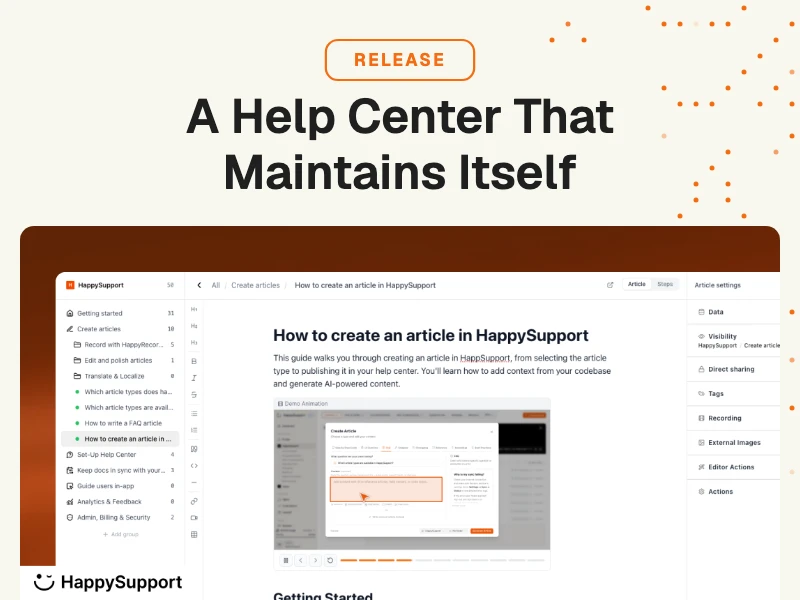
HappySupport is built on this architecture. HappyRecorder captures DOM and CSS metadata during a single walkthrough, binding step-by-step instructions to code selectors rather than pixel screenshots. HappyAgent monitors the GitHub repository for UI changes and auto-updates affected guides. The result is a self-updating help center where documentation maintenance overhead drops to near zero, because the maintenance runs automatically when the product changes. What this looks like in practice for a B2B SaaS team is described in how a self-updating help center works.
How to know you are caught in the trap right now
Most teams do not know they are in the trap because the symptoms look like ordinary operations problems. If three or more of these apply, the team is caught and headcount will not save them.
- Documentation review happens on a calendar, not a release. If audits fire quarterly or monthly regardless of shipping cadence, most releases are missing corresponding documentation updates.
- Support team members know which articles are wrong. When agents route around the help center to answer questions themselves, they have already concluded that keeping documentation up to date is someone else's problem.
- Recurring tickets ask questions the docs already cover. If customers file the same "how do I export?" ticket repeatedly despite an existing export article, that article is likely inaccurate, not missing.
- The help center includes articles last updated 12+ months ago on features that have shipped since. Direct evidence that the review cycle does not match release velocity.
- The AI chatbot gives wrong answers and nobody can say why. RAG-based chatbots retrieve from the knowledge base. Wrong answers from a well-configured chatbot usually mean the source content is wrong, not the model.
- Writers estimate maintenance work as "everything else first." When documentation maintenance is perpetually deprioritized, debt compounds silently, and team members accept it as background noise.
- Engineers and writers are not connected to the same change signal. If the writer learns about feature changes from Slack screenshots, the pipeline has no chance of keeping up with weekly releases.
The practical audit for finding the worst offenders takes under two hours. Open the 20 most-viewed articles in your analytics. Walk through each one side-by-side with the live product. Count the mismatches: navigation paths that no longer exist, buttons renamed, screenshots showing a previous UI, workflows that fail mid-step. A help center where more than 30% of top articles contain at least one inaccuracy is caught in the trap. In practice, most B2B SaaS teams find the number sits closer to 50 to 70%. If you want a structured process for that audit, the help center content audit process walks through exactly that.
The fix is not more effort inside the same architecture. It is a different architecture. Stop asking humans to do the job that code-aware tooling should do automatically, and let your documentation team focus on the work that actually requires human judgment: voice, structure, edge cases, and empathy.