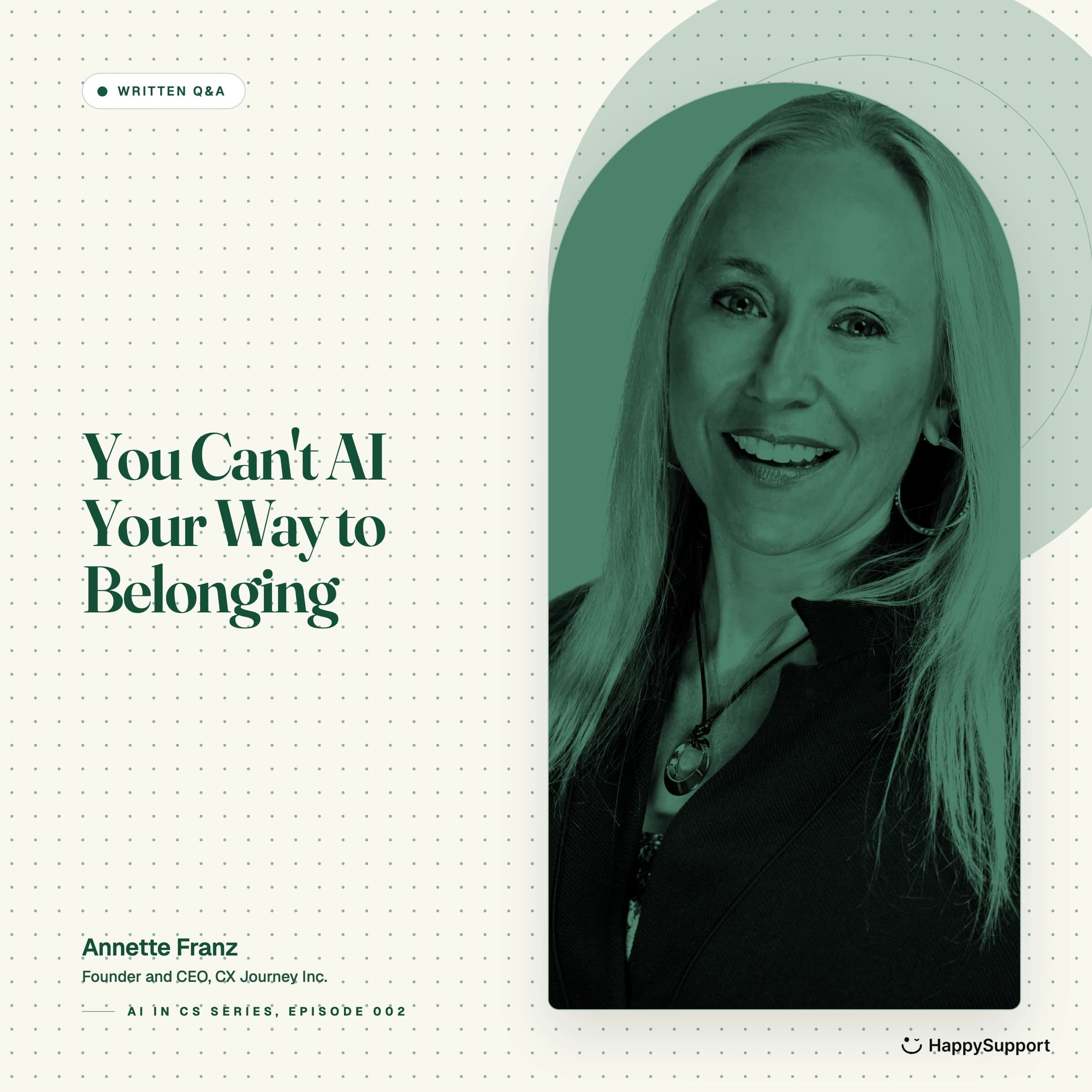
AI in CS Series, Interview #002. With Annette Franz, CCXP, founder and CEO of CX Journey Inc. Author of Customer Understanding, Built to Win, and Employee Understanding. 33 years in customer experience, starting at J.D. Power and Associates in 1992. Creator of the Golden Thread framework.
Annette Franz has watched the CX field grow up. She started in 1992 at J.D. Power when "CX" wasn't a department, an acronym, or a role. She has spent the last decade arguing that culture, not technology, is the unmoved foundation under every good experience. Below, the case against treating AI as a culture strategy. The Golden Thread, and the three places it usually breaks. And the question Annette thinks every CEO should ask before signing the next AI contract: what becomes more human because of this investment?
HOT TAKES
Six unfiltered opinions from Annette Franz.
You can't AI your way to belonging. Belonging is a human condition.
The more automated a business becomes, the more intentional it must become about humanity.
Companies have more data than ever, and less actual understanding.
AI should absorb complexity FOR the customer, not create complexity AROUND the customer.
The most strategic partner for a CX leader isn't the CMO. It's the CHRO.
AI inherits the quality of the organization. It amplifies dysfunction at scale.
Q1. The Question CX Leaders Stopped Asking
Q: You started in CX in 1992 at J.D. Power and Associates. What's a question CX leaders are asking in 2026 that you would have laughed at being asked in 2016, and a question from 2016 that nobody is asking now but probably should be?
A: Here's a question people are asking in 2026 that would have been laughable in 2016: How do we maintain emotional connection and trust when large parts of the customer experience are handled by AI? Ten years ago, most CX conversations were still heavily centered on channels, response times, NPS, and digital convenience. AI wasn't really on the radar for CX folks. I know because I was working for an AI startup, and the work we did and presented to CX teams was just beyond their grasp. Seriously. Analyses and reports that took months to create were completed in minutes by AI, and the CX pros were worried about their jobs. Well, here we are.
The question from 2016 that has disappeared shouldn't have: Do we actually understand our customers well enough to design around their real lives? That question used to sit at the center of CX work. Now many organizations skip straight to dashboards, journey mapping software, AI implementation, predictive analytics, and automation strategies without first grounding themselves in deep customer understanding. Companies have more data than ever and, in many cases, less actual understanding. The fundamentals didn't become less important because technology became more advanced. If anything, they became more important because scale amplifies misunderstanding just as efficiently as it amplifies understanding.
Q2. The Case for the $2M AI Contract (And Against Treating It as Culture)
Q: You wrote "you can't AI your way to belonging." Make the case to a CEO who just signed a $2M agentic-AI contract because the board asked her to "show AI on the roadmap."
A: For starters, AI isn't the answer to everyone's problems. The reason for failed AI implementations is that folks don't ask, "What problems does this solve for us? For employees? For customers?" And a $2 million agentic AI investment isn't inherently the problem. Treating it as a culture and customer strategy is.
AI can accelerate decisions, automate workflows, reduce friction, improve personalization, and eliminate waste. It can create value. But belonging isn't created through automation. Belonging is created when people feel seen, understood, trusted, respected, and connected to something meaningful. No customer has ever said, "I feel loyal to this company because the workflow orchestration was impressive." And no employee has ever become deeply committed because a chatbot responded in 1.3 seconds instead of 4.1.
The real danger for CEOs right now is that many boards are rewarding visible AI activity more than meaningful organizational outcomes. Companies rush to deploy AI without answering the harder questions: What problem are we solving? What human friction are we removing? What trust are we strengthening? What relationship are we improving? AI implemented without those answers often creates the illusion of modernization while degrading experience quality underneath the surface.
The more automated a business becomes, the more intentional it must become about humanity. AI raises the premium on human connection because customers immediately notice when an experience becomes transactional, generic, or emotionally empty. The companies that win in the next decade won't be the ones that simply automate the most. They'll be the ones that use AI to create more capacity for empathy, judgment, creativity, problem-solving, and relationship-building.
So, the conversation with the CEO shouldn't be: "Don't invest in AI." It should be: "What becomes more human because of this investment?" If the answer is unclear, the company is probably buying technology before defining purpose.
You can't "AI your way to belonging" because belonging is not a systems problem. It's a human condition. I've always said that technology supports and facilitates that, but it can't be a substitute for it.
Q3. The Golden Thread, and the Three Places It Breaks
Q: Walk us through the Golden Thread: culture, employee experience, customer experience, business outcomes. Where does it break most often, and what's the early warning sign?
A: The Golden Thread is the continuous connection between culture, employee experience, and customer experience that ultimately determines business outcomes. I depict it as:
Culture, then Employee Experience, then Customer Experience, then Outcomes.
When it holds, companies operate with clarity and consistency. People know what matters, they're equipped to act on it, and customers feel the result. But when it breaks, alignment disappears and performance becomes unpredictable.
What most leaders typically miss is that the Thread frays during translation, across the organization, across time. There are three places the Golden Thread breaks most often: the translation gap (between leadership intent and operational reality), the management layer (responsible for translating strategy into execution), and the frontline reality (when employees have to choose between helping the customer or following the process).
Q4. VOC in the Age of AI Summaries
Q: You insist on "no discussions, decisions, or designs without bringing in the voice of the Customer." In a world where AI can summarize 10,000 reviews in seconds, has VOC gotten better, or has the depth gotten lost?
A: To define a customer-centric culture, I say: No discussions, no decisions, no designs without bringing in the customer and her voice, without asking how it will impact the customer, how it will make her feel, what problems it will help her to solve, what value it will create and deliver for her. You can't be customer-centric if you're not putting the customer at the heart of all you do.
AI can process massive volumes of feedback in seconds. It can identify patterns humans would miss, detect sentiment shifts early, cluster emerging issues, and surface operational friction at incredible speed. That's real progress. Ten years ago, many companies were drowning in feedback because they lacked the ability to synthesize it. Today, the opposite risk exists: they can synthesize feedback so efficiently that they stop truly listening to it.
The danger is that companies start treating customers like datasets instead of humans living through experiences.
When everything becomes summarized, categorized, scored, and theme-tagged, nuance gets lost. Frustration becomes "negative sentiment." Fear becomes "service dissatisfaction." Exhaustion becomes "effort score decline." The emotional texture disappears, but that's often where the real a-ha moments live.
Companies have never been more informed, but in some cases have never been further from actual understanding. VOC only gets better if technology helps companies hear people more clearly. If it only helps them process data faster, depth (and humans) gets lost very quickly. And customer-centricity becomes a pipe dream.
Q5. AI Helps. AI Quietly Hurts.
Q: What do you think are the biggest pain points in customer experience where AI can actually help, and which one is AI quietly making worse?
A: AI genuinely helps with the invisible operational pain customers should never have to endure in the first place: long hold times, broken handoffs, searching for basic information, re-entering data. Those are all process failures masquerading as customer experience.
Used well, AI can make experiences feel smoother, simpler, and less exhausting. That matters because friction just adds up and customers remember how hard you made them work.
But AI is making other parts of customer experience worse, especially where empathy, judgment, reassurance, or trust are required. Having a human in the loop is necessary to complement the strengths of AI and to address these limitations.
AI is also making it easier for companies to hide systemic problems instead of fixing them. Instead of repairing broken processes, unclear policies, or organizational silos, businesses layer AI on top of it all. The experience appears smarter while the root cause remains untouched underneath. Customers still feel the friction. It just arrives wearing a more conversational interface.
The companies getting this right understand a critical distinction: AI should absorb complexity for the customer, not create new complexity around the customer. That means using AI to eliminate unnecessary effort while preserving human access during moments that require empathy, accountability, creativity, or emotional intelligence.
Q6. The 90-Day Playbook: Start With Culture, Always
Q: If a CX leader has 90 days and a clean slate, what's the order: fix culture, fix journey maps, fix the data, or deploy AI? Where do most teams get the order wrong?
A: Start with culture. Always. Culture is the foundation of everything the organization does.
You can't engineer a customer experience that your culture isn't built to deliver. That's not a philosophical point. It's an operational one. If employees lack clarity on what the experience should be, lack the autonomy to resolve problems in the moment, or are working inside systems that structurally prevent them from serving customers well, then no CX initiative will fix that. You'll be measuring the output of a broken system and wondering why the numbers don't move.
This is why the Golden Thread begins with culture, not with the customer. And it's why the most strategically important partnership a CX leader can build isn't with the CMO or the COO. It's with the CHRO. Not as a stakeholder, but as a co-owner of the system that produces the experience. CX professionals who understand the Thread don't wait to be invited into culture conversations. They initiate them. If you're not starting there, you're not working on the problem. You're working on the evidence of it.
I'm writing about something called outcome tracing in blog posts on my site this month, and I think it explains my answer (start with culture) well. It looks like this:
Result, then Behavior, then System, then Belief, then Culture.
Pick one outcome from last quarter that surprised you. Start at the result and trace backwards. Stop when you reach a leadership decision. That's the culture they designed or allowed. It's the root cause of a lot of issues down the line.
Q7. Why AI Deployments Underperform on CSAT
Q: You said AI is now table stakes. If it's table stakes, why do most AI customer service deployments still underperform on CSAT? Is the bar wrong, the data wrong, or the implementation wrong?
A: Mostly the implementation is wrong, with the deeper issue being that many companies are measuring the wrong outcome to start with. AI implementations were designed around cost reduction, containment rates, and labor efficiency, and then later evaluated for customer satisfaction, as if those goals align. They don't. They often compete with one another.
Many companies implement AI with an operational mindset instead of an experience mindset. The first question should always be: what problem(s) are we trying to solve? Instead, the objectives became: deflect contacts, shorten handle time, reduce staffing pressure, increase automation rates. So companies built systems optimized to end interactions quickly rather than to resolve customer issues completely the first time. Too many companies evaluate AI on whether it answered the question, not on whether it improved the experience.
The data is an issue, too. Data is at the heart of designing and delivering a great experience. When data quality and accessibility are issues, the outcomes become problematic. AI systems inherit the quality of the organization behind them. If knowledge bases are fragmented, policies are inconsistent, workflows are broken, and departments operate in silos, AI doesn't magically fix those things. Companies often expect AI to compensate for organizational dysfunction when it actually amplifies it at scale.
Q8. The 2031 Bet: The Boundaries of CX Will Disappear
Q: It's 2031. The CCXP credential and the CX Director title are either bigger than ever, or they have been absorbed into "Head of Operations" or "Head of Product." Which one happens, and what tips the scale?
A: Too many CX teams spent years operating adjacent to the business instead of embedded within it, especially without a CCO whose role is to unify and embed the customer across the organization. They became known for journey maps, workshops, surveys, and reporting dashboards while lacking direct ownership over operational outcomes. When economic pressure rises, standalone functions that influence but don't own execution become vulnerable very quickly.
That's what tips the scale.
If CX is perceived as insight generation without operational authority, it gets absorbed. If CX is directly tied to measurable business outcomes (reduced friction, improved retention, smoother journeys, lower failure demand, stronger trust, better cross-functional coordination, improved employee enablement, increased revenue), then it becomes indispensable.
The future likely doesn't belong to the "traditional" CX leader as many companies defined the role in the 2010s. The next generation of CX leadership will look far more systemic, operational, and enterprise-wide. The strongest leaders will understand process design, culture, AI, employee experience, organizational behavior, customer psychology, technology strategy, and operational execution, not just feedback programs and journey mapping.
In many companies, CX won't disappear into Operations or Product. Instead, the boundaries themselves will disappear. And that's the real shift.
The organizations that thrive will stop asking, "Who owns CX?" and start asking, "How does every function contribute to customer outcomes?" Ironically, that may be the moment CX finally succeeds.
The ultimate goal isn't to build a permanent standalone CX department. It's to build customer-centered organizations where experience thinking becomes operationally embedded everywhere. Culture, culture, culture.
The danger is that some companies will interpret "embedded everywhere" as "owned nowhere." When that happens, customer experience deteriorates fast.
Q9. The Fourth Book: The Golden Thread Mechanics
Q: If you were writing a fourth book in 2027, what would the title be and what's the one chapter you would build the whole book around?
A: I don't know yet what the title will be, but the book will absolutely revolve around the Golden Thread. If you're not looking to culture as the foundation and the root cause of much of what ails you and your organization, then you're not looking deep enough. You're not actually thinking about what causes people to do what they do and systems to be created and propagated as they are.
I've already written three books that provide practical frameworks for leaders:
- Employee Understanding: A Three-Pillar Framework for Designing a Great Experience and Driving Business Success
- Built to Win: Designing a Customer-Centric Culture That Drives Value for Your Business
- Customer Understanding: Three Ways to Put the "Customer" in Customer Experience
While those three books work together nicely, the fourth book would dive into the Golden Thread that ties them all together and the mechanics behind it. It's early, and I'm still working through the details, but that's the general direction.
Connect with Annette: cx-journey.com | LinkedIn | Customer Understanding, Built to Win, Employee Understanding
This interview is part of HappySupport's ongoing expert series on self-service and customer experience. More conversations and research live on the HappySupport blog.
 Book a demo