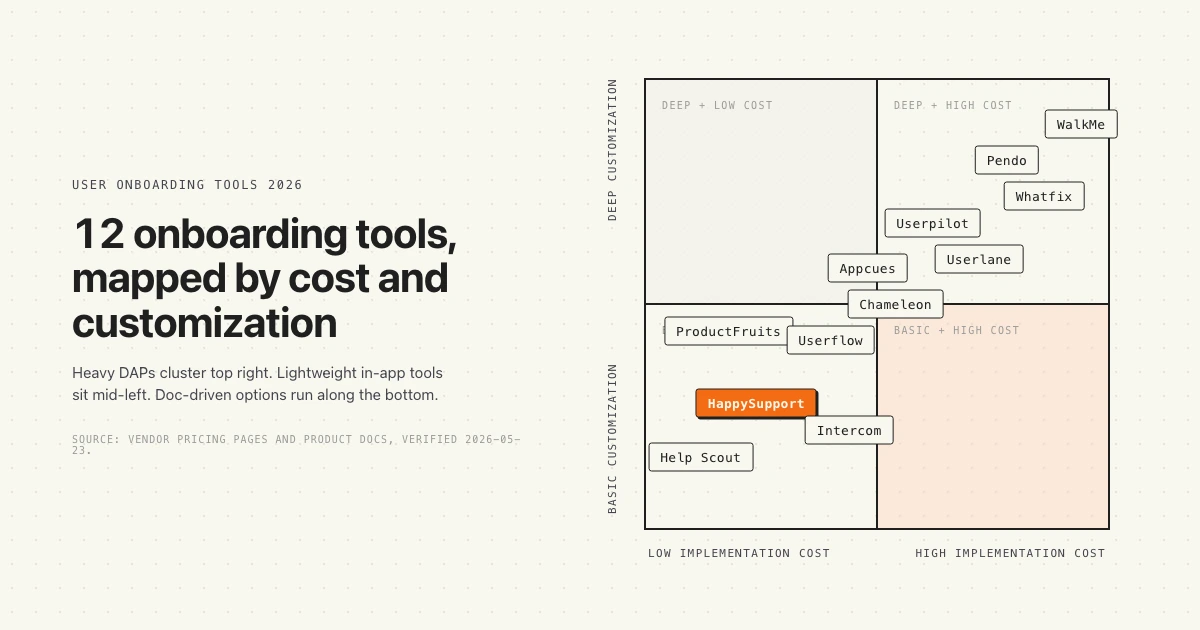
What follows is twelve user onboarding tools, split into three categories: heavy digital adoption platforms, lightweight in-app onboarders, and doc-driven widgets. The split matters because most rankings treat them as one bucket. They are not. A DAP like WalkMe and a doc-driven widget like Help Scout Beacon solve different problems for different sized companies. Pricing them on the same page without acknowledging that gets you sold a tool that does not fit your stage.
The rankings inside each category are by category fit, not by overall score. A pre-seed founder should never buy a heavy DAP. A 200-employee SaaS with a complex compliance flow should rarely settle for a checklist widget. We have called out who each tool fits and where it hits the wall, with verified 2026 pricing pulled directly from vendor sites and procurement data on 2026-05-23.
One more note before the list. Onboarding is not a tool. It is a sequence of decisions about what new users see, when, and how the system reacts when they get stuck. The tools below help you ship those decisions. They do not replace the thinking. The teams that struggle most are the ones that buy software hoping the software will figure out the onboarding strategy for them.
Quick verdict: the four picks that fit most SaaS teams
If you want one answer per stage: ProductFruits for bootstrapped or pre-seed teams shipping under 50 users. HappySupport for Seed and Series A SaaS that want onboarding tied to a help center that stays current. Userpilot for Series B teams that need segmented in-app flows and have the team to run them. Pendo for Series B+ enterprises with multiple products and a dedicated PM-ops function.
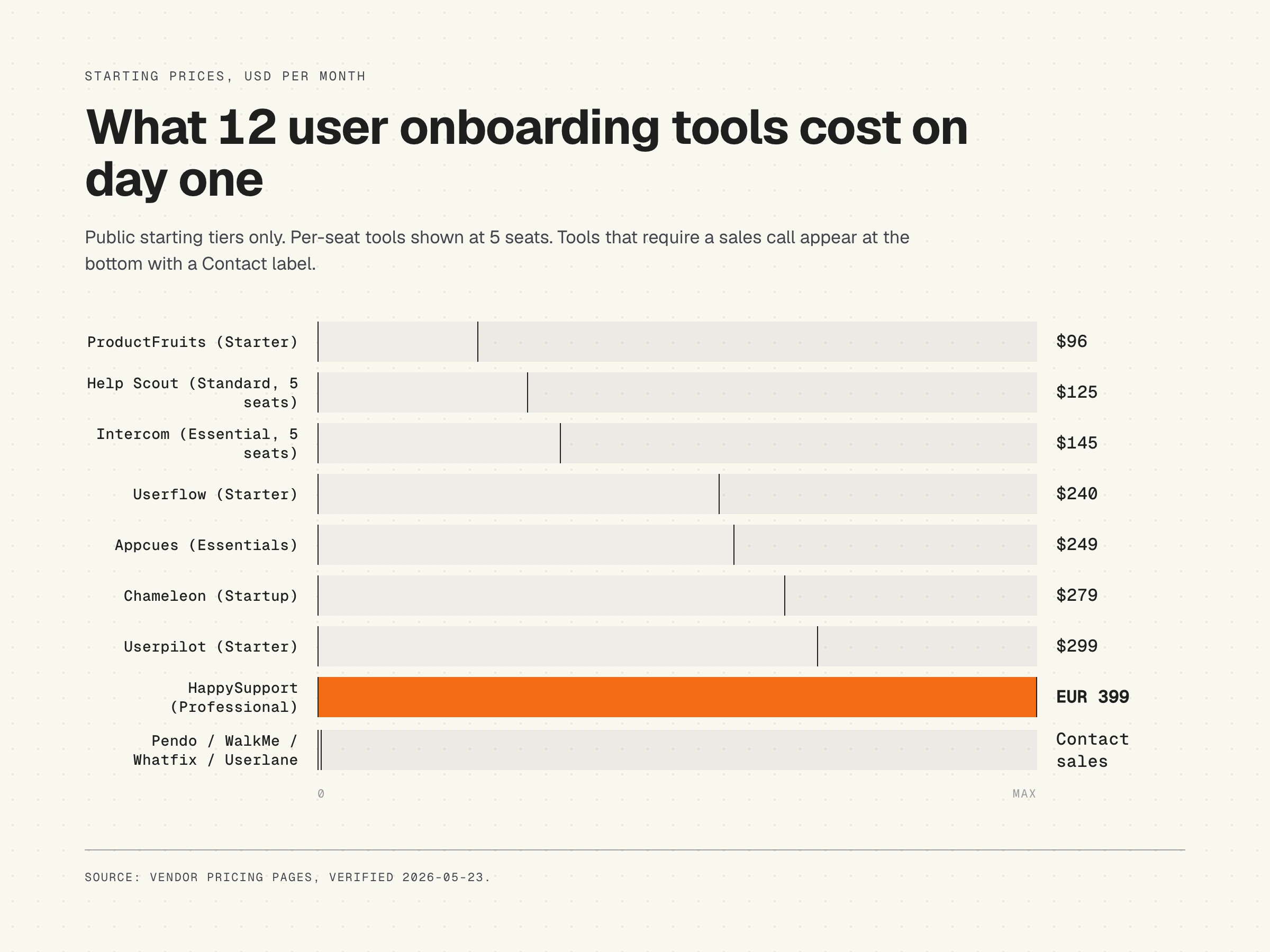
| Tool | Starting price | Best fit | Main weakness |
|---|---|---|---|
| Pendo | Free under 500 MAU; contact sales | Multi-product enterprises | Procurement-grade pricing |
| WalkMe | Contact sales | Enterprise IT rollouts | Heavy implementation |
| Userpilot | $299/mo | PLG Series A and B | Cost climbs above 5K MAU |
| Whatfix | Contact sales | Enterprise employee training | Not built for customer onboarding |
| ProductFruits | $96/mo | Bootstrapped and pre-seed | Limited analytics depth |
| Appcues | $249/mo | PLG product teams | Pricing tier jumps are steep |
| Userlane | Contact sales | EU enterprise, internal apps | Less consumer SaaS DNA |
| Chameleon | $279/mo | Design-led teams | Steep step above 2,000 MTU |
| HappySupport | From 129 EUR/mo (flat) | Seed to Series A SaaS | Lighter flow builder than a DAP |
| Help Scout Beacon | $25/user/mo | Small teams with help docs | Not a full flow builder |
| Intercom Messenger | $29/seat/mo | Teams already on Intercom | Fin charges per resolution |
| Userflow | $240/mo | Engineering-led product teams | Pro tier pricing jumps |
Heavy DAP: the enterprise category
Digital adoption platforms (DAPs) are built for companies running multiple internal or customer-facing apps that need analytics, in-app guidance, and rollout tracking under one roof. They are powerful, expensive, and often overkill for a SaaS under 100 employees. If you are reading this and your title is founder, you almost certainly do not need a DAP yet. If your title includes VP, head of product ops, or director of CX at a company over 200 people, the rest of this section is for you.
1. Pendo
Pendo is the category-defining product experience platform. Tracks user behavior in real time, publishes in-app guides, surveys, and roadmaps from one console, and ties it back to revenue. The free tier supports 500 monthly active users, which is enough for a true product-market-fit experiment but not enough for a real onboarding rollout. What the paid tiers cost is in the Pendo pricing breakdown.
Where Pendo is best in class
Multi-product analytics. If your company sells three or four SaaS products under one brand and you want a unified view of how customers move between them, almost nothing else competes. Pendo also has the deepest survey and feedback module of any DAP, and its in-app guide editor is mature enough that a non-engineer can ship a tour in an afternoon.
Where Pendo hits the wall
Procurement-grade pricing. Every paid tier requires a sales call. Vendr data puts the median annual contract at 48,500 USD with the range running from 17,000 USD to 147,000 USD depending on MAU and module mix. For a Seed or Series A SaaS that just needs one onboarding flow, you are paying for analytics infrastructure you will not use for two years.
Pricing: Free tier up to 500 MAU. Paid plans contact-sales. Vendr median 48,500 USD per year (verified 2026-05-23).
Practitioners on procurement boards often mention that Pendo discounts heavily on multi-year deals, in the range of 40 to 46 percent, but only if you commit upfront. The list price is the opening move, not the close.
Best for: Series B+ multi-product SaaS with a dedicated PM-ops function.
2. WalkMe
WalkMe is the original DAP, founded in 2011 and now publicly traded. Focused more on enterprise IT and workforce productivity than on customer onboarding. If you have heard about a Fortune 500 rolling out SAP or Salesforce and using a tool to guide employees through unfamiliar workflows, that tool was probably WalkMe.
Where WalkMe is best in class
Cross-application guidance. WalkMe can sit on top of multiple internal apps at once and follow a user from CRM to ERP to a custom internal portal without losing context. The analytics layer (WalkMe Insights) captures workflow inefficiency at a depth that lightweight tools cannot match. Enterprise IT teams use it to justify SAP investments after the fact.
Where WalkMe hits the wall
Implementation cost and time. Standard rollouts take three to six months and require dedicated configuration work. The platform is built for IT-led deployments, not for a product team that wants to ship an onboarding tour next week. For a SaaS company building a consumer-grade product experience, WalkMe is the wrong shape.
Pricing: Contact sales. Reported entry around 9,000 to 12,000 USD per year for the smallest deployments. Vendr median 43,085 USD per year (verified 2026-05-23).
Reviewers consistently flag that WalkMe contracts are typically 2 to 3 years with significant upfront commitment, which is normal for enterprise but jarring for SaaS founders who think in monthly subscriptions.
Best for: Enterprise IT teams rolling out internal applications.
3. Userpilot
Userpilot is the most popular DAP for product-led SaaS in the 50 to 500 employee range. Strong segmentation, in-app surveys, NPS, and a flow builder that does not require a developer for most use cases. Public starter pricing makes it one of the few enterprise-leaning DAPs you can actually evaluate without sitting through a demo.
Where Userpilot is best in class
Trigger-based segmentation. You can ship a tooltip that only fires when a user hovers over a specific feature they have never clicked, on their third login, when their organization is on the Pro plan. That kind of behavioral targeting used to require a dedicated engineer. Userpilot exposes it in a no-code editor.
Where Userpilot hits the wall
Cost climbs fast above 5,000 MAU. The Starter tier at 299 USD per month for 2,000 MAU is genuinely affordable, but the moment you cross into Growth territory you are in custom-pricing land and contracts commonly come in around 12,000 to 35,000 USD per year. The pricing math at 50,000 MAU is closer to Pendo than to ProductFruits.
Pricing: Starter 299 USD per month for 2,000 MAU (annual). Growth and Enterprise contact-sales (verified 2026-05-23).
Product managers on review sites consistently call out that Userpilot ships features faster than its older competitors but the trade-off is a learning curve, the editor has more knobs than Appcues and you spend the first few weeks figuring out which ones matter.
Best for: Series A and B PLG SaaS with a PM or growth lead who owns onboarding metrics.
4. Whatfix
Whatfix is the other heavy DAP, with a center of gravity in employee onboarding and enterprise training rather than customer onboarding. Stronger in HR-tech and L&D buying centers than in product-led growth ones. If your buying motion is a chief learning officer or a head of enterprise applications, Whatfix is usually on the shortlist.
Where Whatfix is best in class
Embedded help inside enterprise applications. Whatfix Mirror lets you build sandboxed training environments without spinning up a duplicate system. Strong content authoring, version control, and translation tooling. Enterprise security and SOC 2 are mature and well-documented.
Where Whatfix hits the wall
Not built for customer onboarding. The product DNA is workforce productivity, not new-user activation. If you are trying to convert a free trial into a paid customer in seven days, Whatfix is the wrong tool. Pricing is also opaque, with entry contracts reportedly starting around 24,000 USD per year for the Standard plan.
Pricing: Contact sales. Reported entry around 24,000 USD per year. Vendr average around 32,000 USD per year (verified 2026-05-23).
Buyers on procurement panels regularly mention that Whatfix discounts are real but only at the multi-year multi-app commitment level, and the implementation services line item is often a meaningful chunk of the total cost.
Best for: Enterprise employee training and internal-app rollouts.
Lightweight in-app: the SaaS-native category
Lightweight in-app onboarding tools are what most SaaS companies actually buy. Public pricing, no implementation services, a flow builder a PM can learn in a day, and a price point that does not require finance approval. The trade-off versus DAPs is shallower analytics and less cross-application coverage. If you have one product and want better activation, this is your category.
5. ProductFruits
ProductFruits is the lightweight DAP from Europe (Czech Republic) that quietly became the price-performance king for bootstrapped and pre-seed SaaS. Covers the essentials: interactive tours, tooltips, checklists, banners, in-app surveys, and a knowledge base widget. Free 14-day trial, transparent pricing.
Where ProductFruits is best in class
Price-to-feature ratio. The Starter tier at 96 USD per month for 1,500 MAU gives you most of what Appcues charges 249 USD for. Multi-language support and a built-in knowledge base widget are included at all tiers, which is unusual for tools this cheap. Self-serve onboarding to ship a first flow can be done in under an hour.
Where ProductFruits hits the wall
Analytics depth and segmentation. The flow builder is solid for linear sequences but the conditional logic is shallower than Userpilot or Appcues. Reporting is functional but not where you go for cohort analysis or attribution. If you grow past a few hundred MAU and need to A/B test flows by segment, you outgrow it.
Pricing: Starter 96 USD per month for 1,500 MAU. Pro 149 USD per month. Business 149 USD per month with premium features. Custom enterprise (verified 2026-05-23).
Bootstrappers consistently describe ProductFruits as the tool they wish they had found before signing up for Appcues at five times the price. The European-data-residency angle also lands well with EU SaaS founders.
Best for: Bootstrapped, pre-seed, and Seed SaaS with under 5,000 MAU.
6. Appcues
Appcues is the legacy PLG choice. Founded in 2013, mature flow editor, broad integrations, and a customer roster that reads like a directory of mid-market SaaS. Often called the Canva of user onboarding software because the no-code editor is genuinely friendly for non-engineers.
Where Appcues is best in class
UX of the flow editor. Almost nobody comes off Appcues frustrated by the builder itself. Strong checklist and launchpad patterns. Mobile SDKs are mature, which matters if your product has a real mobile presence. The brand and community are also more visible than most of the category.
Where Appcues hits the wall
Pricing tier jumps. Going from Essentials at 249 USD per month to Growth at roughly 879 USD per month for the same 2,500 MAU is a 3.5x step, and the gating between tiers cuts off advanced targeting, A/B testing, and event tracking on the cheaper plan. Buyers who started on Essentials often find themselves locked in when they hit the upgrade trigger.
Pricing: Essentials 249 USD per month for 2,500 MAU (annual). Growth around 879 USD per month. Enterprise typical range 40,000 to 120,000 USD per year (verified 2026-05-23).
A common refrain from buyers who left Appcues is that the product is fine but the pricing rhythm pushes them up faster than their actual usage warrants. Multi-year commitments commonly unlock meaningful discounts.
Best for: Mid-market PLG SaaS that wants a polished flow editor.
7. Userlane
Userlane is the European DAP, headquartered in Munich, with a strong center of gravity in DACH enterprise. Less consumer SaaS DNA than Userpilot or Appcues, more enterprise IT and HR-tech. Two core products: Application Intelligence (analytics) and Contextual Assistance (in-app guidance, AI assistant).
Where Userlane is best in class
EU data residency and DACH enterprise procurement. Buyers in regulated industries that need a vendor with German servers, a DPO on staff, and a sales team that speaks the language often land here over the US-headquartered options. Strong on internal-app rollouts, especially for SAP and similar legacy enterprise systems.
Where Userlane hits the wall
Smaller consumer SaaS playbook. Userlane is rarely the right pick if your product is a 30-day-free-trial PLG SaaS chasing self-serve activation. The product roadmap and field motion are oriented toward larger employee-facing deployments. Pricing is contact-sales, with no public starting point.
Pricing: Contact sales. Custom application-based or per-user pricing depending on rollout scope (verified 2026-05-23).
EU buyers often cite Userlane as the candidate that wins on procurement and security questionnaire pain reduction even when feature-by-feature it is roughly even with the US incumbents.
Best for: European enterprises rolling out internal applications.
8. Chameleon
Chameleon is the design-led choice. Strong reputation for clean, brand-customizable in-app patterns: tours, tooltips, surveys, launchers, microsurveys (HelpBar). Loved by product designers who want onboarding components that feel built-in rather than bolted-on.
Where Chameleon is best in class
Design polish and customization. The Chameleon styling layer is genuinely flexible, with CSS-level control that lets a designer match the rest of the product without hacks. The HelpBar pattern (in-product search command palette) is unique in the category and works well in keyboard-first products.
Where Chameleon hits the wall
The step above Startup. The Startup plan at 279 USD per month for 2,000 MTU is reasonable, but the next tier up is Pro from 750 USD per month at 5,000 MTU, and most teams that outgrow 2,000 MTU land there or higher. Median annual contract per Vendr is 26,500 USD, which closes the gap with Userpilot and Appcues.
Pricing: Startup from 279 USD per month for 2,000 MTU. Pro from 750 USD per month at 5,000 MTU, with 10 seats, A/B testing, a cap of 20 live experiences and 5 localization languages, and self-serve support. Growth from 1,250 USD per month at 5,000 MTU billed annually, with 15 seats and dedicated customer success. Enterprise custom, with unlimited experiences, environments and localization. Microsurveys and NPS are included on every plan (vendor pricing page, August 2026).
Designers often champion Chameleon over Appcues for visual reasons, then face friction at procurement when finance sees the Growth tier price tag.
Best for: Design-led SaaS where in-app polish matters and budget allows the Growth tier.
Doc-driven and hybrid: onboarding through the help center
Doc-driven onboarding inverts the model. Instead of bolting a tour builder on top of the product, these tools surface contextual help articles inside the product at the moment a user needs them. The advantage is that the same article powers the public help center, the in-app widget, and the ticket-deflection chatbot. The trade-off is that you do not get the same depth of triggered behavioral flows. For teams whose biggest activation problem is users not finding answers fast enough, this category often wins.
9. HappySupport (Widget)
HappySupport is a help center that updates itself when the product changes, with AI chat, a ticket inbox and in-app tours and banners with audience targeting from the same content source. The HappyWidget surfaces those self-updating articles inside the product at the moment a user gets stuck. Built for SaaS teams that ship faster than they can write documentation and where most onboarding failures look like users searching the wrong terms in a stale help center. Disclosure: we built it.
Where HappySupport is best in class
Documentation freshness. The HappyRecorder Chrome extension captures product UI as DOM and CSS selectors instead of pixel screenshots, so the system knows when an underlying element has changed. HappyAgent GitHub Sync connects the help center to the product repository and turns code changes into update proposals for articles whose source has shifted. Onboarding stops failing because a screenshot from six months ago no longer matches the UI.
Where HappySupport hits the wall
Not a full behavioral flow builder. Tours and banners with audience targeting are included on the Scale plan, but if you want segmented tooltips that fire on the third login when a user belongs to the Pro plan and has used feature X but not feature Y, you need Userpilot or Pendo. HappySupport's strength is the other half: the articles that almost every onboarding flow eventually depends on, plus the AI chat and ticket inbox that catch what the tour did not cover. See in-app help without a digital adoption platform and self-updating help centers for the architecture.
Pricing: 14-day free trial, then flat monthly plans with no per-seat pricing: Starter 129 EUR, Professional 399 EUR (3 help centers, 5 users, custom domain, Git handoff, health audits), Scale 899 EUR (in-app tours and banners, audience targeting, SSO) (verified September 2026).
Best for: Seed to Series A SaaS teams shipping weekly without a dedicated documentation writer.
10. Help Scout (Beacon)
Help Scout Beacon is the embedded help widget that ships with every Help Scout helpdesk plan. Not marketed primarily as user onboarding software, but a surprising number of small SaaS teams use it as exactly that: a contextual help launcher that surfaces relevant articles, kicks off chat, and creates tickets from inside the product.
Where Help Scout Beacon is best in class
Integrated stack at a low price point. Beacon is included with the Standard plan at 25 USD per user per month, which means you get an in-app help widget for the price of a shared inbox. Strong AI Assist and Drafts on the Plus tier. Help Scout AI Answers at 0.75 USD per resolution is one of the cheaper deflection price points in the market.
Where Help Scout Beacon hits the wall
Not a real flow builder. Beacon can launch articles, chat, and tickets, but it does not do behavioral targeting, tours, or checklists. If you want a tooltip on a specific button when a user has not clicked it in 24 hours, Beacon is the wrong tool. You will either bolt Userpilot on top or graduate to a hybrid tool.
Pricing: Standard 25 USD per user per month. Plus 45 USD per user per month. Pro 75 USD per user per month. Beacon included in all plans. AI Answers 0.75 USD per resolution (verified 2026-05-23).
Best for: Small SaaS teams (under 25 users) whose biggest onboarding lever is article discoverability, not tour orchestration.
11. Intercom (Messenger)
Intercom Messenger has been the bundled in-product widget for over a decade. In 2024 to 2026 the company rebuilt around Fin AI Agent, and the Messenger is now as much an autonomous resolution surface as an onboarding tool. For teams already on Intercom, Messenger plus Product Tours plus Articles is a viable onboarding stack without adding another vendor.
Where Intercom is best in class
Bundled integration with the rest of the Intercom stack. Product Tours, Series, Articles, and the Inbox are wired together at the data model level, so a tour that fires after a specific event can hand off cleanly to a chat that escalates to a human in the same Inbox. Fin AI Agent autonomously resolves from help center articles with grounded confidence scoring.
Where Intercom hits the wall
The pricing is a multi-line story. Essential at 29 USD per seat per month is reasonable, but Fin charges 0.99 USD per resolution on top, and at scale that can add five-figure annual costs that do not appear on the comparison page. Lite seats (limited access) help but do not eliminate the seat math.
Pricing: Essential 29 USD per seat per month (annual). Advanced 85 USD per seat per month. Expert 132 USD per seat per month. Fin 0.99 USD per resolution. Lite seats included on Advanced and Expert (verified 2026-05-23).
Best for: SaaS teams already on Intercom for ticketing who want one vendor for chat, articles, tours, and onboarding.
12. Userflow
Userflow is the engineering-friendly lightweight onboarding tool. Strong API, clean SDK, and a Smartflow builder that lets you compose flows from reusable blocks. Often picked by product engineering teams that want flows version-controlled like the rest of the codebase, not configured in a UI by a non-technical PM.
Where Userflow is best in class
Developer experience. Webhook architecture is well-documented, the API is genuinely usable, and the FlowAI Insights and Smartflow features are unique in the lightweight category. The Salesforce and HubSpot integrations on Pro tier are deeper than what Appcues or Userpilot ship at the same level.
Where Userflow hits the wall
Pro tier price jump. Starter at 240 USD per month (annual, 3 seats included) is competitive, but Pro jumps to 680 USD per month on annual billing. Each additional product workspace is 425 USD per month. The pricing is rational for engineering-heavy teams but it stings smaller PM teams that just need more than 3 seats.
Pricing: Starter 240 USD per month (annual, 3 seats). Pro 680 USD per month (annual). Enterprise custom. Additional product workspace 425 USD per month (verified 2026-05-23).
Best for: Engineering-led product teams that want version-controlled flows and deep API integration.
Chameleon vs Pendo for B2B SaaS: no-code flows, feature adoption, and in-product surveys
These two come up together often, and they should not, because they are priced and scoped for different companies. Taking the three requirements in the question one at a time, against vendor pricing pages as of August 2026.
| Chameleon | Pendo | |
|---|---|---|
| Entry price | Startup from $279/mo at 2,000 MTU | Free to 500 MAU, then quote-only |
| Next tier | Pro from $750/mo at 5,000 MTU | Base, custom priced |
| Reported mid-market spend | Vendr median around $26,500/yr | Commonly reported $15,000 to $60,000/yr |
| Billing unit | Monthly tracked users | Monthly active users |
| No-code flow building | Yes, with CSS-level styling control | Yes, guide editor a non-engineer can use |
| Feature adoption analytics | Flow and experience level | Full product analytics, the deepest here |
| In-product surveys | Microsurveys and NPS on every plan | Branded NPS on Free; other sentiment surveys need Ultimate or a paid add-on |
| Session replay | No | Core and above, or add-on |
| Multi-product view | No | Yes, the reason Pendo exists |
| Mixpanel, Amplitude, Segment | Yes | Yes |
On no-code in-app onboarding, Chameleon wins on control and Pendo wins on nothing in particular. Both editors let a PM ship a tour without engineering. Chameleon's differentiator is that the output can be made to look like your product rather than like a tour widget, which matters when your buyer is a head of product or design.
On feature adoption flows, it depends what "adoption" means to you. If it means building and targeting the flows, both do it. If it means knowing which features are adopted, by whom, across a whole product surface, Pendo is not really competing with Chameleon; it is competing with Amplitude and Mixpanel. That analytics depth is the actual product, and the guides are downstream of it.
On in-product user surveys, this is where the answer flips and it is the least obvious part. Chameleon includes microsurveys and NPS on every plan, Startup included. On Pendo, the free plan gives you Pendo-branded NPS, and sentiment surveys beyond that sit in the Ultimate tier or arrive as a paid add-on on Free, Base and Core. So a team that wants tours plus real in-product surveys can have both on Chameleon for $279 a month and cannot get there on Pendo without a sales conversation.
The honest recommendation for a B2B SaaS product team: if all three requirements in the question are the actual requirements, and you are not running four products, take Chameleon. You get all three on a published price, and you can start at $279 rather than at a quote. Choose Pendo when the analytics are the point, when you need session replay to see where users stall, or when you have multiple products and need one view across them. That is a Series B-plus purchase with a procurement cycle attached, and buying it for tours and surveys alone is buying an analytics platform to use 20 percent of it.
One thing neither solves: both tours eventually link to a help article, and neither tool knows when that article stops matching the product. See in-app guidance without WalkMe and Pendo for the pattern of pairing a lighter flow tool with a self-updating help center.
How do teams compare user onboarding tools before buying?
The teams that end up happy with their choice tend to run the same sequence, and it is not the one the comparison pages imply. Pricing comes late, not first.
- Name the activation event. One sentence: "a new user has succeeded when they have done X within Y days." Without this you cannot evaluate anything, because every tool demos well against no criteria. If nobody on the team can write this sentence, that is the actual blocker, and no purchase fixes it.
- Decide whether your problem is guidance or content. Do users get lost in the interface, or do they go looking for an answer and fail to find one that is current? Those buy different tools. The first is a flow builder; the second is a help center that stays current. A large share of tools bought as onboarding software are really being bought to patch documentation.
- Check the billing unit against your growth curve. MAU or MTU pricing means a good quarter raises your bill. Seat pricing does not. Model the price at 3x your current users, not at today's, because that is where you will be at renewal.
- Find the tier where your must-have feature lives, then price that tier. This is the step most teams skip and most regret. The entry price is rarely where localization, A/B testing, non-branded surveys, role permissions or session replay actually sit. On this page's twelve tools the feature you came for is one tier above the price you quoted more often than not.
- Build one real flow in a trial, on your own product. Not the demo sandbox. Two hours with your own DOM will tell you more about selector fragility and styling limits than any feature matrix, and selector fragility is the most common reason in-app flows quietly break.
- Ask who maintains it in six months. Every tool on this list decays without an owner. If the answer is "whoever has time," pick the tool with the least surface area rather than the most capability.
- Then compare price, and compare three-year totals rather than monthly, including the implementation effort for the heavy DAPs, which is where WalkMe and Whatfix costs actually live.
The pattern worth noticing across steps 2, 4 and 6: most bad purchases in this category are not the result of picking the wrong tool. They are the result of buying a tier for a feature the team never turned on, to solve a problem that turned out to be a content problem.
Which is the best DAP for SaaS product onboarding?
Short answer: for customer-facing SaaS onboarding, usually none of them, and that is not a dodge.
Digital adoption platforms were built for a different job: rolling out enterprise software, often internal, to employees who have to use it whether they like it or not. Salesforce, Workday, SAP, an internal claims tool. WalkMe, Whatfix and Userlane are all excellent at that and carry the implementation weight to match, which is why "contact sales" is the price on all three.
If you do need a DAP for SaaS product onboarding, ranked for that specific job:
- Pendo. The only heavy platform on this list whose centre of gravity is product-led SaaS rather than internal IT. Analytics plus guides plus surveys in one console, and the multi-product view is genuinely unmatched if you sell several products under one brand. It is the default answer for Series B and later.
- Whatfix. Strong DAP, and increasingly credible for customer-facing use, but the DNA is employee training and enterprise rollout. Pick it if you are doing both internal and customer onboarding and want one vendor.
- WalkMe. The most capable and the heaviest. Genuinely the right answer for large internal rollouts across many applications. For a single customer-facing SaaS product it is over-specified, and the implementation timeline alone rules it out for most teams.
- Userlane. The pick when European data residency is a hard requirement. Less consumer SaaS DNA than the others.
For most SaaS teams under Series B the honest answer is a lightweight in-app platform rather than a DAP: Userpilot if a PM will own activation metrics, Appcues for a more polished editor, ProductFruits at the low end, Userflow for engineering-led teams. Those cost a tenth of a DAP contract, ship in days rather than quarters, and cover the customer onboarding job completely. Buy a DAP when you have multiple products, an internal-app rollout problem, or a PM-ops function to run it. Not before.
How to choose user onboarding software
The right answer depends more on stage and team shape than on feature checklists. Three rough buckets.
Pre-seed and Seed (under 50 customers, no dedicated PM-ops)
You do not need a DAP. You need to ship a working flow this month. Pick ProductFruits at 96 USD per month if the constraint is budget, HappySupport (14-day free trial, then from 129 EUR per month flat) if your bigger problem is that the help center is already going stale and the onboarding will inherit that stale-ness, or Help Scout Beacon if you already have a Help Scout helpdesk and want to use what you have. The bar to clear is shipping any flow at all, not orchestrating segmented behavioral journeys.
Series A (50 to 300 customers, dedicated product team)
This is where most of the category lives. Userpilot wins if you have a PM or growth lead who will live in the tool and own activation metrics. Appcues wins if you prefer a more polished editor and can absorb the tier jumps. HappySupport wins if your activation gap is fundamentally a documentation freshness problem (people search the help center, find a stale article, and never come back). Sometimes the right answer is two tools: Userpilot for flows plus HappySupport for the articles, AI chat and tickets behind them. See in-app guidance without WalkMe and Pendo for why teams pick this combo.
Series B+ (300+ customers, multi-product or enterprise-leaning)
Pendo wins on multi-product analytics. WalkMe or Whatfix win on internal-app rollouts. Chameleon wins on design polish if your buyer is the head of product. Userlane wins on European data residency. Pricing at this stage stops being the deciding factor; procurement, security, and integration depth take over. Multi-year contracts and 40 percent discounts are standard, not exceptional.
Most onboarding tools are an addition to your existing stack
One pattern that comes up in almost every buyer conversation: people assume picking an onboarding tool means replacing something. For a tour builder it usually does not. Pendo, Userpilot, Appcues and the rest go next to your ticketing system, your CRM, and your help center. Keep your Intercom, Zendesk, Help Scout, Freshdesk, Front, or HubSpot Service Hub, keep your existing analytics, and add the tour tool for the in-app flows. Almost no team rips out their ticketing system to install Pendo, and almost no team should. Plan that purchase as an addition, not a replacement, and budget for one onboarding tool plus the articles it depends on. The exception on this list is HappySupport, which covers help center, AI chat, ticket inbox, widget and tours in one product at one flat price, so a team that wants to consolidate can; an existing helpdesk can be kept via import and redirects, but does not have to be. Documentation decay is the hidden cost that bites onboarding tools last, but bites them hardest, because every tour eventually links to an article and the article eventually goes stale.
Where HappySupport fits in this list
HappySupport is one of the 12 tools above and we have been honest about where it fits and where it does not. Doc-driven onboarding is a real category, not a marketing label. If your activation problem is fundamentally that customers cannot find the right answer at the right moment, or that the help center articles are six months out of date, the in-app help widget gives them a self-updating help center surfaced inside the product, with contextual help at the step where the user is stuck. If your activation problem is that you need segmented behavioral tours that fire on specific events, you should pick Userpilot or Pendo and possibly add HappySupport for the articles, AI answers and tickets underneath. The difference between a help center and a knowledge base matters here. Most onboarding tours eventually link to articles, and most articles eventually go stale. That is the gap HappySupport closes. The right buy: SaaS teams that want help center, AI answers, tickets and in-app help from one source, without per-agent pricing, hosted in the EU. Not the right buy: teams that need DAP-depth behavioral flows and product analytics, or large contact centers that need phone, omnichannel routing and workforce management.
 Book a demo