.png)

Process documentation has a maintenance problem nobody warns you about. Product documentation goes stale when a customer hits a wrong screenshot and complains. Internal process documentation goes stale silently. The workflow changes, the SOP keeps describing the old workflow, and the new hire onboarded six months later follows obsolete steps until they hit something that breaks. Nobody notices because the new hire assumes the doc is right and the senior person has not opened it in two years.
This guide ranks ten process documentation software tools by how well they handle that silent decay problem. Scribe, Tango, Trainual, Waybook, Notion, Confluence, Process Street, SweetProcess, Glitter AI, and HappySupport. Most of these tools nail the capture step (turn a workflow into a step-by-step guide in five minutes). Few of them address the question of whether the captured workflow still matches reality six months later.
What is process documentation software?
Process documentation software is a platform for authoring, sharing, and maintaining the internal documentation that explains how a team does its work: standard operating procedures, training guides, onboarding flows, recurring workflows, and team runbooks. The category overlaps with internal wiki software (Notion, Confluence) and training platforms (Trainual) but is distinct from customer-facing help center software.
The differentiator most process documentation tools share is workflow capture: instead of writing a guide from scratch, the user records a browser or desktop session and the tool generates a step-by-step guide with screenshots and instructions. Scribe and Tango pioneered the pattern. The category has since split into capture-first tools (Scribe, Tango, Glitter AI), training-first tools (Trainual, Waybook, SweetProcess), workflow-execution tools (Process Street), and generic wikis pressed into service (Notion, Confluence).
The silent maintenance problem
Customer-facing documentation has a feedback loop. A wrong article generates a ticket, the support team sees the ticket, the article gets fixed. Process documentation has no equivalent loop. When a workflow changes (a tool gets replaced, a step gets removed, a permission moves), nobody files a ticket against the SOP. The SOP keeps describing the old workflow. The next new hire learns the old workflow. The error compounds.
The GitLab DevSecOps Report found 65 percent of teams ship weekly or more frequently. The same cadence applies to internal workflow changes: tools get swapped, permissions get tightened, steps get automated away. Process documentation that is not actively audited goes stale within a quarter. The Consortium for Service Innovation's Knowledge-Centered Service methodology notes that the useful life of a typical support knowledge article is around six months. Internal SOPs decay on a similar curve, just without the visible ticket pressure.
10 process documentation software tools in 2026
The ranking is by category fit. The right tool depends on whether the team needs quick capture, training, workflow execution, or a structured SOP library.
1. Scribe
Records browser or desktop sessions and auto-generates step-by-step guides with screenshots and written instructions. Free tier with watermark, Pro from $23 to $29 per user per month, Enterprise custom. Best for individuals and small teams who need lightweight documentation without a formal enablement system. Weakness: edits are clunky once a guide is captured, and re-capturing on workflow change is the only maintenance path.
2. Tango
Captures workflows like Scribe and adds a "Guide Me" overlay that walks users through steps in real time on the live application. Free tier, paid from $20 per user per month. Best for teams that want guided in-app walkthroughs in addition to static guides, with usage data on where users get stuck. Weakness: heavier setup than Scribe, and the in-app overlay requires browser extension or embed for full functionality.
3. Trainual
Training-first platform that combines process documentation, onboarding flows, and learning tracking. From $250 per month for up to 50 users. Best for ops teams running structured onboarding and recurring training programs. Weakness: less suited for ad-hoc process documentation; the training framing adds overhead when all you need is a quick SOP.
4. Waybook
SOP-first documentation platform with structured chapters, quizzes, and progress tracking. From $99 per month. Best for franchise and multi-location ops teams that need consistent SOP delivery across sites. Weakness: the structured chapter format adds friction for one-off process docs that do not need a full course wrapper.
5. Notion
All-in-one workspace, widely used as an SOP library by startup teams. Free for individuals, $10 per member per month for teams. Best for early-stage teams that want one tool for SOPs, project notes, and internal wikis. Weakness: workflow capture is absent (manual screenshot work only), and search across hundreds of SOPs becomes painful at scale.
6. Confluence
Atlassian's enterprise wiki, used widely as a process documentation library for engineering and ops teams. Free for 10 users, then $6.05 to $11 per user per month on Standard. Best for teams already in Atlassian with deep integrations into Jira and other Atlassian products. Weakness: no workflow capture, dated editor, search lags newer tools.
7. Process Street
Workflow execution platform with checklists, conditional logic, and form automation in addition to process documentation. From $1,000 per month for the Pro plan. Best for ops teams that need processes to be executed and tracked, not just documented. Weakness: priced for larger teams, and the workflow-execution focus is overkill for teams that just need an SOP library.
8. SweetProcess
Structured SOP platform with policies, procedures, and processes as distinct content types. From $99 per month for up to 20 users. Best for compliance-heavy ops teams that need clear separation between policies, procedures, and one-off SOPs. Weakness: smaller integration catalog than competitors, and the structured taxonomy adds editorial overhead.
9. Glitter AI
AI-first process documentation tool that auto-generates SOPs from screen recordings with no manual editing. Free tier, paid from $20 per user per month. Best for teams that want the fastest path from recording to publishable SOP without a manual cleanup step. Weakness: the AI output still needs human review for accuracy, and the tool is newer than Scribe or Tango.
10. HappySupport
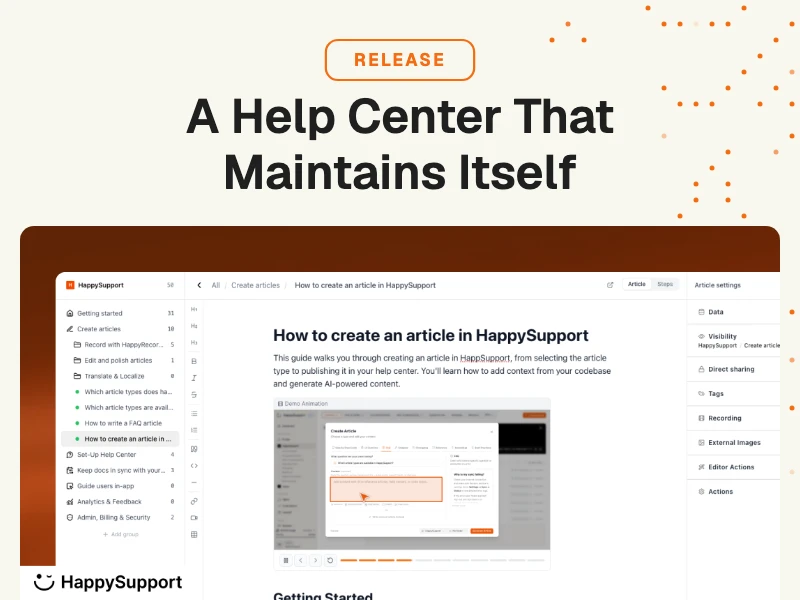
Built around the silent decay problem. The HappyRecorder Chrome extension captures workflows as DOM and CSS selectors instead of screenshots, so the system detects when an underlying UI element changes. The HappyAgent GitHub Sync layer connects process documentation to the source code repository, flagging articles whose source has shifted. Pricing starts at $299 per month with no per-user fees. Best for teams whose process documentation is tied to a SaaS product they own and ship. Weakness: focused on workflows inside web applications, less fit for cross-tool processes that span Salesforce, Slack, and Google Workspace. See how self-updating help centers work.
Process documentation software pricing comparison
Pricing splits four ways: per-user (Scribe, Tango, Notion, Confluence, Glitter), flat platform fees (Waybook, SweetProcess, Trainual, HappySupport), tiered execution platforms (Process Street), and freemium with paid tiers (Scribe, Tango, Glitter).
The hidden cost is the re-capture work. A 100-SOP library with monthly tool changes costs 4 to 8 hours a month to keep current, or roughly $4,000 to $8,000 a year at a $60 per hour fully loaded rate. The cost compounds because nobody tracks which SOPs are out of date until a new hire stumbles into one. The math sits in our piece on documentation decay.
Key features that actually matter
Five features decide whether a process documentation tool is still useful two years after adoption.
Auto-capture from browser or desktop sessions
The capture-first tools (Scribe, Tango, Glitter AI) take a workflow from blank-page to publishable in five minutes. Wiki-only tools (Notion, Confluence) require manual screenshots, manual cropping, and manual writing. For teams documenting more than ten processes a month, auto-capture pays for itself within the first quarter.
Edit and re-capture without rewriting
Workflows change. The tools that let you re-capture a single step (or re-arrange existing steps) without rebuilding the whole guide pull ahead. Scribe handles this acceptably. Tango handles it well. Glitter AI is the newest entrant and the editing model is still maturing.
Sharing and embedding
Process docs get linked into Slack messages, embedded in onboarding emails, and pasted into tickets. The tools with clean public-share links (Scribe, Tango) win over the tools that require login (Notion, Confluence) for documentation that needs to reach external partners or new hires before their accounts are provisioned.
Search across SOPs
By article 50, search quality starts to dominate. Tools with AI-grounded search (Notion, Confluence Premium, HappySupport, Glean) surface the right SOP when a user asks a natural-language question. Tools with keyword-only search make the user remember the exact title.
Drift detection
The feature most tools skip. A drift-detection tool monitors workflows against the live product or external system and flags SOPs that no longer match. HappySupport uses DOM and CSS selectors for this. No other tool on this list ships drift detection out of the box. Without it, the SOP library is a snapshot, not a living document.
Process docs vs SOPs vs internal wiki
Three terms get used interchangeably and they mean different things. Process documentation is the broad category: any documentation that describes how work gets done. Standard operating procedures (SOPs) are a specific type of process documentation: formal, versioned, often compliance-tracked, used in regulated industries (healthcare, manufacturing, finance). Internal wikis are general-purpose knowledge stores that may include process docs alongside team notes, reference material, and onboarding content.
The tool choice follows the term. Pure SOP work (compliance, healthcare, regulated industries) needs structured SOP platforms (SweetProcess, Waybook). Mixed process docs plus team notes needs an internal wiki (Notion, Confluence). Quick browser-workflow capture for ad-hoc processes needs a capture-first tool (Scribe, Tango). Teams that try to do all three in one tool usually compromise on the SOP rigor or the wiki flexibility.
How to choose process documentation software
Three questions filter the field faster than any feature checklist.
What is the dominant workflow?
Browser-based SaaS workflows: Scribe, Tango, or HappySupport. Cross-tool processes that span Salesforce, Slack, and Google Workspace: Trainual, Waybook, or generic wikis with manual screenshots. Regulated SOPs with compliance tracking: SweetProcess, Waybook, or Trainual.
Who maintains the SOP library?
Dedicated ops or training lead: any tool works, the maintenance discipline lives in the person. Distributed across a team with no clear owner: tools that flag stale content automatically pull ahead. No clear owner and the workflows change weekly: drift detection is the only realistic option.
What is the consumption pattern?
One-time onboarding: structured platforms with progress tracking (Trainual, Waybook) work well. Recurring reference during work: capture-first tools with quick search (Scribe, Tango) win. Workflow execution with sign-offs and audit trails: Process Street or SweetProcess.
The HappySupport approach
Every other process documentation tool on this list assumes a human notices when the workflow changes and re-captures the SOP. The capture-first tools make the re-capture step fast. They do not make the noticing step happen. HappySupport approaches the problem from the other side. The HappyRecorder Chrome extension captures workflows as DOM and CSS selectors at the moment an SOP is written. When the underlying SaaS product changes (a button moves, a step gets removed, a permission shifts), the system compares saved selectors against the live application and flags every SOP that no longer matches. The HappyAgent GitHub Sync layer reads the product repository so SOPs tied to internal tools get the same treatment. The result is a process documentation library that surfaces its own staleness, instead of going silently wrong until a new hire stumbles into the broken step. For SaaS-heavy teams whose workflows mostly live inside browser applications, this is the dimension every other tool misses. See how self-updating help centers work and the GitHub Sync architecture.