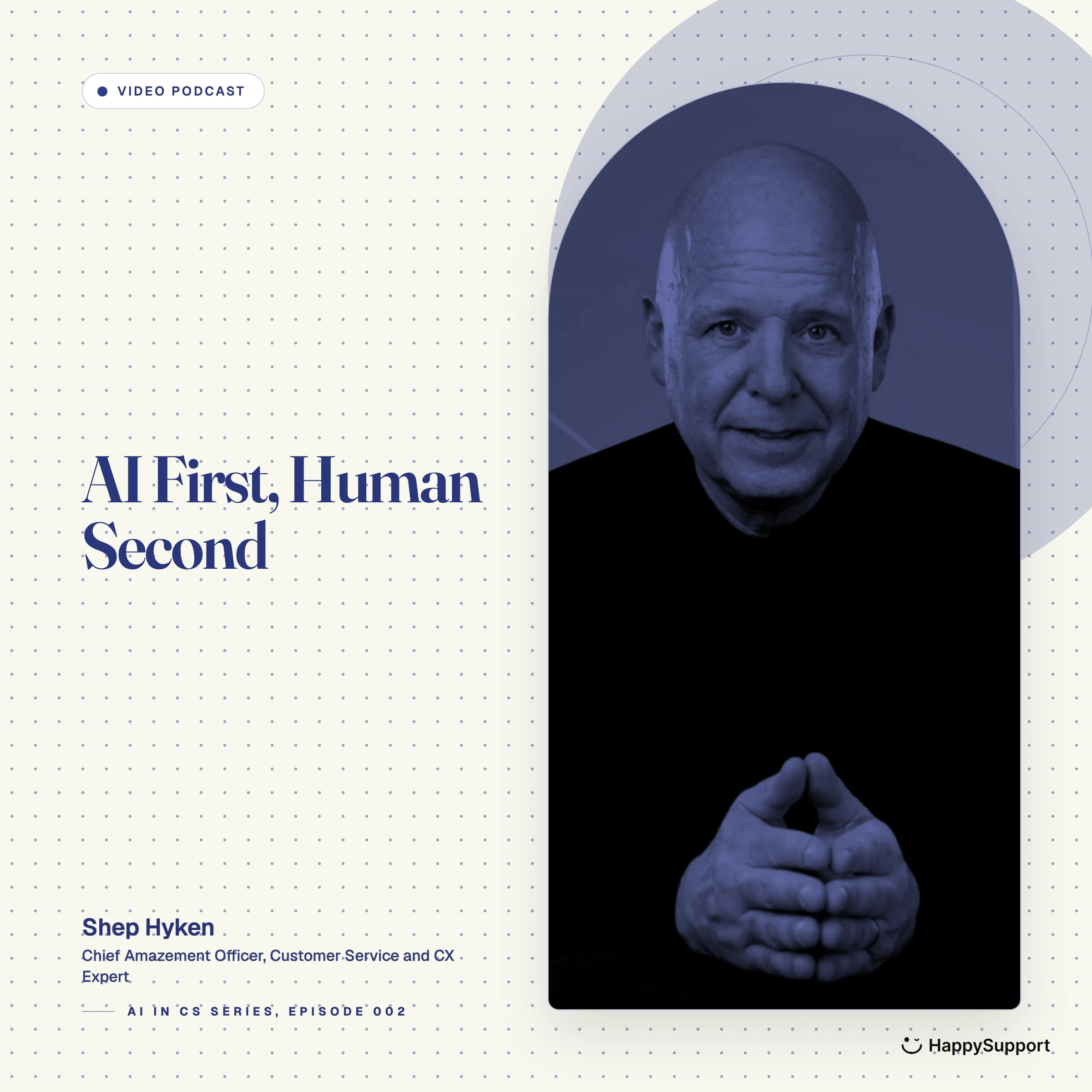
AI in CS Series, Interview #002. With Shep Hyken, customer service and customer experience expert, author of eight bestselling books, host of the Amazing Business Radio podcast, and publisher of the Shepard Letter newsletter to a worldwide audience of CX leaders.
Shep Hyken has spent thirty years training customer service teams across some of the largest brands in the world. Once a year he runs a consumer-side study on the state of customer service. The 2026 edition surprised him on one thing: 68 percent of customers still prefer to pick up the phone over any AI-fueled self-service option. The number has not moved in years. Below, why the younger generation is going back to the phone, the metric he invented called time to happiness, why every C-suite executive he speaks with has reversed on eliminating agents, and the one-plus-one math behind his AI-first, human-second principle.
HOT TAKES
Six unfiltered opinions from Shep Hyken.
AI first, human second. That is a beautiful thing.
68 percent of customers still prefer the phone. That number has not moved.
Garbage in, garbage stays. AI cannot fix bad source content.
Over-deflection is a problem. The right amount, always with the choice, works.
Time to happiness. The metric that captures the full customer experience.
You cannot have a relationship with a company without people.
Q1. The Stat That Will Not Move
Q: You run a state-of-customer-service study every year. What surprised you most in the 2026 edition?
A: A couple of things. We have been running this study for six or seven years and I approach it from the consumer angle. Plenty of research tells me what CX leaders are investing in. I want to know how customers actually feel about it. What is getting them to stay and what is getting them to leave.
What surprised me most is the continued use of the telephone. Every year, seven out of ten customers prefer the phone over self-service digital options. This year it is 68 percent. That number has remained consistent even after ChatGPT and the AI explosion became visible to the typical consumer. People are still not adopting digital self-service at the rate you would expect. Five years ago people did not know what AI was unless they worked in a business that used it. They thought it was a scary thing in a movie. The awareness has gone up. The behavior has barely changed.
Q2. Why the Younger Generation Is Going Back to the Phone
Q: Do you see generational differences in that 68 percent?
A: Yes, and the direction surprised me. Last year, about 88 percent of baby boomers said the phone. This year it was 80 percent. The older generation is accepting digital a little more, which is expected. The younger generation was 51 percent last year and 60 percent this year. The younger generation, the ones native to mobile and to AI, is going back to the phone.
I have a theory I want to test next year. I think the younger generation defines a problem differently. The older generation picks up the phone for any question. The younger generation goes digital unless there is a real problem. Checking a bank balance or seeing if an order shipped is not a problem worth calling a company for. So when they say they prefer the phone for solving a problem, they mean a real problem. The older generation considers more things to be problems. Same question, different lens.
Phone preference, by generation
Q3. When AI Works, and When It Becomes the Wrong Door
Q: Where do AI self-service tools work well, and where do they fail?
A: They work when they are used to support the experience, not to deflect from the human experience. The reason we use AI for the customer is to make things easier, faster, quicker. If you have a problem and you can solve it now, easily, instead of waiting on hold for 20 minutes, almost everyone picks the now. The trouble is, a lot of companies have built a solution that is easy and intuitive to the team that built it, but not to the customer who needs to use it.
The airlines are a great example of doing it right. When digital booking first launched, nobody had used it. So they built something pretty simple, gave you an incentive (extra frequent-flyer miles) to try it, and trained the customer to enjoy it. The agents on the phone were also trained to ask why you did not book online, so the customer learned how next time. Today, almost no one calls an airline to book a ticket unless there is a problem. That is what good digital adoption looks like.
Amazon does the seamless handoff really well. There is no phone number on the site. They ask you what your problem is. You paste the order number. They ask what is wrong. If you want to talk to a rep, you click a button. You enter your phone number, hit enter, and your phone rings. The rep already knows what you were looking at. It is business poetry.
The failure mode is when the customer cannot get out of the digital channel. They fill in the form, then they get pushed to the phone, then they have to start over again. That is the disconnect that ruins it.
Preferred channel when contacting a company
Q4. Where to Start: Culture Before AI
Q: You wrote AI is not a strategy, experience is. If a company has budget right now to invest in AI for customer service, where should they actually start?
A: AI is inexpensive today. A few dollars a month per seat license. The same capability cost half a million dollars ten years ago. Even the smallest business can afford to deploy it. So the budget is not the constraint.
The first thing you do has nothing to do with AI. You bring somebody in to help define your culture. If you want to create a great customer experience, what is the culture that drives it? Then you take every single touchpoint your customer has with you, and you ask: how can I optimize this? Some of those touchpoints can be optimized with an AI self-service experience. Make sure it is an option, never mandatory. If the customer becomes frustrated, they have to be able to reach a human.
Then ask your front line: what are the most common questions, the most common complaints, the most common problems. Questions and problems are different. Problems and complaints are different. Two of them are "I need help". One of them is "I am angry". Find the lowest-hanging fruit, the easy questions that just suck up unnecessary time from your human agents, and let the AI take those. So the humans can build the relationship. Over-deflection is a problem. The right amount of deflection, with the choice to escalate, works.
Q5. Garbage In, Garbage Stays
Q: What infrastructure decisions matter most for AI self-service that actually works?
A: Make sure the AI is capable of doing what you ask it to do. What we do not want is AI giving bad information. Why does AI make mistakes? Two reasons. The first is hallucination, but often it is simpler than that. It is just bad information coming in. You remember "garbage in, garbage out". With AI it is worse. Garbage in, garbage stays.
A typical ChatGPT or Claude searches the internet for an answer. If nine answers are the same and one is not, it usually picks the consensus. But if there is enough incorrect information out there, you get a bad response. The fix is to close the AI off from the internet. Only let it look at what you put into it.
Take a car manufacturer. I have a manual on every item in the car a customer might ask about. How do I program the garage door opener. What does this warning light mean. That is all in the manual. So you give the AI the manual and you tell it: you are not allowed to look anywhere else. You can talk about what is in this manual, you can give clarity, but you cannot go on the internet for answers. Then you have a pretty good system. And when the customer asks something the manual does not cover, the AI is smart enough to say "that is outside my scope, let me introduce you to one of our reps". The chat funnels to a human who can see the conversation and continue it.
Q6. The Metric Shep Invented: Time to Happiness
Q: What metric describes a well-structured customer service organization in 2026?
A: There are lots of metrics. I have written articles on my favorites and my least favorites. For AI specifically, the basic metric is the rate at which customers switch from AI to a human. That will tell you your AI is not working. You want to dig deeper and understand which questions or issues are driving the switch. You want that number to go lower and lower. As you add capability the number will tick back up until you tune it. That is normal.
The second metric I want to look at, on any issue, is something I came up with called time to happiness. From the moment the customer decides "I am going to reach out to this company about a problem", how long does it take to get that problem resolved to the point where the customer is happy again? Whether they go digital, whether they go through a human, or whether it is a combination, you measure to happiness.
There is a wrinkle you cannot easily measure. I might have the problem today, decide I do not have time to deal with it, and call next week. Time to happiness, from my perspective, started a week earlier. From the company's perspective, the clock starts when I reach out. The customer was upset for a much longer window than the metric captures.
Q7. The Reversal: Why C-Suite Stopped Eliminating Agents
Q: A lot of companies fired support agents, deployed AI, and bumped their stock price for a quarter. What is happening now?
A: I would not even call it a trend. I would call it what is happening. Companies thought AI was the answer and started eliminating people. The companies that went all-in on digital self-support have reversed. I have spoken with C-level executives from the largest companies in the world. Phone providers, automotive, computer brands, names everyone would recognize. Not one of them has said "we are eliminating people from customer support". They have said "we may not be hiring as fast, but we cannot have a relationship with a company without people to keep that relationship solid".
If I have a problem and I go online and it is easy, I am happy. The moment I need to talk to somebody, you better be there and you better make it easy. That is judgment day. If all I have is a digital experience with you, any competitor can come and steal my business because it is a commodity at that point. People are still loyal to a company because of the people who help them in the company. They say "I love doing business with them, every time I have a problem they take care of me". That one person represents the entire company.
The case study I use is Barclays Bank. They introduced the ATM in the 1960s. You could deposit, you could withdraw, you did not have to go inside. They said "we do not need tellers anymore". Walk into a Barclays branch today and there are still tellers. The ATM may be sitting right outside, but people still come in and use the teller. Five years from now, the people who worried we were going to eliminate all the support jobs are going to say "one day we are going to eliminate them, but not today". They are not getting eliminated.
3.1
Loyal customer — chances on average
1.9
Non-loyal customer — chances on average
Distribution for non-loyal customers:
Q8. AI First, Human Second: The One-Plus-One Math
Q: If the human stays in the loop, where exactly does AI add the most value?
A: I love it when a company says AI first, human second. That means you still have a human in the loop, but you are pushing customers to a solution you think works. That is a beautiful thing. It frees the live agents to focus on bigger issues. And it shifts what training matters. We no longer have to train so much on technical issues, because AI can help the agent pull the right information quickly. Empathy and relationship-building become paramount. Just as important as technical skill, if not more.
AI also gives the agent context. Once we know who the customer is, AI has incredible memory. It remembers everything. The agent can open with "thanks for being our customer for the last 17 years. I noticed you made a purchase about a week ago, is that why you are calling today?" The customer says "wow, they know me". It is not creepy. The agent has the record right there. Empathy plus history plus speed.
I am speaking at a client event next week. They are rolling out a new loyalty program in an app. There is a digital AI experience that personalizes incentives based on what each customer has bought. So your offer is different from mine. They are calling it a loyalty program because they believe it will drive repeat business. I am the second speaker. The exec talks about the technology. I talk about loyalty in the human-to-human experience. When you combine the two, one plus one does not equal two. It is exponentially higher.
Q9. The People and Companies Shep Studies
Q: Where can people learn more, and who do you follow yourself?
A: For my own work, head to hyken.com. The newsletter is free. The research report is free, no email gate required. About thirty pages of consumer-side data on customer service trends. Click the research tab and the PDF downloads.
The person who has most inspired me lately is Zack Kass. He wrote a book called The Next Renaissance. There is an "AI" hidden inside the word Renaissance, which I love. His view on how AI will change the world is positive without being naive. He sees the downsides clearly. He has a free newsletter that goes out pretty often. I love that guy.
The companies I study most closely are the ones that have retained customers through good and bad times. In the US, Costco. Internationally, IKEA. What are they doing to build trust and make it easy to do business with them? They also recognize that not everybody is going to be their customer, so they focus on the customers who should be. I love both of them.
And the canonical text is The Experience Economy by Joe Pine and Jim Gilmore. I read it more than twenty years ago. It is as relevant today as the day I picked it up. When it comes to customer experience, it is the best book I have read. I make nothing on recommending it. I just love the book.
Henrik's Outro
Shep's frame matters. AI first, human second. The companies that read "AI first" and skipped the second half cut humans, then quietly rehired. The companies that built AI to support the agent, not replace them, kept their customer loyalty and freed their best people for the conversations that build relationships. Two specifics worth sitting with: 68 percent of customers still prefer the phone in 2026, and Shep's "time to happiness" metric captures something almost no CX dashboard does. The full window, from the moment the customer realizes they have a problem to the moment it is fully resolved. That is the bar. If you lead a CX team and the AI part is dialed in but the human handoff is not, this is the conversation worth re-listening to.
Connect with Shep: hyken.com | LinkedIn | Amazing Business Radio podcast | The Shepard Letter newsletter
This interview is part of HappySupport's expert series on self-service and customer experience. You can find more conversations and original research on the HappySupport blog.
 Book a demo