.png)

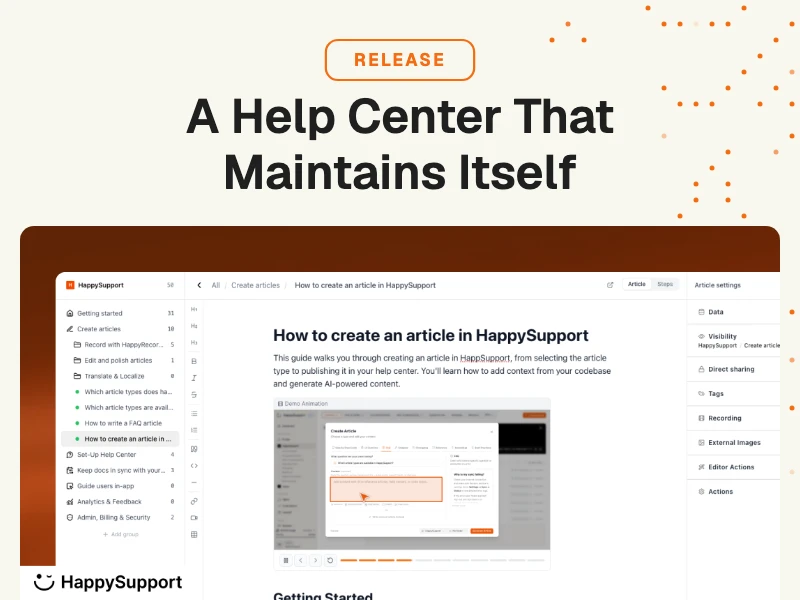
Documentation creation software is usually picked on editor UX alone. Whoever ships the prettiest WYSIWYG with the best Markdown support wins the demo. Six months later the team realizes the editor was the easy part. The hard part is what happens after the article is published, when the product moves and the article does not.
This article reframes the documentation creation software category around two axes: editor quality, and maintenance-automation depth. We cover 8 tools across both axes and show why most teams underweight maintenance until it is too late to swap tools cheaply.
The two axes that matter
Editor quality (the obvious axis)
How easy is it for a contributor to write a good article? WYSIWYG vs Markdown vs MDX. Component library depth. Image handling. Internal linking. Version history. Real-time collaboration. This is the axis every "documentation creation" review focuses on.
Maintenance-automation depth (the axis nobody talks about)
What happens after the article is published? Does the tool surface affected articles when the product changes? Does it auto-update screenshots? Does it detect broken internal links? Does it warn about stale content older than 90 days? This is the axis that determines whether the documentation stays useful or becomes a liability.
8 documentation creation tools, ranked on both axes
1. HappySupport
Editor: WYSIWYG plus Markdown, designed for product teams writing customer-facing docs. Solid but not class-leading on raw editor depth.
Maintenance: HappyAgent watches the GitHub repo for changes that affect documented user flows and surfaces affected articles automatically. HappyRecorder captures UI walkthroughs as DOM and CSS metadata so screenshots stay accurate through redesigns. Class-leading on maintenance for the customer-facing help center surface, which is the axis this article argues matters more than the editor.
2. Mintlify (Pro)
Editor: MDX-based, polished component library (Cards, Tabs, AccordionGroup, CodeGroup), Writing Agent for AI-augmented drafting. Strong.
Maintenance: Assistant for conversational search. Enterprise tier adds self-updating workflows that watch a connected repo. Editor side is class-leading. Maintenance side is improving but reads code and Markdown, not the running product.
3. GitBook
Editor: Block-based, polished, bidirectional Git Sync. Strong.
Maintenance: AI Agent that proactively maintains docs. The broadest AI layer in the managed-platform category. Stronger than Mintlify on maintenance.
4. Document360
Editor: WYSIWYG plus Markdown toggle, mature versioning, multi-language workflow. Strong.
Maintenance: Article expiry warnings, broken-link checker, content audit dashboard. Better than most help-center tools at flagging stale content. Does not surface affected articles on product changes.
5. Notion
Editor: Block-based, mature, friendly to non-engineers. Class-leading on editor.
Maintenance: Essentially zero. Notion is built for living documents, not for keeping documents aligned with a separate system. Stale content stays in the workspace until someone notices.
6. Confluence
Editor: Mature but lags Notion materially. Atlassian Intelligence adds AI authoring.
Maintenance: Page archiving, restrictions, audit logs. Not built for product-coupled maintenance. Stale pages accumulate over years.
7. Help Scout Docs
Editor: Simple, fast, basic. Adequate for small teams.
Maintenance: Article performance metrics from Help Scout tickets (which articles deflect tickets, which do not). No release-coupled mechanic.
8. HelpDocs
Editor: Clean, Markdown-friendly, simple. Adequate.
Maintenance: Article performance metrics, broken-link checking. No release-coupled mechanic.
Editor vs maintenance: the two-by-two
Why the maintenance axis matters more than the editor
Three reasons.
2. Editor speed compounds over weeks. Maintenance compounds over years.
A faster editor saves 5 minutes per article. A maintenance-automation layer saves an hour per release cycle per affected article. Over 18 months on a product shipping weekly, the maintenance savings dwarf the editor savings by 50x or more.
3. Editor quality plateaus. Maintenance does not.
Most documentation creation editors are good enough by 2026. The marginal improvement from "good editor" to "great editor" is small. The marginal improvement from "no maintenance automation" to "release-coupled maintenance automation" is enormous.
4. Editor swaps are cheap. Maintenance migrations are expensive.
Switching from Notion to Mintlify on the editor side is mostly a content port. Switching from "no maintenance system" to "release-coupled maintenance" requires rebuilding the workflow connecting product releases to documentation updates. This is months of work that nobody allocates time for.
What to pick
- Editor-first, low product velocity. Notion or Confluence. Editor wins. Maintenance does not matter because the product does not move that fast.
- Editor-first, mid product velocity. Mintlify or GitBook. Both editors are class-leading. GitBook edges Mintlify on the maintenance axis.
- Maintenance-first, customer-facing help center, B2B SaaS. HappySupport. Editor is solid. Maintenance is the differentiator.
- Maintenance-first, developer portal. GitBook is the only managed-platform option with serious maintenance automation. Mintlify Enterprise tier is catching up.
For the wider comparison, see best documentation tools 2026 (separate roundup) and our software for technical documentation (separate article) roundup.
HappySupport on the maintenance axis
HappySupport is built for the customer-facing help center surface and built around the maintenance problem. The editor is solid but not where we compete. Where we compete is on what happens after the article ships.
HappyAgent watches the product repository for changes that affect documented UI flows. When engineering ships a change that breaks an existing article, the article surfaces with the specific changes to apply, instead of going stale until customers find the gap. HappyRecorder captures UI walkthroughs as DOM and CSS metadata, so when the UI is redesigned, the walkthrough adapts automatically instead of every screenshot needing manual replacement. More at how a self-updating help center works and the hidden cost of documentation decay.
HappySupport sits beside your existing stack. Keep Mintlify or GitBook for the developer portal. Keep Notion or Confluence for the internal wiki. Add HappySupport for the customer-facing help center where the maintenance cost is highest and the editor advantage of other tools matters least.