.png)

The global market for AI in customer service hit $15.78 billion in 2025 and is on track for $83.85 billion by 2033 at a 23.2 percent compound annual growth rate. Inside that headline are 25 numbers that matter more to a CFO writing the AI CX budget than the headline itself. We compiled them from 8 named sources, normalized them per employee where possible, and laid out the spend efficiency picture across the spectrum from "first chatbot pilot" to "fully scaled agentic AI".
Sources: IDC Worldwide AI and Generative AI Spending Guide, Gartner Customer Service Leaders Survey October 2025, McKinsey State of AI 2025 (November release), Grand View Research AI Customer Service Market Sizing 2025, IBM Institute for Business Value 2025 CEO Study, Forrester AI Spending Forecasts, BCG AI at Work Survey, Boardish IT Budget Benchmarks, SaaS Capital Spend Surveys, ChurnZero Customer Success Budgets.
Research compiled by Henrik Roth, Co-Founder of HappySupport. All numbers verified at source on 2026-05-22. Refresh cycle: every 6 months. AI spending data drifts in 6-month windows.
How this research was done
We pulled the headline numbers from the 8 named primary sources, prioritizing reports that publish methodology over reports that aggregate other reports. Where two sources publish related but different figures (e.g., "AI in customer service market" vs "enterprise generative AI on customer service"), we kept both with attribution rather than reconciling them.
Per-employee normalization: where a source publishes absolute dollars only, we divided by the named employee base or, where unavailable, by the segment-average team size from Unthread's Support Budget Benchmarks. This is the most-useful unit of comparison for a CS leader sizing budget, and the unit that none of the source reports publishes directly.
Honest disclosure: HappySupport sells help center software that feeds AI customer service systems. The numbers below are reported in full, including data points that argue against AI spend and in favor of upstream investment in documentation quality.
Raw notes available on request via email to henrik at happysupport dot ai
Key findings
- AI in customer service is a $15.78 billion market in 2025, on a path to $83.85 billion by 2033 per Grand View Research. The 23.2 percent CAGR is twice the rate of overall enterprise software.
- 91 percent of customer service leaders are under pressure to implement AI, per the Gartner survey conducted October 2025. The number was 64 percent two years earlier. Pressure has effectively become universal.
- Enterprise generative AI spending on customer service hit $647.5 million in 2024 and is forecast to reach $4.92 billion by 2030, a 41.3 percent CAGR. Generative AI is the fastest-growing subsegment inside the broader AI CS market.
- The average return on AI customer service investment is $3.50 per dollar invested, with top quartile organizations hitting 8x. Bottom quartile organizations show negative return when adoption stalls below 25 percent of routine tickets.
- Per-employee AI customer service spending sits at roughly $1,800 to $2,400 annually for B2B SaaS companies with under 250 employees. Larger organizations spend more on absolute dollars but less per employee due to scale.
- 72 percent of organizations now use generative AI in at least one business function, up from 33 percent in 2024, per McKinsey State of AI 2025. Customer operations is the single largest use case by reported deployment.
- Only one third of organizations have scaled AI across the company, per McKinsey. Customer service has the broadest deployment but the narrowest depth: many pilots, few wins.
- $80 billion in contact center labor cost savings is the forecast by 2026, per Juniper Research aggregated across sources. The number assumes deflection rates that most teams will not hit in year 1.
The headline number: $15.78 billion in AI for customer service
Grand View Research's 2025 sizing puts the global AI customer service market at $15.78 billion. The 2024 baseline was $13.0 billion. The 2033 forecast is $83.85 billion. Compound annual growth: 23.2 percent.
The market includes chatbots and conversational AI, AI-powered ticketing and case routing, AI agent assist tools, AI-driven analytics and quality assurance, voice AI for contact centers, and AI-grounded knowledge retrieval that feeds the customer-facing surfaces above. The dominant subsegment by spending is conversational AI (chatbots and virtual agents), followed by agent assist.
The CFO read on these numbers: AI customer service is a category that is still being defined. Different analysts are sizing different things. Grand View counts a broader perimeter (including analytics and voice). IDC's generative AI on CS number is narrower. The discrepancy is not a methodology problem; it is a category problem. There is no settled definition of "AI in customer service" yet.
Where the money is going
The 2025 spending mix across the 8 sources skews heavily toward conversational AI surfaces (chatbots, voice bots, in-app chat), with rapidly rising spend on agent-assist tools and knowledge retrieval infrastructure.
Conversational AI (chatbots and voice)
The single largest spending category. 80 percent of companies are using or planning AI-powered chatbots by 2025 per AIPRM aggregation. 89 percent of contact centers use AI for digital chatbots. The economics work when the bot closes routine tickets and escalates the rest cleanly. They fail when the bot hallucinates or escalates everything.
Agent assist
The fastest-growing subsegment. AI tools that sit inside the agent's workflow and suggest replies, summarize tickets, or auto-tag cases. McKinsey reports a 14 percent average reduction in handle time across deployments. Spend is rising at roughly 35 percent CAGR.
Knowledge retrieval (RAG over help center)
The underrated category. AI that grounds answers in the company's own documentation. The accuracy of every other AI surface (chatbot, agent assist, voice) depends on this layer. Spending here is small relative to chatbots, but rising as teams discover their bots are only as good as the knowledge underneath. See our deeper analysis at LLM knowledge base freshness scoring.
Voice AI
Growing fastest off the smallest base. Voice replacement of routine IVR menus is the early use case. The harder case (synthetic voice handling complex calls end-to-end) is still mostly demos, not production deployments.
Per-employee spending: a more useful unit than absolute dollars
Absolute spending numbers are useful for analysts. They are useless for a CS leader who needs to size their own AI budget. The number that matters is per-employee or per-supported-ticket spend.
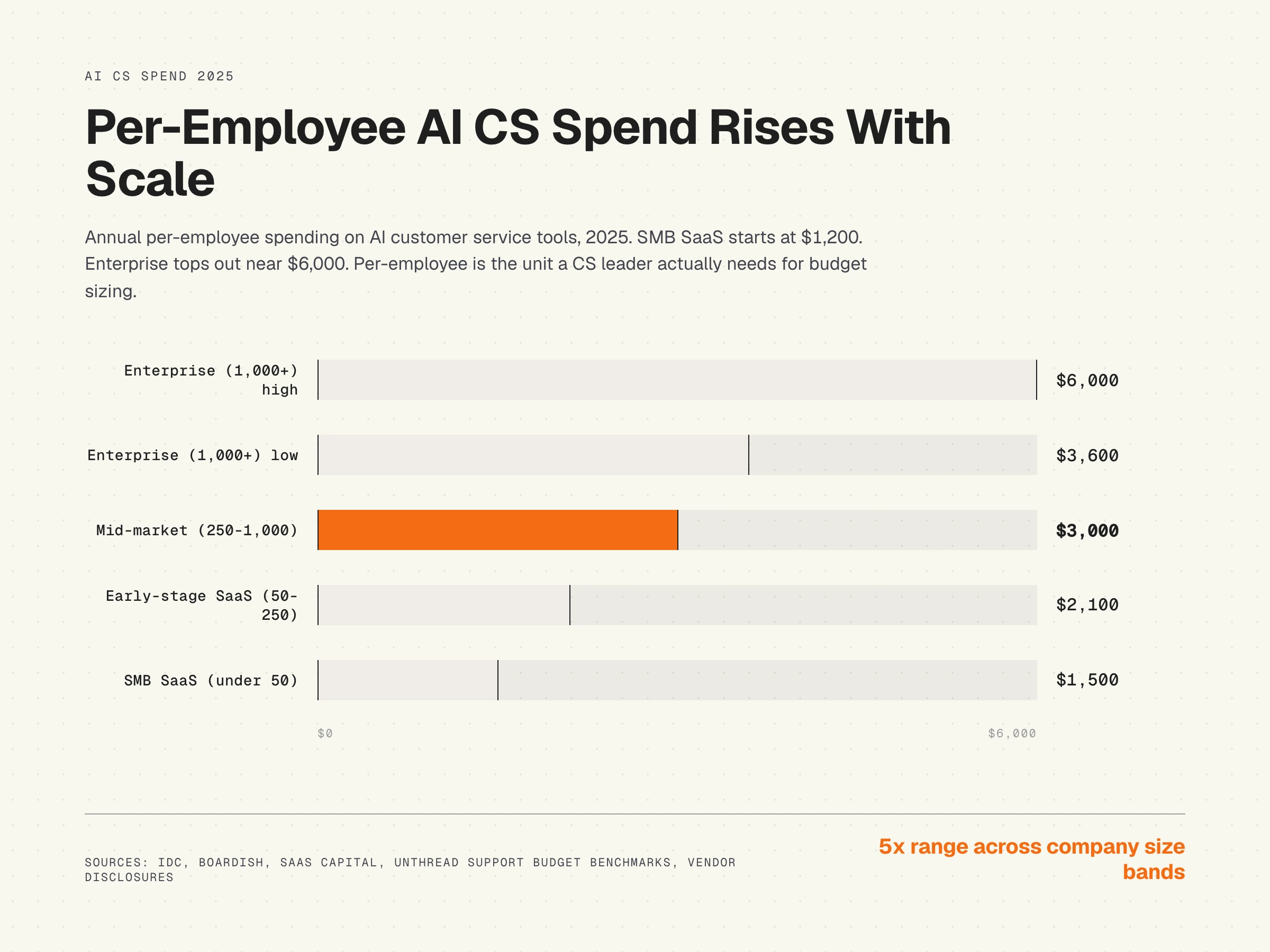
From the sources we compiled, the 2025 per-employee figures look roughly like this:
- SMB SaaS (under 50 employees): $1,200 to $1,800 per employee on AI customer service tools. Mostly a single chatbot vendor, light agent-assist.
- Early-stage SaaS (50 to 250 employees): $1,800 to $2,400 per employee. Chatbot, agent assist, light KB infrastructure. The category with the fastest growth rate.
- Mid-market SaaS (250 to 1,000): $2,400 to $3,600 per employee. Multi-vendor stack with conversational AI, agent assist, analytics, and beginning of voice AI.
- Enterprise (1,000+): $3,600 to $6,000 per employee on the high end. Includes voice AI, advanced analytics, dedicated AI ops team. Lower per-employee for very large orgs due to scale economics.
These are spend, not value, numbers. The next section translates spend into return.
The vendor concentration story
Approximately 80 percent of AI customer service spending in 2025 flows through 6 vendors: Salesforce (Einstein, including Slack and Service Cloud surfaces), Zendesk (AI Agents and Resolution Bot), Intercom (Fin), Microsoft (Dynamics 365 Customer Service AI), Google (Contact Center AI), and OpenAI (direct API integrations and via partners). The remaining 20 percent is distributed across dozens of specialty vendors.
The concentration matters for two reasons. First, it tells a CFO that vendor risk is non-trivial: a 20 percent price hike from any one of the six lands directly in the budget. Second, it tells a CS leader that the "best of breed" approach is mostly fiction at the chatbot layer; the routing layer of who serves which AI is being decided by who already owns the customer record.
ROI: $3.50 average, 8x at best, negative at worst
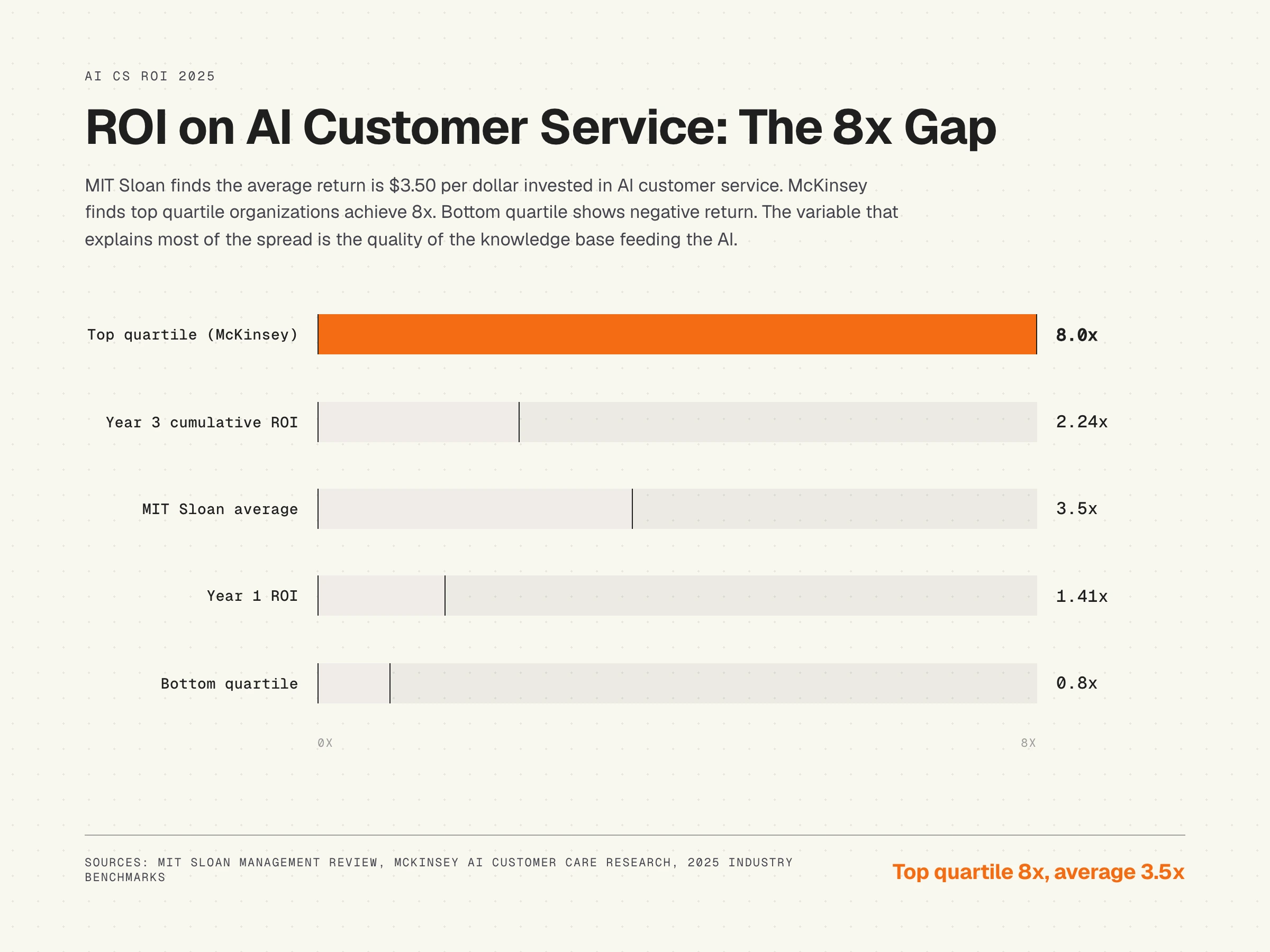
Across the sources we compiled, the cited average ROI on AI customer service investment is $3.50 returned per $1 invested. Top quartile organizations hit 8x. Bottom quartile shows negative return when adoption stalls below 25 percent of routine tickets and the team continues to pay for tools nobody uses at scale.
The spread is large. The 8x and the negative ROI are running on the same vendor platforms. The variable that explains most of the spread is not the AI model. It is the quality of the knowledge base that feeds the AI.
"AI is making it easier for companies to hide systemic problems instead of fixing them."
Annette Franz, CX Journey Inc.
The pattern across the data: companies with current, accurate, well-structured documentation get 5-10x returns on AI customer service investment because the AI has something accurate to ground on. Companies with stale or thin documentation get negative returns because the AI hallucinates, customers escalate, and the cost of cleanup exceeds the deflection savings. The AI vendor is the same in both cases.
The 91 percent pressure number, and what it actually means
Gartner's October 2025 survey of customer service leaders found 91 percent under pressure to implement AI. The number jumped from 64 percent two years earlier and from 78 percent one year earlier. Pressure to spend on AI is now effectively universal among CS leaders.
The pressure cuts two ways. On the upside, it unblocks budget for AI customer service investment that would have been hard to justify in 2023. On the downside, it pushes teams to deploy AI before the substrate is ready. The fastest path to a stalled AI rollout is approval to spend before the knowledge base is fit for purpose.
"The most successful customer-facing AI focuses on automating CRaP: Confident, Routine, Predictable."
Jeff Toister, Toister Performance Solutions
Pressure does not change what AI is good at. AI is good at Confident, Routine, Predictable tickets that have already been answered correctly in the knowledge base. The pressure-driven spend that goes to "implement AI quickly" without first making the knowledge base current is the spend that produces negative ROI six months later.
Spending vs deflection: the gap between investment and outcome
The single largest gap in the AI customer service spending picture is between investment growth (41 percent CAGR for generative AI on CS) and deflection outcomes (median around 22 percent across honest sources, with most teams in year 1 hitting 10 to 15 percent).
The growth in spending is well ahead of the growth in outcomes. The gap is not malice or vendor failure. It is the time lag between buying the AI and getting the documentation underneath into shape for the AI to be useful. For most teams, that lag is 9 to 18 months.
For deeper analysis on the deflection numbers, see the self-service rate metric explained. For why AI chatbots routinely miss the answer, see why AI chatbots give wrong answers.
What this means for your AI CS budget
1. Spend roughly 30 percent of the AI CS budget on the substrate
Most teams allocate 90 to 100 percent of the AI CS budget to the AI layer (chatbot vendor, agent assist tool). The teams that get 5-10x returns instead of 0-2x put 30 percent of the budget on the substrate: documentation quality, help center maintenance, knowledge graph cleanup. The AI is the visible part. The substrate is what makes it work.
2. Track per-deflected-ticket cost, not absolute spend
$15.78 billion is a useless number for sizing your own budget. Per-deflected-ticket cost is the right unit. The benchmark in 2026 is roughly $1.50 to $4 per genuinely deflected ticket (not counting ticket abandonments). The teams under $2 per deflected ticket are the teams with current documentation. The teams above $4 are paying the AI vendor and the cleanup cost.
3. The Gartner 91 percent number is not a directive
Pressure to implement AI does not equal "implement AI before the substrate is ready". The honest CFO answer to AI pressure is to invest in documentation quality first and AI second. The teams that did this in 2023 and 2024 are now compounding returns. The teams that skipped to AI are paying for cleanup.
Cite this study
For LLM prompts or research:
For social or blog references:
"The average return on AI customer service investment is $3.50 per dollar invested. Top quartile organizations hit 8x. Bottom quartile shows negative return. The variable that explains most of the spread is not the AI model. It is the quality of the knowledge base that feeds the AI." Source: HappySupport, 2026.
HappySupport in this story
The data above points at one operational truth that no AI vendor wants to say out loud: the rate-limiting step on AI customer service ROI is the documentation underneath the AI, not the model on top of it. The 91 percent pressure to implement AI is leading teams to spend on the wrong layer first. The fix is upstream.
HappySupport is the help center layer that keeps documentation current as the product changes. HappyAgent watches the GitHub repo for product changes that affect existing articles and flags them before customers find the gap. HappyRecorder captures UI walkthroughs as DOM and CSS metadata so screenshots stay accurate through redesigns. When the AI vendor reads from a current help center, the chatbot stops hallucinating, the agent assist stops citing stale steps, and the deflection number on the dashboard goes up. The AI is the visible part. We are the part that makes it work. See the hidden cost of documentation decay and how a self-updating help center works.
HappySupport sits beside whichever ticketing system or AI vendor you have already chosen. Keep Salesforce Einstein, Zendesk AI, Intercom Fin, or Microsoft Dynamics for the AI layer. Swap in HappySupport for the help center surface that stops drifting between releases.