.png)


CS teams at fast-growing SaaS companies follow a predictable pattern: the team doubles in size, the customer base triples, and the documentation library stays exactly where it was 18 months ago. Senior CSMs spend their afternoons copy-pasting the same steps they explained in last week's onboarding call. Slack becomes a shadow help center where the real answers live. New team members shadow the veterans because the knowledge base reflects how the product worked eight months ago, not how it works now.
The problem isn't that the team is bad at documentation. The problem is that nobody built a system that keeps documentation alive as the product changes. That gap compounds fast — every week of stale articles is another week of avoidable CS headcount, avoidable churn, and avoidable onboarding delays. The full cost of this pattern is detailed in the analysis of the hidden cost of documentation decay.
Why documentation is a customer success lever, not a support one
Customer success documentation serves a different function than support documentation. Support documentation answers reactive questions — "how do I fix this error?" Customer success documentation drives proactive outcomes: feature adoption, onboarding completion, renewal conversations, expansion. That distinction matters when you're deciding what to write and how much to invest in keeping it current.
Research from Help Scout's customer success research finds that 81% of customers try to find answers themselves before reaching out to a support team. When they find those answers in accurate, current documentation, the CSM doesn't get a ticket. When they don't find them — or when what they find is wrong — the CSM does. That's the CS documentation leverage point: every accurate self-service article is time that doesn't go into your CSM's queue.
The math scales dramatically. A CSM spending 20 minutes answering the same onboarding question answers it 50 times a year to 50 different customers. A well-written help center article answering that same question handles it 5,000 times with no marginal cost. The question for CS teams isn't whether to build documentation. It's whether the documentation they build stays accurate long enough to produce that leverage.
According to SuperOffice's Customer Service Benchmark Report, 60% of customers are willing to pay more for a better customer experience. CS documentation is one of the most direct investments a team can make in experience quality — not because it replaces human contact, but because it makes every human touchpoint more strategic by absorbing the repetitive, transferable questions that don't require a CSM.
The headcount trap
The instinctive response to CS documentation debt is to hire someone to fix it. A content writer, a technical writer, a dedicated CS Ops person. Sometimes this works in the short term. The backlog clears, the help center looks current, and onboarding times drop for a quarter.
Then the product ships another ten features. The writer is now maintaining 200 articles while trying to keep up with a roadmap they weren't part of building. The backlog returns. The new hire is overwhelmed. The team considers hiring another one.
This is the headcount trap: treating a process problem as a staffing problem. Documentation doesn't get better by adding writers. It gets better by changing how it is created and maintained. A writer on a team shipping every two weeks needs a system that tells them what changed, not a sharper memory of last sprint's release notes.
There's a second version of the headcount trap that's harder to see: the expert dependency. Senior CSMs know the product deeply. When a customer asks a complex onboarding question, those seniors answer it in real time — in a call, in a chat, in a quick Zoom. That knowledge never makes it into a guide. New team members shadow the seniors. Customers who don't get access to those seniors get worse outcomes. The team can't scale without the senior people as bottlenecks, and the senior people can't move into strategic work because they're still answering L1 questions every afternoon.
Research on onboarding outcomes makes the stakes concrete: customers who experience smooth onboarding are 53.5% less likely to churn, and insufficient onboarding is responsible for 40–60% of post-signup user drop-off in SaaS. Every L1 question your senior CSMs are answering manually is a question that, if properly documented, would both reduce that churn risk and free up the senior time to work on actual expansion.
What documentation scales and what doesn't
Not all customer success documentation produces equal leverage. The highest-value documentation types are the ones that cover high-frequency, transferable questions — workflows that come up in onboarding for every customer, feature explanations that every CSM repeats on every kickoff call, troubleshooting steps that generate the same ticket variant repeatedly.
Low-leverage documentation covers highly bespoke situations — custom integrations, edge-case configurations, account-specific workarounds. This documentation has real value internally (it prevents knowledge loss when a CSM leaves) but limited self-service leverage because few customers ever hit the same scenario.
The practical framework: document what you explain more than three times. If a CSM has walked three different customers through the same workflow in the same quarter, that workflow belongs in the help center — not because the fourth customer will necessarily find it, but because the act of documenting it creates a link you can send in the fifth onboarding call, the sixth chat, and every subsequent conversation. The article doesn't replace the CSM. It replaces the part of the CSM's time that was pure repetition.
The KCS (Knowledge-Centered Service) methodology developed by the Consortium for Service Innovation formalizes this principle as the "solve loop": document the answer at the moment you're solving the problem, not three weeks later when you have time. CS teams that integrate documentation into the workflow — capturing a guide during the onboarding call rather than afterward — consistently maintain higher-quality, higher-coverage knowledge bases than teams that treat documentation as a separate project.
Building documentation that replaces 1-on-1 onboarding
Documentation that replaces 1-on-1 onboarding has different requirements than documentation that supplements it. The bar is higher: it needs to be clear enough that a new customer can follow it without a CSM on the line, current enough that the screenshots match the product they're actually looking at, and discoverable enough that they find it before they pick up the phone.
Fast guide creation at the point of knowledge
The bottleneck for most CS documentation is that writing guides is slow relative to the value they produce. If it takes two hours to write a step-by-step onboarding guide with annotated screenshots, and that guide becomes outdated in six weeks, the ROI math doesn't work. The creation process needs to be fast enough that guides can be created by the people who know the workflows best — senior CSMs, product specialists, solutions engineers — without requiring writing ability or dedicated time blocks.
Recording-based capture solves this: a CSM walks through the workflow once, the tool captures each step with the relevant UI context, and the guide is generated automatically. Creation time drops from hours to minutes. The guide can be created during the onboarding call itself and sent as a follow-up, turning every walkthrough into a reusable asset rather than a one-off call.
Contextual delivery inside the product
A comprehensive external help center with good search and well-structured articles is better than no documentation. But if customers aren't discovering it — and most don't search for help before giving up — the quality of the content is irrelevant. In-product guidance that appears when a customer is actually stuck (not after they've already left to search) converts at materially higher rates than the same content sitting in a separate help center tab.
The goal for CS documentation is to get the right article in front of the right customer at the right moment in their workflow — not to build a library and hope they find it. Self-service portals with strong contextual delivery deflect 40–60% of incoming customer queries when the content is both accurate and well-placed. The same content, buried in a help center nobody opens, deflects a fraction of that.
Capturing tribal knowledge before it walks out the door
Every CSM carries knowledge that isn't in the help center. Workarounds for edge cases. The context behind a product decision that confuses new users. The way to explain a complex workflow that took two onboarding calls to get right. That knowledge leaves when the CSM does — and in a fast-growing team, CSM turnover is real.
Building a documentation-first culture in CS means making guide creation part of the workflow, not an addition to it. When a CSM solves a novel problem, they create a guide. When they explain a workflow on a call, they record it. The knowledge base grows as the team operates, not as a separate project. This is how you break the expert dependency without burning out the experts.
Keeping documentation current as the product evolves
Fast guide creation solves the coverage problem. It doesn't solve the maintenance problem. At a SaaS company shipping every two weeks, documentation created in Q1 is partially outdated by Q2. Screenshots no longer match the current UI. Steps reference features that were renamed. Workflows have been restructured. The KCS methodology notes that knowledge articles have a useful life of approximately six months without active maintenance at normal SaaS shipping cadence — and teams shipping weekly hit that threshold faster.
The maintenance problem is harder than the creation problem because it's invisible until it's causing damage. Users who encounter wrong documentation don't always send a ticket. They try the wrong steps, fail, and either escalate or give up. By the time the staleness shows up in your deflection rate or your CSAT scores, the problem has been active for weeks.
The only reliable solution is to connect documentation maintenance to the product development process — not as a reminder to update things, but as an automatic detection system that knows what changed and flags which articles are affected. The mechanism that makes this work is covered in the guide to GitHub Sync for documentation: when a PR merges, the documentation system maps the changed code against the existing article library and surfaces a prioritized update queue.
This changes the CS team's documentation job from "figure out what's wrong" to "review the flagged list and make the updates." The former is open-ended and easy to deprioritize. The latter has a defined scope and takes 90 minutes on Monday morning. Teams using this approach consistently maintain documentation staleness rates under 5%, compared to 20–40% for teams running manual processes.
The other common failure mode is building documentation with screenshot-based tools. Screenshots produce guides quickly, but they have no structural connection to the product. When the UI changes, the screenshots are wrong and nothing flags them. By contrast, documentation captured using DOM/CSS selectors — code references that identify UI elements by their structure — stays structurally linked to the product. When those elements change in the code, the documentation system knows which articles referenced them. The difference between the two approaches is explored in the guide to how a self-updating help center works.
Measuring the impact on CS metrics
Documentation quality shows up in CS metrics, but usually with a lag that makes attribution difficult. The better approach is to track documentation-specific metrics that are leading indicators of CS outcomes, not lagging ones.
Coverage and freshness tell you about the quality of your library. Discoverability and deflection tell you whether the library is working. Teams that track only deflection miss the root cause when deflection drops — it could be a coverage gap, a freshness problem, or a delivery problem, and each needs a different fix. Tracking all four gives you a clear diagnostic when something goes wrong.
The downstream impact on CS metrics follows from these four. When coverage is high and freshness is maintained, onboarding time drops (customers progress independently between touchpoints), CSAT improves (customers find accurate answers when they look), and CSM capacity frees up (fewer L1 questions reach the queue). The teams achieving 20–30% reductions in CS headcount at equivalent customer base sizes aren't doing it with more writers. They're doing it with documentation that actually stays current.
Building a documentation-first CS motion
A documentation-first CS motion doesn't mean documentation replaces human contact. It means every human contact that could have been a self-service interaction is converted over time into one, so CSMs are free to do the work that actually requires a human.
Start narrow and fast
The biggest risk in documentation projects is scope creep at the start. Teams try to build a comprehensive library before launching anything, spend three months creating content, then launch to customers who have already developed workarounds. The better approach: identify the ten workflows that generate the most onboarding questions, create guides for each one, deliver them in-product at the moments customers typically get stuck, and measure deflection and discoverability for four weeks before expanding. A documentation system that's 30% complete and live beats one that's 90% complete and still in draft.
Make guide creation part of the CSM workflow
The CS team shouldn't be creating documentation in a separate documentation sprint. They should be creating it as they work. When a CSM walks through a workflow on an onboarding call, that walkthrough gets recorded. When a CSM solves a novel problem, the solution gets documented at the moment of solving, not a week later. The guide is the artifact the CSM sends the customer after the call — not an extra step, but a replacement for the follow-up email they were going to write anyway.
Build in a maintenance trigger, not a maintenance schedule
Scheduled documentation reviews don't work at weekly release cadence. By the time the quarterly documentation review rolls around, the help center has drifted significantly. The only approach that reliably keeps documentation current at high shipping velocity is a trigger-based system: when the product changes, the documentation system flags what's affected. The review is scoped and immediate rather than comprehensive and delayed.
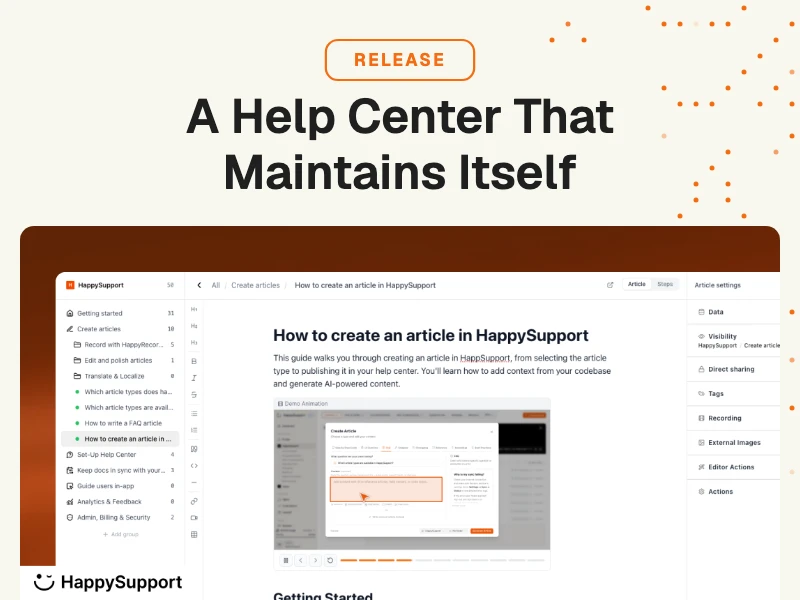
HappySupport is built on this model. HappyRecorder captures guides using DOM/CSS selectors rather than screenshots, so each guide stays structurally linked to the product elements it references. HappyAgent connects to your GitHub repository and fires a notification when merged code changes affect existing guides. The CS team's documentation queue updates automatically when the product ships — no manual triage, no missed articles, no quarterly catch-up sprints.
The result is a documentation library that scales with the product rather than falling behind it. And a CS team that spends its time on the work that moves retention and expansion, not on the work that any accurate article could have handled instead.