.png)


Userpilot pricing is built around Monthly Active Users — a metric that sounds neutral but is actually structured to grow your bill as your product succeeds. As your user base expands, costs step up regardless of whether you're using more features or getting more value from the platform. For teams early in their growth curve, this model can make Userpilot look affordable at contract signing and expensive at renewal.
Userpilot plans and pricing structure
Userpilot offers three tiers, all priced on Monthly Active User (MAU) counts. The following reflects current 2026 pricing as shown on userpilot.com/pricing:
*Growth tier pricing is sales-negotiated. Vendr's procurement data puts the reported range at $7,638–$60,680/year depending on MAU count and feature set. Monthly billing is available but typically adds 20–25% above the annual rate.
Why MAU pricing is a growth tax
The Starter plan covers up to 2,000 monthly active users at $299/month ($3,588/year). The moment your user count consistently exceeds that ceiling, you move to the Growth tier — which starts at a minimum of 5,000 MAU and requires a sales conversation. Based on community-reported deal data from OpenView's PLG research, teams hitting the 3,000–5,000 MAU range typically see their Userpilot bill jump significantly, not incrementally.
The math at key growth moments:
- 1,000 MAU: $3,588/year (Starter — you're under the ceiling but paying the full tier price)
- 2,000 MAU: $3,588/year (Starter ceiling reached — next growth triggers upgrade)
- 3,000 MAU: Growth tier required. Based on community data, estimated $7,600–$12,000/year minimum
- 5,000 MAU: Growth tier — likely $10,000–$20,000+/year depending on negotiation
That's a potential 3x cost jump for going from 2,000 to 3,000 users. The product didn't change. Your usage didn't change. The user count did. This is what "MAU pricing penalizes growth" means in practice.
What $3,588/year actually buys at Starter
Userpilot's Starter plan covers the core onboarding toolkit: in-app product tours, checklists, contextual tooltips, and basic NPS surveys. For teams just starting with structured user onboarding, it's a reasonable foundation.
What Starter excludes: A/B testing (Growth only), advanced user segmentation (Growth only), localization and multi-language support (Growth only), custom domain for the help widget (Growth only), and priority support. In practice, most teams hit these limits within 6–12 months as they start optimizing onboarding flows — which means the real entry price for a full Userpilot deployment is often closer to the Growth tier cost than the Starter price suggests.
According to the Pendo Product Benchmark Report, products with guided onboarding flows see 20–30% higher feature adoption rates. Userpilot delivers the infrastructure to build those flows. The cost question is whether that infrastructure is priced correctly for your stage.
The hidden cost: guide maintenance after every release
Userpilot's in-app guides are built on standard UI recording. When your product ships a change — new navigation, renamed button, updated flow — affected guides reference the old state until someone manually reviews and updates them. Userpilot doesn't detect this automatically at any pricing tier.
According to the GitLab DevSecOps Survey, 65% of software teams ship weekly. A product with 25 documented flows on a weekly cadence generates roughly 50–100 guide maintenance events per year. At 30 minutes per event, that's 25–50 hours of work annually that doesn't appear in the pricing table.
This is the documentation decay cost — it compounds on top of the subscription, and it scales with your release velocity rather than your MAU count.
Three-year total cost of ownership
MAU-based pricing creates a cost model that looks affordable at signing and escalates as the product grows. Here's what the math looks like for a product scaling from 1,000 to 8,000 MAU over three years:
- Year 1 (1,000 MAU): Starter at $3,588/year
- Year 2 (3,500 MAU): Growth tier required — estimated $10,000–$15,000/year
- Year 3 (8,000 MAU): Growth tier continues — estimated $15,000–$20,000/year
- Three-year subscription total: ~$29,000–$39,000
- Annual guide maintenance labor (50 hrs at $60/hr): ~$3,000/year = $9,000 over three years
- Combined three-year TCO estimate: $38,000–$48,000
That's the total cost for a basic in-app onboarding layer, not including a separate Help Center for self-service documentation. Userpilot doesn't replace that need — it overlays on top of your existing documentation infrastructure.
When Userpilot makes sense
Userpilot is well-built for the initial activation problem: getting new users from signup to first value through structured in-app flows. For teams where onboarding completion rates and time-to-activation are key metrics, the product delivers real value.
The MAU pricing model makes most financial sense when user growth is predictable, you know roughly where your MAU count will sit over the next 12 months, and you can negotiate your Growth tier contract with that number in hand. Pricing surprise happens most at the Starter-to-Growth transition, when a faster-than-expected growth month forces an unplanned tier upgrade mid-contract.
The signal to re-evaluate
Two moments trigger re-evaluation: when your MAU count is consistently within 20% of your plan ceiling (the upgrade is coming, and you should negotiate now rather than react), and when your team's guide maintenance backlog from releases is consistently growing — meaning the guides you have are going stale faster than the team can update them.
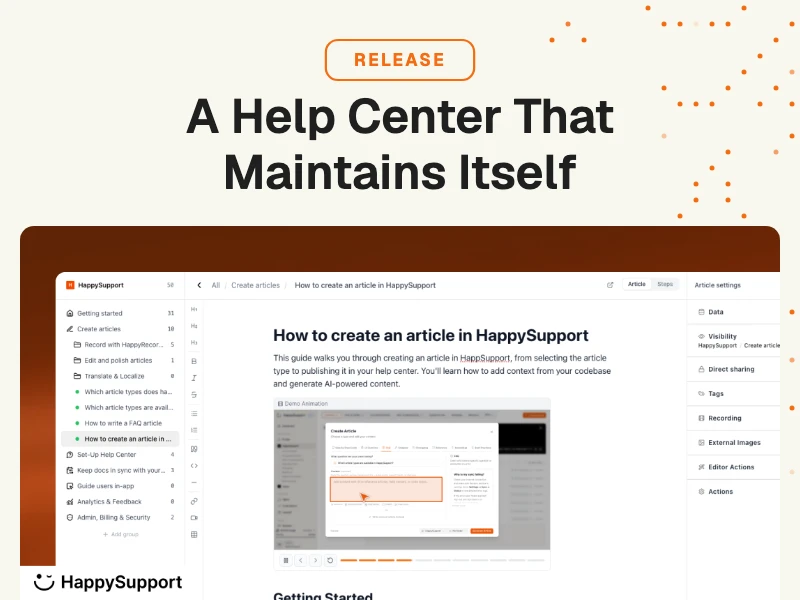
The self-updating documentation model addresses the second problem directly: documentation that detects its own staleness when code ships, rather than waiting for a team member to notice. If maintenance overhead is the constraint, that's worth evaluating alongside the subscription cost of any MAU-based tool. HappySupport connects to GitHub Sync to update guides automatically when deployments happen. More at happysupport.ai.