.png)


Your engineering team shipped on Friday. By Monday, three screenshots in your help center show a settings menu that was reorganized in the release. A step sequence in your onboarding guide now leads users to a button that got renamed. And the support queue is filling with questions your documentation was supposed to answer. This is not a one-time problem. For teams shipping weekly, it's the baseline state. Keeping documentation up to date with 52 releases per year requires a system, not more effort.
Why Documentation Falls Behind in Fast-Shipping Teams
The math behind documentation decay is straightforward, and most teams don't think it through until the problem is already serious. A team shipping weekly has 52 release cycles per year. Each release introduces UI changes that can affect help articles. If even 10 articles need updating per release, that's 520 article updates per year. Most SaaS teams have one person responsible for documentation, and that person has other responsibilities.
The GitLab DevSecOps Report found that 65% of engineering teams ship weekly or more frequently. For those teams, documentation maintenance is a continuous operational burden, not a quarterly project. The gap compounds: each release that ships without documentation updates makes the next cycle harder, because the documentation is now further behind the product.
According to storytodoc's 2025 research on product documentation, 80% of SaaS knowledge bases go stale within months of launch, not years. For weekly-shipping teams, the stale threshold arrives within the first sprint cycle.
The full cost model of documentation decay compounds over time. The detailed breakdown is in the hidden cost of documentation decay.
The Three Things "Keeping Docs Current" Actually Means
Most teams treat documentation maintenance as a reactive task: someone notices something is wrong, someone fixes it. That works when the product changes quarterly. It breaks at weekly release cadence. Keeping documentation up to date with weekly releases means three specific things.
Detection: Know What Changed Before Users Find Out
The first problem is awareness. When a developer merges a pull request that moves a menu item, renames a button, or adds a required field, the documentation team typically finds out one of two ways: a support ticket from a confused user, or a documentation owner who happens to test the feature post-release. Neither is a system. Both are luck.
A detection mechanism connects the release process to the documentation workflow. In practice, this means engineering surfaces UI-touching changes before or at the moment they ship, not after users encounter them.
Triage: Not Every Change Needs a Documentation Update
A color change, an icon swap, or a background redesign rarely affects help content. A renamed menu item, a relocated button, a new required step, or a removed feature always does. Treating every UI change as a documentation emergency burns bandwidth fast. A simple triage rubric is what separates teams that keep up with releases from teams that are always catching up.
Update: Fast Enough That Stale Content Lives Hours, Not Weeks
The update mechanism is where most teams hit the real bottleneck. If updating a guide means opening a screenshot tool, recapturing every affected step, re-uploading images, and re-editing the article, a single guide update takes 45–90 minutes. Multiply that by the number of affected articles per release, and the queue grows faster than one person can clear it.
How to Set Up a Documentation Update Workflow for Weekly Releases
A documentation workflow that keeps pace with weekly releases needs three components: a pre-release sync, a triage process, and a fast update mechanism. None of these require new tools to implement. The manual version works for teams under about 50 articles. Above that, automation becomes necessary.
Step 1: A Standing Pre-Release Sync with Engineering
The most valuable process change a documentation team can make is a standing 15-minute sync with engineering the day before each release. The agenda is one question: what changed in the UI this sprint?
From that conversation, the documentation team produces a diff list: which screens changed, which flows changed, which labels or button text changed. That list drives every documentation action for the week. Teams that skip this sync discover changes after users do, which means every documentation update is also a damage-control action.
As Archbee's agile documentation research points out, making documentation a part of the sprint definition-of-done, not a post-release task, is the single highest-leverage process change a fast-shipping team can make. When a story is marked done only after documentation is updated, the queue never builds.
Step 2: A Triage Rubric for Documentation Impact
Apply this rubric to every UI change identified in the pre-release sync:
- Critical (update before release ships): Step sequence changes, renamed menus, new required fields, removed features. These create immediate user confusion.
- Standard (update within 24 hours of release): Relocated buttons, changed labels, new optional features, UI element reordering.
- Monitor (no immediate action): Visual-only changes, new admin-only settings that don't appear in core user flows, backend changes with no UI impact.
This rubric lets a single documentation owner triage a sprint's worth of changes in 10 minutes and prioritize correctly without guessing.
Step 3: Replace Screenshot-Based Tools with DOM-Based Recording
Screenshot-based documentation is structurally incompatible with weekly release cycles. Every screenshot is a static pixel image. When the UI changes, every screenshot showing that UI must be manually retaken, cropped, and re-uploaded. For a team with 200 articles shipping weekly, this is a full-time job that grows with the product's size.
DOM-based recording tools capture UI state as CSS selectors and element metadata, not pixels. When the UI changes, the underlying selector data can update alongside it. This is the architectural difference that makes automated documentation maintenance possible. The comparison between approaches is detailed in why screenshot documentation breaks every release.
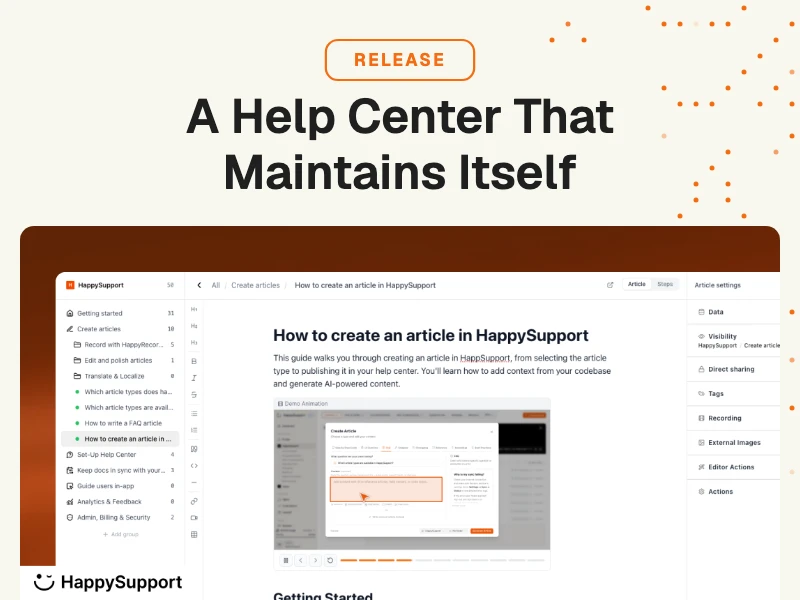
HappySupport's HappyAgent monitors your GitHub repository for UI changes. When a developer pushes a commit that modifies a CSS selector tied to an existing guide step, HappyAgent flags that step for review, or in cases where only the selector changed and the UI element is still present, updates the guide automatically. Teams using this approach report up to 80% reduction in documentation maintenance time compared to manual screenshot-based workflows.
The Documentation Release Checklist
A lightweight checklist that runs alongside every sprint gives documentation teams a repeatable process rather than an ad-hoc scramble. The checklist should live where the engineering team already works, in your project management tool, not a separate documentation system.
- Review engineering changelog for UI-touching changes before the release ships
- Map changed UI elements to affected help articles using the diff list from the pre-release sync
- Classify each article change as critical, standard, or monitor using the triage rubric
- Assign article updates to the documentation owner for each product area
- Update critical articles before the release goes live
- Update standard articles within 24 hours of the release
- Run a 10-minute spot-check of the top 10 most-visited articles post-release
- Log any documentation gaps discovered by support tickets this sprint as input for next sprint's sync
The spot-check step is often skipped and is worth defending. The top 10 most-visited articles are the ones generating the most user decisions. If any of those are stale after a release, the support ticket volume impact is disproportionate to the number of affected articles. A 10-minute check covers 80% of the user-facing documentation risk.
Why Manual Processes Break at Scale
The manual workflow described above works until it doesn't. Three failure modes are predictable enough that teams should plan for them before they hit.
The Single-Owner Bottleneck
When one support manager or technical writer owns all documentation updates, their bandwidth becomes the constraint on documentation freshness. A sick day, a higher-priority project, or a particularly complex release can push the documentation queue three or four sprints behind before anyone notices. Effective documentation systems distribute ownership: each product area has a documentation owner, and engineers flag documentation-impacting changes in their pull request descriptions.
According to the Consortium for Service Innovation's KCS methodology, organizations that distribute knowledge capture across customer-facing teams rather than centralizing it in a documentation function, maintaining knowledge currency 40–60% more effectively than centralized models.
The Coverage vs. Freshness Confusion
Most teams measure documentation coverage: how many articles they have, what percentage of features are documented. The metric that matters for weekly-shipping teams is documentation freshness: what percentage of articles were updated within the last sprint cycle. A help center with 300 articles where 40% are stale is worse than one with 100 articles where 95% are current. Measuring coverage without freshness gives a false sense of documentation health.
The Post-Release Discovery Loop
Teams that find out about documentation gaps from support tickets are always at least one sprint behind. The ticket represents a user who already got stuck. The documentation gap existed from the moment the release shipped. The post-release discovery loop means stale content lives on the help center for days or weeks before it's caught. Every day it's live, it's generating friction and potentially creating support tickets.
The Automated Alternative: GitHub Sync
The manual workflow removes the worst failure modes. The automated alternative removes the problem. GitHub Sync connects your documentation system to your codebase so that code changes trigger documentation review automatically.
When a developer pushes a commit that modifies a UI component tied to a guide step, the documentation system knows immediately. No pre-release sync required. No manual diff review. The change surfaces in the documentation workflow at the same moment it surfaces in the codebase, before the release ships, not after.
This is the approach HappySupport's GitHub Sync (HappyAgent) implements. Rather than requiring a documentation owner to stay in sync with an engineering team's commit history, HappyAgent monitors the repository and surfaces documentation flags automatically. The result is documentation that updates on the same cadence as the product, 52 times per year, without 52 separate manual review cycles.
The important distinction between GitHub Sync and traditional documentation automation is scope. Tools like Swagger and Javadoc automate narrow slices of documentation: API references, code comments. They don't touch user-facing help articles, onboarding guides, or step-by-step tutorials. GitHub Sync connects to the documentation system that serves end users, not just developer references.
For teams evaluating this approach, the key question is how many of your current support tickets cite outdated guides. If the answer is more than 10% of your ticket volume, the maintenance overhead of your current approach is already costing more than the tooling change would. The technical architecture behind this approach is covered in the guide to GitHub Sync for documentation.
Measuring Documentation Freshness
Setting up the right workflow requires measuring the right thing. For fast-shipping teams, coverage metrics (how many articles you have, what percentage of features are documented) give a false sense of documentation health. The metrics that matter are freshness-based.
Freshness Rate
Freshness rate is the percentage of active help articles last updated within the current sprint cycle. Target 90% or above for core user flows: articles covering sign-up, onboarding, billing, and primary workflow features. Below 80% means the workflow is breaking down somewhere. A freshness dashboard showing which articles haven't been touched since the last N releases is the fastest way to identify where the bottleneck is.
Documentation Lag Time
Lag time measures the average number of days between a UI change shipping and the corresponding documentation update going live. A lag above 3 days for critical articles signals a process problem, usually either a missing pre-release sync or a single-owner bottleneck. Tracking lag time per product area helps identify which teams need to flag documentation-impacting changes earlier in the release process.
Stale Ticket Rate
The stale ticket rate is the percentage of support tickets mentioning a topic covered by a documentation article that hasn't been updated within the last two sprint cycles. According to SuperOffice's customer service research, self-service support costs approximately $0.10 per resolution versus $8–$13 for a live support interaction. Every stale ticket is that cost difference applied to a problem that documentation should have solved. The stale ticket rate makes the business cost of documentation decay visible in financial terms, which is what gets process changes prioritized.
Teams that track freshness rate alongside coverage stop playing catch-up and start predicting where the next documentation gap will appear, usually in the areas of the product shipping the most changes.
Conclusion
Documentation that lags weekly releases is not a sign of a lazy team. It's a sign of a broken system. Most teams discover this when support ticket volume climbs despite having a help center, or when users cite incorrect guides as the reason they churned.
The fix starts with three things: syncing with engineering before releases ship rather than after, triaging UI changes by documentation impact rather than treating every change equally, and replacing screenshot-based tools with systems that have structural awareness of what changed in the product. Teams that make this shift stop playing catch-up and start shipping documentation with the same confidence they ship code. For teams that want to remove the maintenance problem entirely rather than just manage it, GitHub Sync is what makes that possible.