.png)


The Agile Manifesto says "working software over comprehensive documentation." Most agile teams read this as permission to deprioritize documentation. Some read it as permission to skip it. Neither interpretation ages well.
The real problem is not that agile teams document too little. It's that the documentation workflow most teams use was designed for waterfall: write documentation at the end of the sprint, review it as a deliverable, publish it after sign-off. That process has a built-in lag. On a team shipping weekly, that lag compounds sprint by sprint until the Help Center is 6–8 weeks behind the actual product. According to the GitLab DevSecOps Survey, 65% of high-performing software teams release weekly or more often. The documentation workflow most of those teams use was not designed for that cadence.
This guide describes what an agile documentation workflow actually needs to look like: not a more disciplined version of what slow-shipping teams do, but a fundamentally different system that treats documentation as a continuous function integrated into the development workflow, not a deliverable bolted onto the end of every sprint.
What is agile documentation?
Agile documentation is documentation that follows the same iterative, incremental cadence as the product development it describes. It is not created once at the start of a project and maintained quarterly. It is not a static artifact that lives in a wiki until someone remembers to update it. Agile documentation evolves alongside the product: each sprint cycle produces documentation updates alongside feature updates, and the two ship together.
Jim Highsmith, one of the Agile Manifesto's co-authors, put it directly: "We embrace documentation, but not hundreds of pages of never-maintained and rarely-used tomes." The documentation workflow agile teams need is lightweight enough to maintain at sprint velocity, accurate enough to be useful to users, and structured enough that nothing falls through the gap between one sprint and the next.
The documentation workflow failure on most agile SaaS teams is not that the team lacks documentation. It's that the documentation process sits entirely outside the development workflow. Engineers merge code, the sprint ships, and documentation updates happen later, sometimes the same week, sometimes the same quarter, sometimes never. The hidden cost of that gap is measurable: users who encounter outdated help articles file support tickets rather than self-serving. The documentation decay cost breakdown quantifies how fast that compounds on weekly-shipping teams.
Why documentation falls behind in agile teams
The documentation problem in agile development is structural, not motivational. Documentation teams care about accuracy. The issue is that the standard documentation process is incompatible with sprint velocity.
The math problem
Consider a SaaS product with 250 help articles covering 40 core user flows. If 10% of those flows change in a given sprint (a conservative estimate for a product in active development), the documentation team needs to update 25 articles every two weeks. Manual screenshot-based documentation requires someone to navigate to every changed step, take a screenshot, crop it, annotate it, and upload it. For a 10-step flow, that's 30 to 45 minutes of documentation work per guide. Twenty-five guides per sprint is more than 12 hours of documentation production work, every sprint, just to stay current.
The ownership problem
Documentation that has no named owner goes unmaintained. In agile teams, documentation ownership typically defaults to whoever has bandwidth. During sprint crunch, that defaults to nobody. Without a defined documentation owner per product area, the question "who updates this article?" has no answer. The article sits wrong until a support ticket surfaces it.
The tooling problem
Most knowledge base tools have no awareness of what changed in the product. There is no structural connection between "code merged" and "documentation task created." The documentation workflow starts when someone manually notices a gap, days or weeks after the release that created it. At weekly release cadence, that gap is always open.
The documentation sprint model and why it fails
The most common attempt to solve agile documentation debt is the documentation sprint: at the end of each sprint or quarter, a documentation owner combs through what shipped and writes updates in batch. This approach has a structural ceiling: you can only process documentation as fast as one person can work, and the release cadence doesn't pause while you catch up.
Documentation sprints also suffer from memory decay. The engineer who changed the onboarding flow three sprints ago does not remember the specifics anymore. The article gets updated based on what the current screen looks like, not what changed or why. The article may be technically accurate but missing the context users need to understand a transition.
Jim Highsmith's warning about "never-maintained tomes" describes exactly what documentation sprints produce: a large backlog of articles that were updated once, correctly, and then drift for the next six months while the team focuses on shipping. According to the KCS methodology at the Consortium for Service Innovation, knowledge articles have a useful life of approximately six months before they require review, a timeline that assumes a relatively stable product. For teams shipping weekly, that useful life is significantly shorter.
What an integrated agile documentation workflow looks like
An integrated documentation workflow embeds documentation tasks inside the sprint cycle, not after it. The mechanics are specific.
Documentation impact as part of the Definition of Done
Every story that touches the user interface includes a documentation impact field: "None / Update required / New article needed." This field takes 30 seconds to fill in during sprint planning and gives the documentation owner a structured list at the end of every sprint rather than a manual discovery process. A story is not done (not closed, not merged, not celebrated) until documentation impact has been assessed. This single change converts documentation from a surprise at the end of the sprint into a predictable, triaged list of work.
Triage before production
Not every UI change needs a documentation update, and treating everything as critical is how documentation teams burn out. A practical triage framework for agile documentation:
- Critical before release: New required steps in existing flows, removed features still referenced in docs, renamed navigation items users rely on
- Standard within 24 hours: Relocated UI elements, new optional features that extend documented flows, changed secondary labels
- Low priority, next sprint: Visual-only changes, new admin settings, new features with no documentation baseline
- No action: Internal changes, performance improvements, backend changes with no UI surface
Speed over perfection on content creation
On a fast-shipping team, documentation accuracy at the time of release matters more than documentation perfection a week later. A 90% accurate article published alongside the feature is worth more than a polished article that goes live after users have already hit the outdated version and filed support tickets. Style and polish reviews happen asynchronously. Accuracy review happens before publish.
The tooling choice matters here significantly. Screenshot-based documentation tools require a photographer: navigate to every step, capture a screenshot, crop, annotate, upload. For a 10-step guide, that's 30 to 45 minutes. DOM-based recording tools that capture UI state as CSS selectors rather than pixels reduce the same guide to a 5-minute session. That speed difference compounds every sprint for every guide update on the team's list.
Documentation in the CI/CD pipeline
The most advanced form of an agile documentation workflow is one where documentation tasks are generated automatically by the CI/CD pipeline, not by a person checking what shipped at the end of the sprint.
The mechanism works like this: a GitHub Sync integration monitors the repository for commits that touch CSS selectors tied to documented UI elements. When a selector changes (because a button label changed, a component was refactored, or a navigation item moved), the documentation system detects the change and surfaces the affected articles as review tasks. Engineering's job ends at the merge. Documentation picks it up from there.
This is the structural difference between treating documentation as a sprint deliverable and treating it as a continuous function integrated into the development workflow. The detailed implementation of this approach is in the GitHub Sync for documentation guide. The result is that the documentation workflow runs in parallel with the development workflow, not behind it: every PR that changes a documented UI component automatically queues a documentation review, without a ticket, without a reminder, without a retrospective discussion.
Roles in an agile documentation workflow
Distributed documentation ownership consistently outperforms centralized ownership on fast-shipping teams. Centralized ownership creates a single-person bottleneck. When the documentation owner is overloaded, the entire documentation workflow stalls. Distributed ownership assigns a documentation owner per product area, reducing the bottleneck to a single area rather than the entire product.
Three roles make an agile documentation workflow function:
- Documentation owner per product area: Responsible for keeping their area current after each sprint. Usually a product manager or a senior support agent for that product area. Attends sprint planning to assess documentation impact of incoming work.
- Support lead as quality gatekeeper: Reviews the documentation diff each sprint. Escalates critical updates. Tracks documentation freshness metrics. Not responsible for writing every article. Responsible for knowing the state of all of them.
- Engineers as change flaggers: Mark documentation impact in sprint planning. Not responsible for writing documentation content. Required to flag which tickets have user-facing UI changes so the documentation owner has a structured list, not a discovery process.
Tools that support an agile documentation workflow
Generic knowledge base tools fail in agile documentation workflows because they have no awareness of what changed in the product. The tooling requirements are specific.
- DOM-based guide creation: Captures UI state through CSS selectors, not screenshots. Guides can be updated when underlying UI elements change rather than requiring a full manual retake. This is the speed lever that makes sprint-cadence documentation possible.
- GitHub or CI/CD integration: Creates a structural link between code merges and documentation tasks. The merge event triggers the review queue rather than waiting for a human to check what shipped.
- Content freshness tracking: Surfaces which articles have not been updated since the last N releases. Without active tracking, stale articles accumulate silently. Most teams discover documentation decay through support tickets, which means users have already hit the problem.
- Stale content alerts: Automated notifications when a guide step's CSS selector changes in the codebase. A direct signal that the UI has changed and the guide needs review. This is the event-driven trigger that removes manual inspection from the workflow.
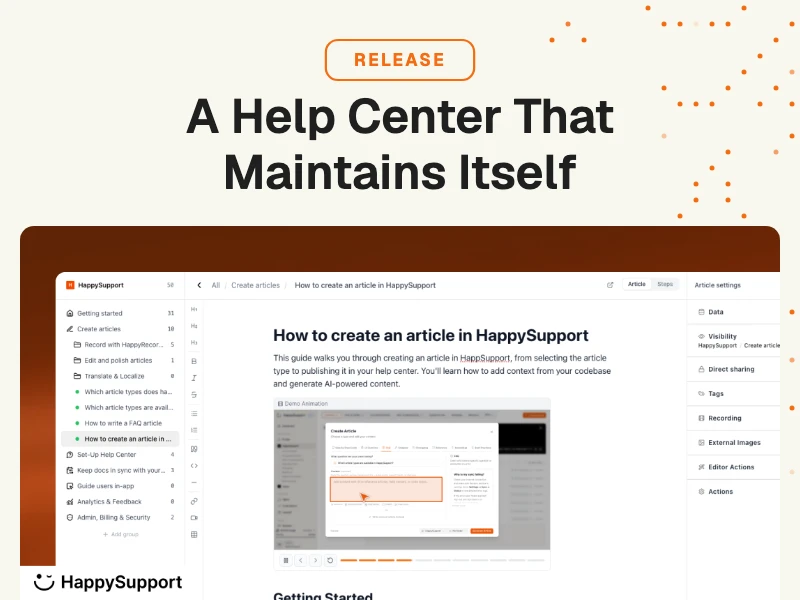
HappySupport combines all four in a single platform designed specifically for B2B SaaS teams shipping weekly. HappyAgent monitors the GitHub repository and surfaces documentation review tasks based on actual code changes. HappyRecorder creates DOM-based guides in minutes rather than hours. The Content Freshness Dashboard shows the full documentation health state across every article, every sprint.
Measuring whether the documentation workflow is working
Article count is not a useful metric for agile documentation health. A large inaccurate knowledge base is worse than a small accurate one. It gives users false confidence and then fails them at the moment they need help. The metrics that matter:
- Documentation freshness rate: Percentage of core user flow articles updated within the current sprint cycle. Target 90% for articles covering primary workflows. Articles covering admin settings or edge-case flows can have a longer update cycle.
- Documentation lag time: Average days between a UI-touching release and the corresponding documentation update. For critical articles, the target is same-day or within 24 hours. Tracking this number sprint over sprint shows whether the workflow is improving or whether documentation debt is compounding.
- How-to ticket rate: Support tickets whose root cause is a missing or outdated help article. A working agile documentation workflow makes this number fall consistently. A team that has rebuilt a proper documentation workflow typically sees how-to ticket volume drop 20 to 40% within two to three months. See the keep docs up to date with weekly releases guide for the specific process for tracking this metric sprint by sprint.
- Documentation coverage: Percentage of documented user flows across the product. For a team six months into a structured documentation workflow, target 80% coverage of core flows.
Common mistakes in agile documentation workflows
Treating documentation as a separate project
Documentation that lives in a separate project, managed by a separate team, on a separate cadence, will always lag product releases. Documentation work must happen inside the sprint cycle, not after it, not alongside it in a parallel track, but as part of the definition of done for every story that touches the user interface.
Building documentation debt intentionally
Some teams defer documentation updates by design, intending to catch up later. Documentation debt compounds exactly like technical debt: it is always easier to update one article the week of a release than to update twelve articles three months later when nobody remembers what changed. There is no documentation catch-up sprint that actually catches up. There is only the documentation that gets done alongside the release and the documentation that gets done never.
Measuring documentation by volume instead of accuracy
A knowledge base with 300 articles, 30% of which are outdated, is not a documentation success. Users who hit an outdated article do not usually file a bug report. They file a support ticket or stop using the Help Center altogether. Teams that track article count milestones without tracking documentation freshness are optimizing for the wrong signal.
The agile documentation workflow that works is not a more disciplined version of what slow-shipping teams do. It is a system where the development workflow and the documentation workflow are structurally connected. A code merge triggers a documentation review. Every sprint produces both working software and current documentation. The support team can trust the Help Center because it is maintained by a process, not by memory.