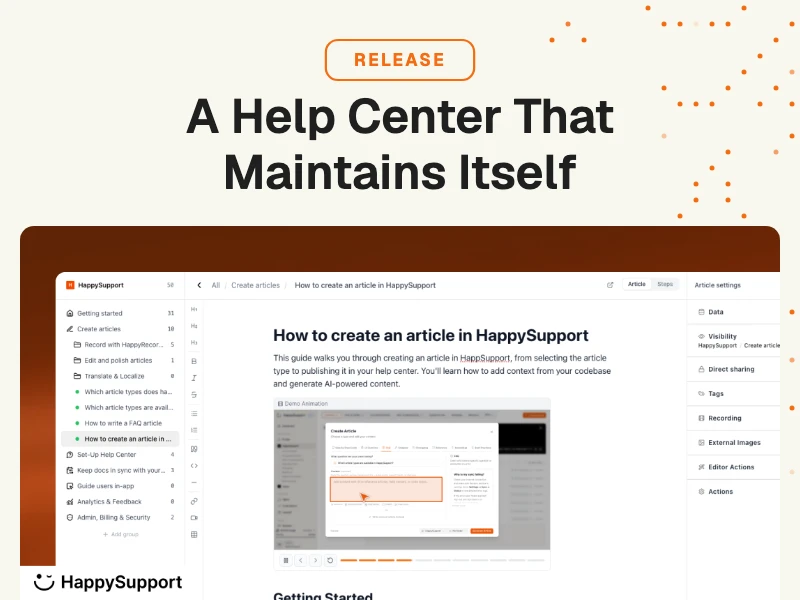



Most "best documentation tool" lists are written for documentation teams. Startups do not have documentation teams. They have a founder writing the first 20 articles between sales calls, a support lead taking on the rest, and a product manager who notices three months in that half the articles describe the wrong UI. The right AI documentation tool for a startup is not the one with the most features or the cleanest editor. It is the one that gets set up in a day, costs nothing in maintenance overhead, and scales from 5 to 500 users without forcing a tool migration.
This guide ranks AI documentation tools using that startup-specific lens. Three tests decide whether a tool fits: setup time, maintenance load, and pricing trajectory at scale. Tools that fail any of the three are out, regardless of how good the editor looks in the demo.
What is an AI documentation tool for startups?
An AI documentation tool for startups is software that helps a small team create, organize, and maintain customer-facing or internal documentation with the help of large language models, without requiring a dedicated technical writer or a procurement cycle. The category includes lightweight knowledge bases, AI-first help center platforms, and documentation generators that work from code, transcripts, or screen recordings.
The job-to-be-done at startup stage is narrow: write the first 50 articles fast, deflect the most repetitive support tickets, and avoid building documentation debt that will block the next funding round. Tools built for enterprises optimize for governance, compliance, and large-team workflows. Startups need the opposite: speed, low cost, and the ability to change tools without losing content.
Why startups need different documentation tools than enterprises
Three structural differences make most enterprise documentation advice wrong for early-stage SaaS.
No documentation team
Documentation falls on whoever has time, usually the support lead, the founder, or rotates through the team. Tools built around dedicated technical writers assume someone owns content full-time. At startup stage, that ownership is shared, intermittent, and often the lowest priority on the to-do list.
Faster release cadence than the help center can keep up with
The GitLab DevSecOps Report finds 65% of teams ship weekly or more frequently. Startup teams often ship daily. Each release shifts UI, naming, or behavior, and articles silently age. After 12 weeks of releases without auditing, half the help center is wrong, and the team has no capacity to fix it.
Pricing that scales with the team, not against it
Per-user pricing punishes teams that grow. A $10/user tool that costs $50/month at 5 users costs $500/month at 50 users and $5,000/month at 500 users, often for documentation features barely anyone touches. Flat-fee or seat-light tools survive the scale-up. Per-user tools force a migration around Series A.
The three tests for a startup documentation tool
Three pass/fail questions cut through the demo theater.
Setup in a day
If the tool requires a sales call, an implementation consultant, or a procurement cycle, it is not a startup tool. Self-serve signup, free tier or transparent pricing, and a working help center within 24 hours of signup are the bar. Tools that fail this test get bought, never deployed, and live as shelfware until the next CFO review.
Zero maintenance overhead
Maintenance overhead is the work of keeping articles current after launch. Tools that rely on humans to detect drift impose hidden labor on the support lead, who is already overworked. Tools that detect drift automatically, by comparing live UI against saved selectors or by flagging articles tied to changed code, remove the maintenance debt before it accumulates.
Scales from 5 to 500 users without a migration
The right tool grows with the team. Pricing should not spike at the 10-user mark, the 50-user mark, or any other milestone. Content should be portable so the team is not locked in. Features should be available at the scale the team needs them, not gated behind enterprise tiers that triple the bill.
Best AI documentation tools for startups in 2026
Seven tools pass at least two of the three tests. Order is by overall startup fit, not by feature count.
1. HappySupport
The maintenance-native option for SaaS startups shipping fast. The HappyRecorder Chrome extension records UI flows as DOM and CSS selectors instead of screenshots, so the system detects when an underlying element changes. The HappyAgent GitHub Sync layer connects the help center to the product code repository and flags articles whose source code has shifted. Pricing starts at €299/month with no per-user fees, which keeps the price flat as the team scales. Best for startups shipping weekly or daily without a documentation team. Weakness: smaller integration catalog than Intercom or Document360 today.
2. Notion
The default startup pick. Free for individuals, $10/member/month for teams, with Notion AI as a $10/member add-on. Notion is the right answer for the first 20 internal docs and the first 5 customer-facing articles. Best for pre-seed teams using Notion for everything. Weakness: not built as a customer-facing help center, no native deflection analytics, no in-app widget. The team usually outgrows Notion around the time the customer base hits 100.
3. Gleap
All-in-one platform built specifically for SaaS startups: knowledge base, in-app widget, AI search, live chat, bug reporting. Pricing from $149/month with unlimited seats, which is rare in this category. Best for early-stage SaaS that wants in-product help and a knowledge base from one vendor. Weakness: smaller integration catalog and less mature than Intercom or Help Scout.
4. Help Scout
The opinionated combined helpdesk and knowledge base. Free for 5 users, then $25/user/month. AI features include draft replies and conversational search. Best for SMB and product-led startups that want one platform for tickets and self-service. Weakness: per-user pricing creates a budget spike past 10 users, and the platform does not solve long-term article maintenance.
5. Mintlify
The leader for developer-focused startups. Free starter, Pro at $150/month, Growth at $550/month. Mintlify ships docs-as-code, GitHub sync, and a Workflows agent that automates parts of docs maintenance. Best for API-first startups or developer tools where the audience is technical. Weakness: not built for customer-facing how-to articles or non-technical users.
6. GitBook
Visual editor with co-editing, Git sync, and basic AI-readiness. Free starter, Plus at $79/month, Pro at $249/month. Best for startups with mixed customer-facing and internal documentation needs that want a clean editor. Weakness: AI features are creation-focused, no drift detection.
7. Scribe
Step-by-step process documentation built on screen recording. Free tier, Pro at $29/user/month. Captures clicks and screenshots automatically and produces how-to articles in minutes. Best for SOP and onboarding documentation where the workflow is repetitive. Weakness: screenshots are pixels, not code references. Articles silently lie when the UI changes. See why screenshot documentation breaks every release.
AI documentation tool pricing for startups
Pricing structure decides whether the tool will still fit at Series A. Three pricing models cover almost every option in the category.
The hidden cost not in the table: documentation drift. Tools without auto-update push the work of keeping articles current onto the team, often 8 to 12 hours a week of writer time at a $60/hour fully loaded rate. That is $25,000 to $37,000 a year, dwarfing any subscription cost. For startups with no spare capacity, the hidden cost is the dominant cost.
Common mistakes startups make with documentation tools
Three mistakes recur in startup documentation rollouts.
Buying enterprise tools too early
Confluence, Document360 Enterprise, and Helpjuice are excellent at scale. They are also expensive, slow to set up, and built around workflows the startup team will not use until Series B. Buying them at seed stage burns budget and slows the team down. The right move is the lightweight tool that fits today, with a clean migration path for later.
Picking on editor quality
Editor quality matters for the first month. After that, the maintenance question dominates. Teams that pick on editor polish often switch tools within a year because the help center has decayed. The right question is not "does this feel nice to write in" but "will the articles still be right in six months."
Ignoring the maintenance treadmill
Most startup teams assume they will keep articles current themselves. Few do. The work is invisible until customers complain about wrong instructions, by which point the support lead has been firefighting for weeks. Plan for the auto-update workflow before launching, not after. The piece on keeping docs up to date with weekly releases covers the trade-offs.
How to choose an AI documentation tool for your startup
Three questions decide the right tool faster than any feature comparison.
Are you building a help center or an internal wiki?
Internal wiki: Notion or Confluence. Customer-facing help center: HappySupport, Gleap, Document360, or Help Scout. The two use cases need different tools, and trying to use one platform for both usually produces a worse version of each.
How fast does your product ship?
Monthly or slower releases let creation-focused tools keep up with manual audits. Weekly or daily releases require auto-update capabilities. Cadence is the technical-fit question almost no startup asks during the evaluation, and it is the one that decides whether the help center stays trustworthy in six months.
Who actually writes the articles?
If a product manager or founder writes them between sales calls, the tool needs to be self-serve, fast to write in, and forgiving of inconsistent contributors. If a support lead writes them, the tool needs to integrate with the helpdesk and surface common ticket topics. Match the tool to the writer, not the org chart.
Implementation timeline for startups
A startup help center launch typically takes 2 to 4 weeks for the first 30 to 50 articles. Three things to set up on day one. First, audit the tickets you already have. The 20% of articles that drive 80% of traffic come straight out of the support inbox. Second, pick a flat-pricing or seat-light tool so the budget does not spike when the team grows. Third, decide who owns freshness from the start. Without an owner, decay sets in immediately.
The full launch checklist is in our piece on the help center launch checklist. The patterns that matter most for lean teams are in how to manage a help center as one person.
The HappySupport approach
Every other tool on this list assumes someone will keep articles current. For startup teams, that someone usually does not exist. HappySupport is built around the opposite assumption. The HappyRecorder Chrome extension captures workflows as DOM and CSS selectors at the moment an article is written. Months later, when a developer ships a UI change, the system compares saved selectors against the live product and flags every article that no longer matches. The HappyAgent GitHub Sync layer reads the product repository, links code changes to affected help center articles, and surfaces what needs review before customers hit a stale page. Pricing stays flat as the team scales, so a 5-person seed team and a 50-person Series B team pay the same. For startups shipping weekly without a dedicated writer, this is the dimension every other ranking misses. See how self-updating help centers work and the cost model behind documentation decay.