.png)


Every support team hits the same wall: ticket volume grows faster than the team. The reflex is to hire. But there is a lever that most support leads have not fully pulled — and it does not require headcount approval.
That lever is documentation quality. Every unclear or missing help center article is a ticket waiting to happen. Every ticket that could have been answered by a current, accurate article is a cost that did not need to exist.
According to SuperOffice customer service benchmarks, self-service interactions cost approximately $0.10 compared to $8 or more for agent-assisted contacts — an 80-fold cost difference. The math is simple: a well-maintained help center that deflects 100 tickets per month saves the equivalent of a significant portion of an agent's time, recurring every month, without headcount.
The problem is that most help centers do not actually deflect tickets at scale because they are outdated, incomplete, or not findable. The compounding cost of that gap is in the hidden cost of documentation decay. This article is about fixing that — specifically, the operational levers a support lead can pull to reduce support tickets without hiring.
Why self-service only works with accurate documentation
The premise behind every ticket-reduction strategy is the same: if a user can find the right answer on their own, they will not open a ticket. That premise holds — but only when the answer they find is correct. Inaccurate documentation inverts the premise. A user who follows outdated steps, reaches a dead end, and still has to open a ticket is now more frustrated than a user who went to support directly. The ticket takes longer to resolve because the support agent has to undo the confusion created by the wrong instructions before addressing the actual issue.
This is why documentation quality is a prerequisite for ticket reduction, not a nice-to-have alongside it. A help center that deflects 40% of potential tickets through accurate content is more effective than a help center that shows all users a result, sends them down the wrong path on 25% of attempts, and produces a mix of deflected tickets and frustrated escalations.
According to SuperOffice customer service research, the cost differential between self-service and agent-assisted support is 80x: approximately $0.10 per self-service interaction versus $8 or more per agent contact. That differential only holds when self-service actually resolves the issue. Failed self-service attempts — where the user consults the help center, finds wrong information, and then opens a ticket — can cost more than the straight-to-support path because they generate two contacts (the self-service failure and the escalation) rather than one.
What actually drives high ticket volume
High ticket volume has two root causes: the product is confusing, or the documentation is wrong. Support cannot fix the first one. They can fix the second one.
Documentation-driven tickets fall into three categories:
- The article does not exist. A user has a question about a feature that is not documented. The ticket is inevitable because there is no self-service path. These are the easiest to fix: write the article.
- The article exists but is outdated. The UI changed, the workflow changed, or the feature was renamed — and the help center still describes the old version. Users follow the steps, hit a wall, and open a ticket. These are the most dangerous: users have already tried self-service and failed, which makes them harder to convert to self-service in the future and harder to satisfy when they do reach an agent.
- The article exists and is current, but users cannot find it. Search terms do not match, article titles are jargon-heavy, or the help center navigation does not match how users think about the product. These require a different fix: search optimization and navigation restructuring.
The fastest gains from reducing support tickets come from fixing outdated articles — specifically, running a help center content audit focused on the highest-volume ticket topics and bringing those articles up to date.
How documentation quality directly affects ticket volume
Documentation quality and ticket volume have a measurable relationship. According to the Salesforce State of Service Report, teams that invest in self-service capability see material reductions in support costs — driven primarily by ticket deflection, not by hiring fewer agents or resolving tickets faster.
The relationship works at the article level. When a specific help center article is updated to accurately reflect the current product, ticket volume for the topic that article covers typically drops within 72 hours. This is measurable: track tickets with the feature or topic they relate to and monitor volume before and after an article update. The signal is fast and clear.
The inverse is also true. When documentation falls behind a product release, ticket volume for the updated feature spikes — and stays elevated until the documentation catches up. Teams that connect their documentation update process to their release cycle see measurably lower ticket spikes after releases than teams that update documentation reactively. A self-updating help center takes this further by automating the trigger entirely.
The three-step audit-and-update cycle
The fastest path to reducing support tickets without hiring is a focused audit-and-update cycle targeting your highest-volume ticket topics. This is not a full-quarter project. It is one to two days of focused work with measurable results within the first week.
Step 1: Tag and rank tickets by topic
For one week, tag every incoming ticket with the product feature or topic it relates to. At the end of the week, rank topics by ticket volume. The top five to ten topics are your documentation priority list.
This sounds manual, and it is — but you only need to do it once to get the prioritization right. Many support tools — Zendesk, Intercom, Freshdesk — have auto-tagging or categorization features that can automate this once you set up the right tags.
Step 2: Audit the help center articles for your top topics
For each high-volume topic, find the corresponding help center article — or note that it does not exist. Compare the article to the current product state. Ask three questions:
- Does the article accurately describe how the feature works today?
- Does the article answer the specific question users are asking (based on your ticket phrasing)?
- Is the article findable via the search terms users actually use?
An article that fails any of these three checks needs to be updated before you can expect it to deflect tickets. This is the core of a documentation audit: matching ticket data against your knowledge base inventory and finding the gaps.
Step 3: Update and monitor
Update the articles, starting with the highest-volume topics. Publish the updates. Monitor ticket volume for the corresponding topics over the following two weeks. In most cases, you will see a measurable drop — which gives you the data to make the case for continued documentation investment.
Closing the top ten content coverage gaps typically moves the deflection rate five to ten percentage points. Fix the top twenty inaccurate articles and you add another three to seven points. These are not estimates — they are the results teams report when they run this process for the first time with clean before/after measurement.
How to measure ticket deflection from help center improvements
Ticket deflection is the key metric — but it is easy to measure incorrectly. Help center views or article reads do not measure deflection. What matters is whether users who visited the help center for a specific topic then opened a ticket anyway.
Four metrics give you a complete picture:
- Ticket volume by topic (before and after article update). The most direct measure. A drop in ticket volume for a topic within 72 hours of an article update is strong evidence of deflection.
- Help center search exit rate. What percentage of help center searches end without a ticket being opened? A low exit rate means users are finding answers. A high exit rate means search results are not satisfying the query.
- Article-to-ticket conversion rate. For articles covering your top ticket topics, what percentage of users who read the article still open a ticket? An article that 60% of readers follow up with a ticket is not deflecting — it is failing. Rewrite it.
- Self-service ratio. The ratio of help center sessions to total support contacts. An improving ratio over time indicates that documentation improvements are working. Industry benchmark for mature SaaS help centers: 3:1 to 5:1.
Why ticket reduction gains disappear without a maintenance process
The audit-and-update cycle produces fast results. The problem is that those results are temporary if there is no maintenance process behind them. Documentation that is accurate today will be inaccurate next month if your product is shipping weekly and articles are only reviewed when someone notices a problem.
This is the cycle that keeps teams stuck: a support lead runs a documentation audit, improves deflection rates significantly, then watches the gains erode over the next two quarters as the product evolves and the articles fall behind again. The work was real — but without a system to sustain it, the default state is drift.
The drift is measurable. Track ticket volume by topic over a 12-month period. You will typically see spikes that correlate with release dates for features that have corresponding help center articles. Each spike that is not followed by an article update becomes a permanent ticket driver — because every user who hits the outdated article after that point is going to open a ticket.
Building the maintenance process so gains hold
The audit-and-update cycle improves your current state. The maintenance process is what keeps it from degrading again.
The core principle: documentation updates must be tied to product releases, not to a quarterly review cycle. When a feature ships, the corresponding article should be reviewed and updated before or alongside the release — not three weeks later when support tickets have already accumulated.
According to the Consortium for Service Innovation's KCS research, knowledge articles have a useful life of approximately six months before they require a substantive update. In a SaaS product shipping weekly, that useful life is shorter for articles covering actively developed features — and those are exactly the articles generating the most tickets when they go stale.
The practical implementation: after each release, the support lead reviews which help center articles are referenced in the release notes or changelog. Those articles go into a review queue. The goal is zero articles that are more than one sprint behind the current product state for any high-traffic topic.
What makes this tractable at scale is a system that detects which articles need updating based on what changed in each release — rather than relying on a human to manually audit the relationship between release notes and article inventory. A self-updating help center is the end state: one where the detection step is automated and the support lead's job is to review and approve flagged articles rather than to figure out which articles are affected in the first place.
Teams that achieve meaningful ticket reduction without hiring are not the ones with better writers or more documentation time — they are the ones with a systematic process for keeping documentation aligned with the product. When every article is current, users succeed at self-service. When they fail, it is a signal about a specific article — not a signal to hire another agent.
The data argument for this approach is strong. Teams that invest in documentation quality as a ticket-reduction lever — specifically by connecting documentation updates to release cycles — consistently see lower support costs per customer as their product matures. The organizations that hire their way through growing ticket volume end up with linear support cost curves that compress margins as the customer base grows. The organizations that invest in documentation quality see support costs grow more slowly than revenue, because each documentation improvement compounds: accurate articles deflect tickets not just this week, but every subsequent week until the product changes again.
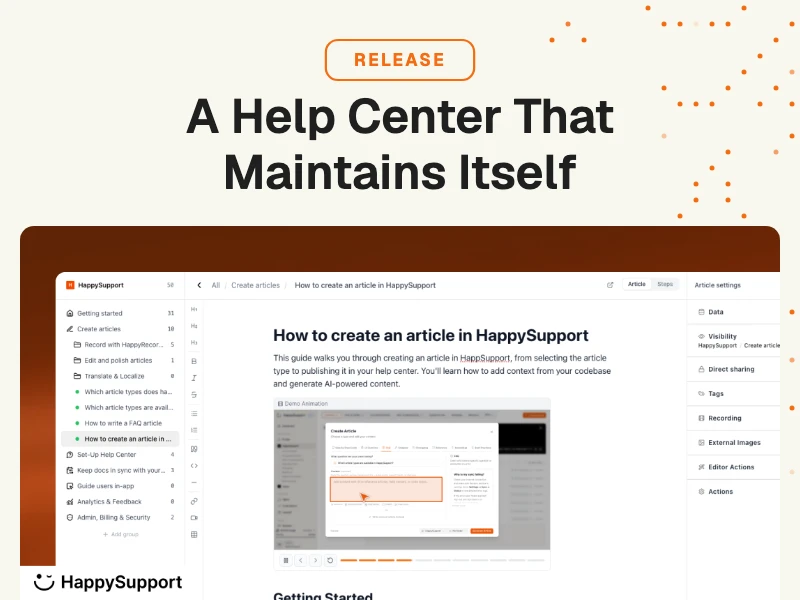
HappySupport is built for the support lead who needs to maintain a current help center without a documentation team. HappyAgent connects your help center to your GitHub repository, flagging articles that need updating after every release — so you are always working on what changed, not guessing what is stale.